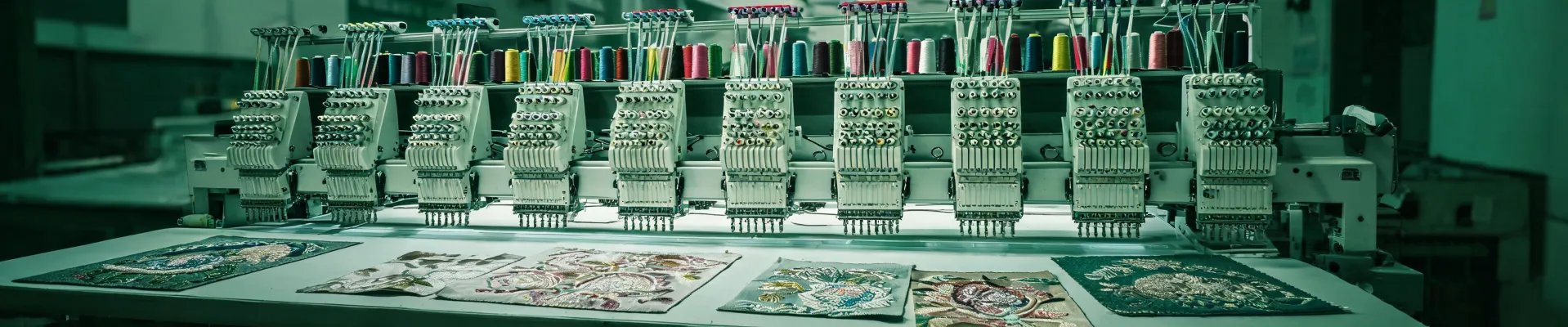
Used Barudan Embroidery Machine vs New Capella: What 7 Years in London Taught Me
Posted on 2026-08-17 by Jane Smith
-
Dimension 1: Sticker Price vs Total Cost of Ownership
-
Dimension 2: Reliability, Downtime, and What “New” Actually Buys You
-
Dimension 3: Barudan Embroidery Machine Hoops vs Budget Hoops
-
Dimension 4: Support in London—the Part Salespeople Don’t Show You
-
Used Barudan or New Capella? What I’d Tell a Friend
If you’re searching “machine embroidery London” because you’re starting a shop or planning to bring production in-house, you’ve probably seen two very different price tags: a new budget embroidery machine, and a used Barudan. I’ve owned both. I started an embroidery studio in East London in 2018, and seven years and eleven significant mistakes (roughly £14,000 in wasted budget) later, my team works from a checklist I wish I’d had on day one.
This is a hands-on comparison: a new Capella embroidery machine (the budget-friendly option I started with) versus a used Barudan embroidery machine (the one I run now). I’m not going to tell you one is universally better, because that’s not what I found. I’ll walk through the dimensions that actually mattered to my production—cost, uptime, hoops, and support—so you can decide for yourself.
Dimension 1: Sticker Price vs Total Cost of Ownership
Let’s get the obvious numbers out. A new Capella single-head 15-needle machine listed around £4,000–5,500 in UK dealer quotes in early 2025. A used Barudan single-head in good condition ran £3,500–6,000 depending on age and hours, and a used 6-head Barudan was £12,000–18,000. On paper, the Capella looks like the no-brainer for a first shop.
But here’s the part nobody puts on the spec sheet: total cost of ownership (i.e., not just the unit price, but hoops, repairs, downtime, and what you get back when you sell). My Capella needed £1,400 in repairs in year one, plus about £2,100 in lost production while it sat waiting for parts. The used Barudan needed £650 in preventive maintenance over two years and nine days out of service—most of it scheduled, none of it urgent. When I compared the cost per production month over three years, the Barudan came out cheaper despite its higher sticker price.
The bottom line: the lowest quoted price is rarely the lowest total cost. That single lesson would have saved me most of the £14,000 I mentioned earlier.
Everything I’d read about buying machines said “new means fewer surprises.” My experience with seven years of production suggests otherwise. A used industrial machine with documented maintenance can outperform a new entry-level machine with unknown quality-control history.
Dimension 2: Reliability, Downtime, and What “New” Actually Buys You
I knew I should test the Capella properly before taking delivery—thread tension, a 30-minute pattern run, verify the hoop seats. But I thought, “it’s new, what are the odds?” The odds caught up with me when the thread-break sensor failed on needle A in week two. The distributor’s solution was “send us a video, and we’ll ship a part in 10–14 days.” That works for a hobbyist. Not for a shop with a £3,200 contract on a deadline.
With the used Barudan, I did the opposite: asked for service records, ran it for half a day before paying, and called a London technician to walk through common failure points. Two years later, it hasn’t missed a scheduled production day. Barudan’s own product documentation (barudan.com) frames their machines for continuous industrial operation—something I’d read dismissively until I saw the difference in daily use.
Here’s the counterintuitive part: the used machine was more reliable because I vetted it, and the new machine was less reliable because I assumed “new” meant “can’t be broken.” Reliability isn’t a brand attribute—it’s a habit. A used machine with documentation can outrun a new machine with mystery quality control. And before anyone accuses me of brand bias: I know shops running Capella machines profitably today. The red flag is never the brand. It’s the absence of a maintenance story.
Dimension 3: Barudan Embroidery Machine Hoops vs Budget Hoops
If you’ve done any home sewing, you already know accessories aren’t universal. A foot ruffler to sewing machine A won’t necessarily fit machine B. Embroidery hoops are exactly the same—and this is where my assumptions cost me the most.
Barudan machines use their own hoop system. A Barudan embroidery machine hoop—especially the magnetic hoops that make tubular garments dramatically easier—runs £150–350 depending on size. A compatible hoop for a Capella can cost half that. I saved £80 once on a generic hoop that “fitted.” Then I watched it flex during a run of 47 polo shirts. Every single piece shifted by 2mm. That order cost me £890 in redo plus the weekend I spent re-stitching it.
When I compared Barudan’s magnetic hoop against the budget equivalent side by side, I finally understood why the gap in price was so large. Frame rigidity, magnet placement, and the tension-adjustment mechanism weren’t just “better”—they were in a different category. Does every budget hoop need to be thrown away? No. If you’re doing caps and flat goods, you may never notice the difference. The moment you move to stretchy performance fabrics, the hoop becomes the bottleneck. No amount of digitizing skill can fix mechanical flex.
In 2024, after switching fully to Barudan hoops, hoop-related rejects dropped to zero across six months of production. That outcome alone rewired how I think about accessories on industrial machines.
Dimension 4: Support in London—the Part Salespeople Don’t Show You
Someone once told me: “You’re not buying a machine. You’re buying the network behind it.” I didn’t believe it until I needed help.
Barudan’s UK presence means technicians in and around London who know the machines inside out. In January 2024, my used Barudan started dropping stitches on needles 3 and 5. One phone call with a London-based technician diagnosed a worn tension spring. Part cost: £18. Fix time: one hour. Around that same period, a friend with an import machine needed a controller board and was quoted 17 days for the part to arrive.
In a city like London, timeline certainty matters as much as speed. Event merch, team kit, fashion samples—none of it waits for a part stuck in customs. In Q3 2022, I made a different mistake: hired a general repair guy who didn’t know embroidery machines. He made things worse—not a little worse, a week-of-production worse. Pay for specialists. Schedule maintenance. Decide in advance who you’ll call when the machine doesn’t start.
Used Barudan or New Capella? What I’d Tell a Friend
After seven years, here’s my honest answer, and it depends on your situation:
- If you have consistent orders and can handle a larger upfront payment, a used Barudan (or another true industrial machine) with documented service history beats a new budget machine on cost-per-month, in my experience. The certainty of a machine that starts every Monday is worth real money.
- If you’re starting part-time or doing small-batch work, a new entry-level machine like a Capella is a legitimate first step. Just add 15–20% to your budget for accessories and first-year fixes—and vet your dealer as carefully as you vet the machine.
- If you already have a machine, check hoop compatibility before buying anything. It’s cheaper to buy the right Barudan embroidery machine hoop once than to rerun an entire order.
- And whether you’re buying a hoop for an embroidery machine or a foot ruffler for a sewing machine, verify the fit against your exact model. “Fits most” is not a spec, and “should work” is not a plan.
There’s something satisfying about a machine that simply runs. After the Capella years, watching my Barudan start up cleanly on a Monday morning still feels like a small victory.
Take it from someone who lost more money than he’d like to admit: an informed customer asks better questions and makes faster decisions. I’d rather spend an hour explaining machine options than see another owner repeat my mistakes. Understand why you’re buying what you’re buying, run the numbers properly, and let the checklist—not the sales pitch—make the final call.
Prices referenced are from UK dealer listings in early 2025; verify current rates before committing.

Jane Smith
I’m Jane Smith, a senior content writer with over 15 years of experience in the packaging and printing industry. I specialize in writing about the latest trends, technologies, and best practices in packaging design, sustainability, and printing techniques. My goal is to help businesses understand complex printing processes and design solutions that enhance both product packaging and brand visibility.