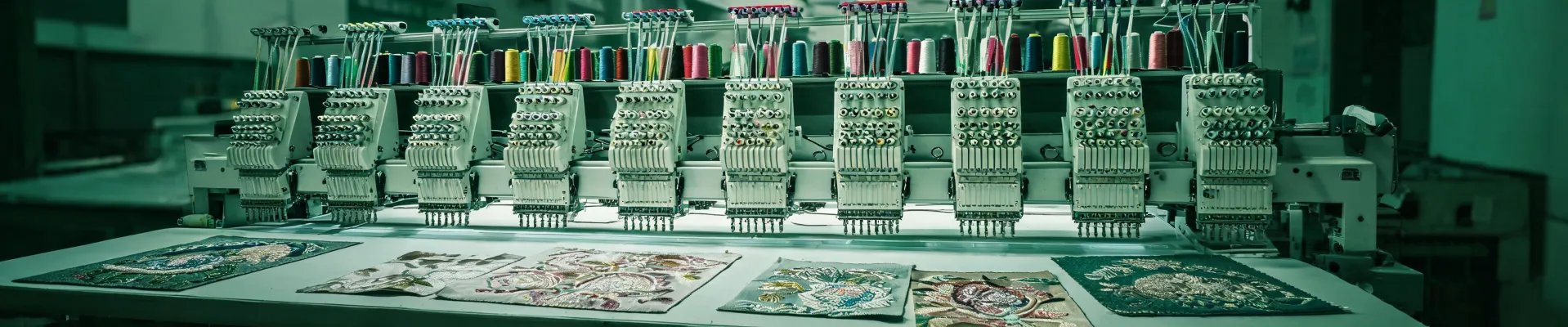
Barudan 8 Head Embroidery Machine FAQ: Magnetic Hoops, Software, and Used-Machine Checks
Posted on 2026-08-31 by Elise Marceau
-
How Many Pieces Per Hour Can a Barudan 8 Head Embroidery Machine Actually Produce?
-
Are Magnetic Hoops for Barudan Embroidery Machine Worth It?
-
Which Software Comes With a Used Barudan: Celeste or ProEmb?
-
What Actually Breaks on a Barudan 8 Head Embroidery Machine?
-
What Should I Check Before Buying a 2nd Hand Embroidery Machine?
-
Can a Barudan 8-Head Handle Small Runs Without Eating Your Margin?
If you're searching for a Barudan 8 head embroidery machine because you're getting ready to buy one, you probably don't need another sales pitch. You need to know what it's actually like to run one.
I've been production manager at a contract embroidery shop for 11 years. We run multiple Barudan 8-heads, and I've handled a few hundred 'can you do it by Friday?' orders in that time—including same-week turnarounds for clients whose own machines went down. This FAQ answers the questions buyers ask most often, especially people shopping the 2nd hand embroidery machine market.
Here's what we're covering:
- Real production numbers
- Magnetic hoops: worth it or not?
- Celeste vs. ProEmb software
- What actually breaks on an older Barudan
- Used machine inspection checklist
- Can an 8-head do small runs?
How Many Pieces Per Hour Can a Barudan 8 Head Embroidery Machine Actually Produce?
A salesman will quote you head speed, but real output is another story. On our floor, a standard 5,000-stitch chest logo with five or six color changes runs about 70 to 100 finished pieces per hour on the 8-head. That includes hooping, unhooping, trimming, and the occasional thread break. If it's a tiny one-color design, you'll beat that number. If it's a big back design with dense fill, expect a lot less.
The rated speed matters less than setup efficiency. As of early 2025, Barudan's official product pages (barudan.com) are useful for model features. Just don't plan production capacity from brochure numbers. The machine can sew faster than your team can feed it.
Are Magnetic Hoops for Barudan Embroidery Machine Worth It?
It took me years to understand that hooping method affects output as much as machine condition. Search for magnetic hoops for Barudan embroidery machine and you'll see plenty of aftermarket options. For certain fabrics, they're a no-brainer. Fleece, soft knit hats, and stretchy polo shirts hold better when you don't have a lower ring fighting you. There's genuine satisfaction watching a cap sew out without shifting.
From the outside, magnetic hoops look like a shortcut. The reality is they still need the same setup discipline. If magnet placement isn't right, you'll get registration drift. Honestly, the most frustrating part is watching an operator blame the hoop when the real problem is hoop pressure. The hoop wasn't the weak link; training was.
Which Software Comes With a Used Barudan: Celeste or ProEmb?
Both, depending on the machine's age. Newer setups often include Celeste embroidery machine software; older ones frequently have ProEmb embroidery machine software. What matters more than the brand name is that the license dongle and install disk are included and working. These packages are mainly machine control and file management tools. They do not replace proper digitizing software.
A quick story: in 2023, we bought a 2nd hand embroidery machine from a broker who thought ProEmb was on the hard drive. The hard drive had crashed. No disk. It took a week to track down a replacement copy, and that delay messed up our schedule. That was on me for not checking the dongle before paying. If software is part of the deal, boot it up in person.
What Actually Breaks on a Barudan 8 Head Embroidery Machine?
Usually not the big expensive parts. It's the small stuff: thread break sensors, trim solenoids, rotary hook timing, and voltage regulators. We had a control board issue in March 2024, about 36 hours before a 1,200-piece order shipped. The machine kept losing home position. A repair tech came in at 6am, we found a used board from a parts dealer, paid overnight shipping (which, honestly, hurt), and pushed the order through on time.
That experience changed how I view spare parts. If you own an older 8-head Barudan, keep a spare sensor board or regulator on the shelf. It might sit for two years. The day you need it, it'll be worth every dollar.
What Should I Check Before Buying a 2nd Hand Embroidery Machine?
A low stitch count is nice, but it isn't everything. It's tempting to think a machine with fewer stitches is automatically in better shape. In reality, a well-maintained machine with 30 million stitches can be a better purchase than an idle one that was neglected. Here's the checklist we use:
- Run an actual multi-color job through all eight heads, not a thread-off dry run.
- Check the year, service history, and stitch count from the machine itself.
- Listen for knocking in the rotary hooks and look for oil leaks.
- Inspect needle bars and presser feet for collision damage.
- Confirm the software dongle, cables, and manuals are all physically there.
If possible, bring a Barudan-certified technician along. It feels like an extra expense until it saves you from buying a $40,000 problem.
Can a Barudan 8-Head Handle Small Runs Without Eating Your Margin?
Yes, but only with the right changeover routine. Five years ago, we refused to put anything under 400 pieces on our 8-head. The whole industry has shifted: better hoops, faster machines, and operators who are actually trained to switch quickly. Now we'll run 48-piece orders on the 8-head as long as the design isn't too dense. Below that, we use single-head machines.
The key was realizing that machine speed isn't the bottleneck; preparation is. If the backing is cut, the colors are loaded, and the design is tested before the job reaches the floor, a 60-piece order can be done between lunch and end of day.

Elise Marceau
Elise Marceau is an LED display and digital-signage systems analyst covering LED video walls, modular screens, transparent LED, control processors, and indoor or outdoor signage. She applies IEC 62368-1 safety principles while comparing pixel pitch, luminance, contrast, refresh rate, colour uniformity, viewing angle, ingress protection, power density, module serviceability, and signal redundancy. Her specification guides help integrators, venue operators, retailers, and procurement teams align viewing distance, ambient light, content format, installation access, electrical load, and lifecycle support.