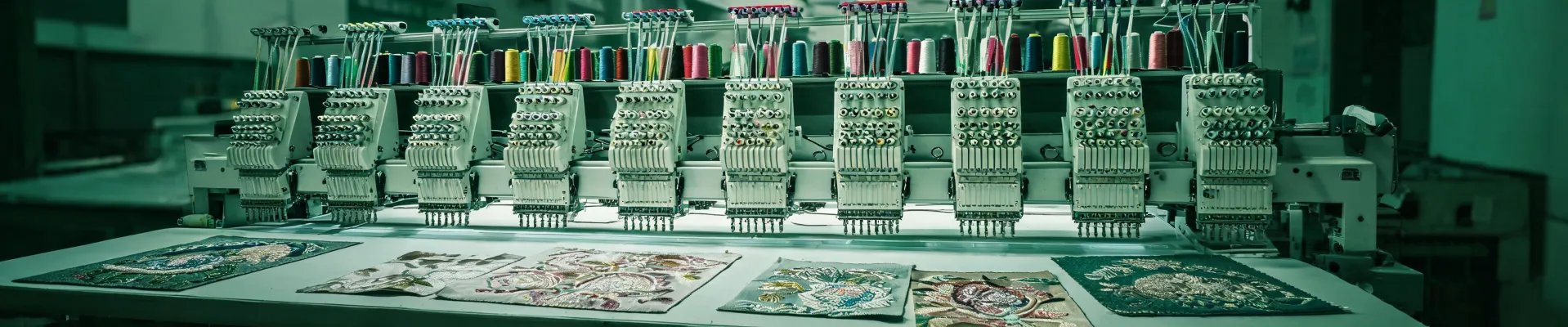
After 200 Rush Orders: Why We Run a Barudan 8 Head Embroidery Machine
Posted on 2026-09-04 by Elise Marceau
I've coordinated roughly 200 rush orders in eight years. The biggest lesson wasn't about express shipping or faster digitizing. It's that under a deadline, the best computer embroidery machine is the one you don't have to think about. Endless features don't matter at 1 a.m.; uptime does.
If you want the direct version of my answer before the reasoning: I've settled on a Barudan 8 head embroidery machine as the center of our production floor. Around it, I'd add magnetic hoops for Barudan frame sizes and a dedicated sample machine like the Celeste that never gets scheduled into production runs. That setup doesn't make rush orders easy. It makes them possible.
Why This Opinion Isn't a Guess
I manage production for a 10-person contract embroidery company. We do work for corporate promo clients, sports teams, and small apparel brands. Over the past three years, we've averaged about 210 work orders annually. In the last 12 months, 54 of those orders had less than 72 hours between approval and delivery.
That kind of schedule forces you to notice where time actually leaks. It rarely leaks through sewing speed. It leaks through rehooping, waiting for samples, frame alignment issues, and machines that stop for reasons no one can explain quickly. Since the start of 2023, we've shipped exactly two jobs late. One was a color-match problem that a physical sample on the real fabric would have caught. The other was hoop slippage that made us rehoop about 90 garments. Nobody on the crew was lazy; the method was fragile.
Why the 8-Head Barudan Feels Like a Safety Net
In March 2024, at 4:47 p.m. on a Wednesday, an event planner asked if we could embroider 640 hoodies with a left-chest logo by Saturday at 8 a.m. Our normal quoted lead time for that volume is seven business days. We said yes. Most of our competitors thought we were crazy.
We could say yes because an 8-head Barudan was coming off another job that evening. Our 12-head was fully committed to a larger order that couldn't be paused without hurting another client. By 9 p.m., the 8-head was cycling eight hoodies per pass. The logo was roughly 4,200 stitches in three colors; at 850 stitches per minute plus load and unload time, each cycle took about six and a half minutes. Eighty cycles later, a little after 6 in the morning, all 640 hoodies were stitched and ready for finishing.
I'm not saying 8 heads is the right number for every floor. I'm saying the 8-head sits in a practical middle. It has enough volume for real production, it doesn't demand the same floor space and capital as a 12-head or 15-head, and in a shop with more than one machine, it gives you the redundancy that emergency orders depend on. If a single large machine is your whole operation, one breakdown takes everything down. The best emergency strategy is a machine park you can split around.
Magnetic Hoops for Barudan Embroidery Machines: A Boring Fix With a Big Payoff
I didn't believe in magnetic hoops for years. They seemed like an expensive convenience for people who didn't want to tighten a screw properly. Then came the December 2023 fleece order that forced us to rehoop about 90 garments because the fabric kept shifting under a standard hoop. That order shipped late. The cost of that mistake was more than the extra labor; it was the client's trust.
After that, we tested magnetic hoops on one machine. Within two weeks, they were our default for flat garments. Magnetic hoops for Barudan embroidery machines aren't magic, but they remove three problems at once: fabric shift, uneven tension across thick materials, and the slow process of aligning and tightening a traditional frame. On flat goods, our handling time dropped by roughly 20 to 25 seconds per piece. On a 640-piece order, that's more than four hours of hands-on time saved during a period when every minute is already on the clock.
To be fair, magnetic hoops have limits. They don't replace cap frames for finished hats, and they're not useful for some tubular or unusual items. For standard flat production, though, they have prevented more rehooping emergencies than any software update we've ever installed.
The Celeste's Job Is to Prevent Do-Overs
When production shops ask me for machine advice, they usually ask about head count. The more interesting question is what to do between orders. We keep a Celeste on the sample table, and its only job is to prevent mistakes before production starts.
A design can look right on screen and wrong on fabric. Thread colors read differently on fleece, polo pique, towels, and performance knit. Our rule is simple: no job goes on the 8-head without a physical sample sewn on the actual material. The Celeste makes that rule affordable because we don't have to stop an 8-head cycle or pull a head out of production to test a color change.
People searching for a Celeste embroidery machine sometimes expect it to be a small production workhorse. That's not how we use it. The Celeste earns its space by not producing saleable volume. It produces certainty: the right thread colors, the right placement, the right backing. That certainty is what lets us commit to impossible deadlines without gambling on a client's order.
When This Setup Doesn't Fit
The same honesty applies to the advice itself. If your dominant work is true yarn embroidery, meaning chenille or loose decorative yarn, a standard computerized multi-head like the one I've described isn't the right comparison. That's a specialty equipment category with its own frames and handling requirements. In our shop, those rare requests get outsourced to a specialist rather than forced through a machine designed for conventional thread embroidery.
If you're a solo embroiderer doing a few hundred pieces a month, an 8-head machine plus a dedicated sample head might be more capital than you need. The math changes at low volume. And if you're buying any industrial machine, verify that technical support and parts are actually available in your area. A machine brand is only as reliable as its local service network.
On our floor, we still get the 4:47 p.m. calls. We still take some of them. The difference is that we no longer rely on heroic all-nighters to fix problems we should have prevented months earlier. A calm 8-head Barudan, magnetic hoops in the sizes we actually use, and a 15-minute sample on a Celeste have done more for our emergency performance than any amount of last-minute rushing ever did.

Elise Marceau
Elise Marceau is an LED display and digital-signage systems analyst covering LED video walls, modular screens, transparent LED, control processors, and indoor or outdoor signage. She applies IEC 62368-1 safety principles while comparing pixel pitch, luminance, contrast, refresh rate, colour uniformity, viewing angle, ingress protection, power density, module serviceability, and signal redundancy. Her specification guides help integrators, venue operators, retailers, and procurement teams align viewing distance, ambient light, content format, installation access, electrical load, and lifecycle support.