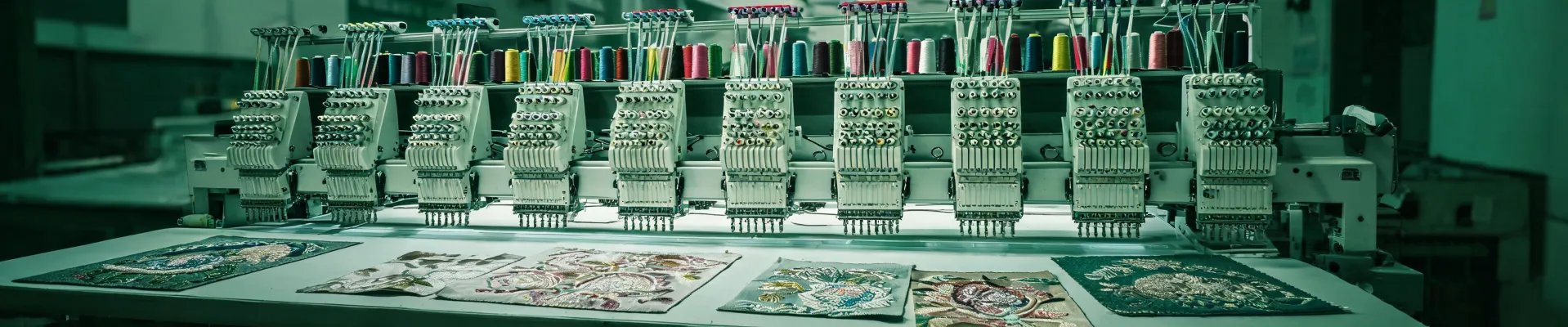
Barudan Embroidery Machine 6 Head: What to Check Before Buying
Posted on 2026-09-03 by Elise Marceau
-
1. Is a used Barudan embroidery machine 6 head still a sensible buy?
-
2. What should a quality inspector check before I buy a used 6-head Barudan?
-
3. Does it matter if the original Barudan embroidery hoops are included?
-
4. How should I evaluate an FDZ embroidery machine when it's priced below a used Barudan?
-
5. Can the embroidery machine SE700 replace a multi-head industrial machine?
-
6. When people search for an industrial sewing machine for wigs, is that an embroidery machine?
-
7. What mistake costs shop owners more than the machine price?
I'm the quality and compliance lead for a commercial embroidery equipment dealer. Before a machine goes out to a customer—new stock, trade-in, or after repair—I'm the one who signs the release. Four years of reviewing roughly 250 machines a year made me less interested in brand stickers and more interested in calibration records. I'll check the 2024 log if you want an exact count, but 250 is close. Around 12% of first inspections in 2024 came back for corrective work, mostly because of tension calibration, frame damage, or missing documentation.
These are my working answers as of March 2025. If you're shopping for a used multi-head or a new first production machine, the questions below are the ones that keep showing up in my inbox.
1. Is a used Barudan embroidery machine 6 head still a sensible buy?
A 6-head Barudan gets you six sewing heads on one bridge, so you can run six garments or hats in the same cycle. For a contract shop, this is the middle step between testing ideas on a single-head and committing to a 12-head line. Barudan's reliability reputation is real, but it does not replace inspection. A machine with no maintenance history will not honor its brand name.
During the Q3 2024 audit at our facility, we went through 18 used Barudan 6-head machines. Four of them looked acceptable in a quick demo but failed our balanced-tension test after 20 minutes. Each needed a rotary hook timing adjustment. Parts cost did not scare me. The lesson was that a clean video can make an old hook assembly look younger than it is.
Is it worth the price? My answer is yes if the machine has verifiable history. Without that history, the badge alone doesn't answer the important question: 'What will this machine cost during the first year?'
2. What should a quality inspector check before I buy a used 6-head Barudan?
Start with the head count and the controls, because both can be altered. We see listings for '6 head' machines with two or three heads out of service. I compare serial numbers, frame ID, and controller firmware to the original build sheet whenever that sheet exists.
Next, run the machine. I use a test sequence that includes flat goods, a cap frame, and a heavier edge material because embroidery machines struggle differently on each. I watch stitch formation from above and below. If bobbin thread shows on top, the tension is too loose. If the fabric puckers, hook timing or thread path needs attention. I also check X/Y movement at high speed. A machine that loses steps on a dense logo can look fine at slow jog speed.
One more thing: open the base. Loose thread trimmings, oil leaks, and worn hook races tell a story. Sellers can clean the cabinet, but the wear pattern inside the head area is harder to hide.
3. Does it matter if the original Barudan embroidery hoops are included?
Yes. Barudan hoops are not a universal bucket of rectangles. Different machines use different frame arm shapes, and the correct hoop must match both the machine generation and the product being stitched. If the seller does not list hoops, ask for exact frame sizes and test them on the bed before you buy. A machine without the proper hoops is like a vehicle without the right wheels.
In 2024 I measured a trade-in hoop set. One of the so-called perfect wooden hoops was out of square by almost 2 mm. On a one-off sample, you might not notice. On a 6-head production run, that 2 mm repeats on every piece. Original Barudan embroidery hoops that are true can be worth real money. Missing or damaged hoops shift the negotiation in the wrong direction.
Aftermarket magnetic hoops are another option. The surprise was not whether they worked; it was how many buyers expected them to fix a worn frame system. Magnetic hoops can save time on flat goods. They cannot compensate for a carriage that has developed play. If you use them, verify that they sit flat and lock consistently on that exact machine.
4. How should I evaluate an FDZ embroidery machine when it's priced below a used Barudan?
FDZ machines show up in our service queue as trade-ins, and I treat them with the same inspection process, not a lower standard. There is nothing automatically wrong with buying an FDZ. The problem is when the lower price is used to replace the paperwork.
The first thing I check is the control board and firmware version. In late 2024 I looked at a trade-in FDZ where the seller's listing said one needle configuration, but the machine's firmware and board data did not match that claim. Did it stitch? Yes. Was it ready to run? No, because the configuration confusion made every support call harder.
If you are comparing a used FDZ with a used Barudan multi-head, write down three things: service manual availability, firmware support, and hoop compatibility. If those are clear, a value-tier machine can be a productive purchase. If they are not, the lower sticker price is the first cost, not the final one.
5. Can the embroidery machine SE700 replace a multi-head industrial machine?
No. The SE700 is a popular home sewing and embroidery combo, and it makes sense for samples, monogramming, and low-volume personal work. It is not designed for continuous multi-piece production. Its single needle, hoop size, and frame setup are in a different category from commercial multi-head equipment.
I've inspected several SE700 units, usually in online lot sales. The disappointing ones were not broken; they were asked to do something the machine was never intended to do. Running a dense logo with thick stabilizer for eight hours will push a home-grade machine past its limits.
Can you use the embroidery machine SE700 to prototype a design before running it on a Barudan 6-head? Yes, and I like that workflow. Just don't buy it expecting factory output.
6. When people search for an industrial sewing machine for wigs, is that an embroidery machine?
Usually not. In wig work, the phrase 'industrial sewing machine for wigs' points to an industrial lockstitch machine used to attach wefts and stitch lace. It is not a multi-head embroidery machine. Embroidery can place a logo on a hat or a lace front, but attaching hair wefts is a different process. A lot of production rooms will use both pieces of equipment together.
A customer once asked me to inspect a 6-head Barudan because he was expanding into hats for the wig and lace market. After we talked through the actual process, he realized the bottleneck was not embroidery. I want to say he needed a cylinder-bed sewing station and a ventilating setup, but I might be mixing that with another project. Either way, we saved him from buying the wrong category for his first order.
7. What mistake costs shop owners more than the machine price?
Missing service documentation. Put another way: documents are cheaper than downtime.
The most frustrating part of my job is not worn-out parts. It's a machine that runs well but has no maintenance history. I cannot tell you whether hook timing was checked, whether the rails were greased, or whether a control board was replaced. A good sample is useful, but it does not prove the rest of the shift will not become a series of mini failures.
In January 2024, a shop had two hours to approve a trade-in Barudan 6-head. Normally I would want six hours with a machine and a test panel. There was no time. I told them, 'I can't verify the history in two hours. Add a 90-day service agreement to your budget.' They did. The agreement covered a worn X-carriage bearing that showed up in the first month. The repair wasn't dramatic, but the unplanned downtime would have been. That is the difference between machine price and machine cost.
A lower-priced machine with no paperwork is not a bargain. It's an unknown. The unknown has a price. You can pay now for inspection or pay later in troubleshooting.

Elise Marceau
Elise Marceau is an LED display and digital-signage systems analyst covering LED video walls, modular screens, transparent LED, control processors, and indoor or outdoor signage. She applies IEC 62368-1 safety principles while comparing pixel pitch, luminance, contrast, refresh rate, colour uniformity, viewing angle, ingress protection, power density, module serviceability, and signal redundancy. Her specification guides help integrators, venue operators, retailers, and procurement teams align viewing distance, ambient light, content format, installation access, electrical load, and lifecycle support.