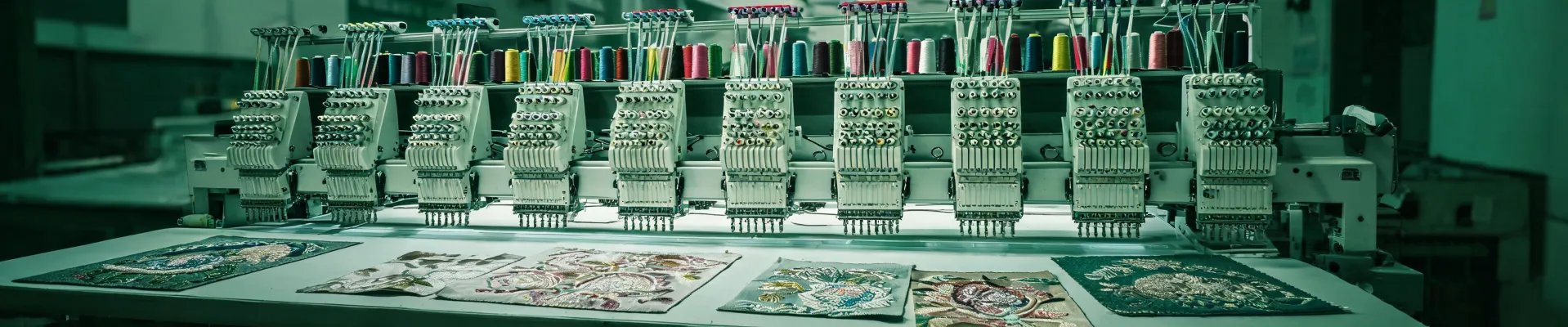
The 6-Head Trap: Why a Barudan 6-Head Embroidery Machine Isn't the Real Decision
Posted on 2026-09-02 by Elise Marceau
I'm a quality and brand compliance manager at an industrial embroidery equipment supplier. I review every machine and accessory that goes out the door—roughly 200+ items a year. In Q1 2024, I rejected a full batch of hoops because the seating depth was inconsistent. The machine they were supposed to be used with was fine. The hoop wasn't.
This is the kind of detail that doesn't show up in a spec sheet. And it's the reason I wrote this: because most shop owners start with the wrong question.
The question I get constantly is: "Should I get a Barudan embroidery machine 6 head, or an 8-head?" Or: "I found a used single-head, is that enough to start?" These are understandable questions. But they're surface questions. The real question is about your production system—and if you get that wrong, the head count won't save you.
Why "More Heads" Is the Wrong Frame
It's tempting to think a 6-head machine is just six single-head machines working side by side. You load six hoops, press start, and get six finished pieces. But it doesn't work that way. A multi-head machine shares the same frame, the same thread tension system, the same operator. If one head gets a thread break, the whole run stops until it's fixed. If one hoop is seated even a fraction off, all six pieces have the same misalignment.
I don't have hard data on industry-wide productivity per head, but based on the orders I've reviewed since 2022, my sense is the first 30 days on a new multi-head install are slower than almost everyone expects. Not because the machine is bad—because the workflow around it hasn't caught up.
Here's the thing: a Barudan embroidery machine 6 head is a production tool. It can move a lot of work—if it's matched with the right hoops, the right files, and an operator who can run it under pressure. If any of those pieces is missing, you're not getting 6x production. You're getting 6x problems.
The Accessory Problem No One Talks About
Most of the calls I get are not about the machine. They're about accessories. Specifically, embroidery hoops for Barudan machines. I know a hoop doesn't sound exciting. But it is the single most common reason I see quality issues in production.
It's tempting to think one hoop fits all machines. The "one-size-fits-all" advice ignores the differences in head spacing, arm configuration, and clamp depth between single-head and multi-head models. A hoop that works perfectly on a single-head Barudan might not seat correctly on a 6-head's frame. And when a hoop doesn't seat correctly, your registration drifts. Designs that looked great on the computer get muddled on the fabric.
A few years ago (okay, it was 2023), I received an order of magnetic hoops for a customer's 6-head machine. I knew I should double-check every hoop against the actual frame spacing before signing off. But we were in a rush, and I thought: "What are the odds?" The odds caught up with me. Thirty of the hundred hoops didn't seat properly, which meant 30 potential rework jobs. We caught it before they shipped, but only just barely.
That's the kind of mistake that feels small until you multiply it. On a 6-head run, one bad hoop ruins six pieces at once.
What It Actually Costs to Get This Wrong
Here's where the problem stops being a technical detail and starts being a business issue.
An incompatible hoop doesn't just create a slight misalignment. It creates rework. Rework eats into margins. On a tight deadline, it also eats into credibility.
I remember one call where a shop had to redo an $18,000 order of branded caps because their hoop set had worn down and wasn't holding the cap frame tightly. The machine had run fine. The design file was fine. But the finished caps had small shifts in registration. The customer noticed. The redo cost more than the original order in rush labor.
Why does this matter? Because most buyers are only comparing machine prices. They don't include the cost of hoops, backing, needles, digitizing, training, and the occasional "oops" batch in their math. The total cost of ownership of a Barudan embroidery machine 6 head is more than the price tag. And the cheapest way to bring that total cost down is to pay attention to the system around the machine.
I wish I had tracked every rush order that came from preventable issues. I don't have the numbers, but I can tell you anecdotally: at least one a month. And it's almost always the same pattern—a shop buys more capacity than its workflow can support, then pays extra to fix what the workflow didn't handle.
The Machine Is Not the Problem
This is the part I don't want you to miss. I'm not saying a 6-head Barudan is a bad choice. I've seen Barudan machines run reliably for years. The Barudan brand built its reputation on durability and service support, and that's real. But the machine is only one node in a chain:
Design file → digitizing → hooping → threading → stitching → quality check → finishing.
If any one of those steps is weak, the machine gets blamed. I see it all the time. A shop blames the "machine" for a registration issue, but the real cause is a worn hoop, a backing that's too soft, or a design with too many color changes for the fabric. It's kinda like blaming the car when the alignment is off.
So when someone asks me whether they should buy a Barudan embroidery machine 6 head, I always ask a different question first: What does your order flow actually look like? How many hoops do you own that fit the machine? Who digitizes your files? What's your training plan? What happens when the machine goes down on a deadline?
What I'd Check Before Buying a Barudan 6-Head
You want a concise solution? Here it is.
If you're serious about a Barudan embroidery machine 6 head, don't start with head count. Start with these five things:
- Hoop ecosystem. Can you get embroidery hoops for Barudan machines in the sizes and types you actually need? Are they compatible with the specific model and head spacing?
- Operator skill. Do you have someone who can handle thread breaks, tension adjustments, and hoop alignment on a multi-head machine under deadline pressure?
- Service and parts. What's the lead time for parts? Is there a local service technician? Downtime counts.
- Floor and power. Does your shop have the floor space, electrical load, and compressed air capacity for the machine? This sounds basic, but I've seen it overlooked.
- A sample run with your own files. Don't test with the demo pattern. Run your actual client work, with your actual hoops and backing, before you sign.
Look, I'm not saying you have to master every detail before you buy. But I've seen too many shops choose a 6-head Barudan because it seemed like the efficient move, then spend the first year fighting small problems. Efficiency is about fewer surprises, not more heads.
What About the Other Searches?
If you got here after searching for a "Brother embroidery machine"—or "brither embroidery machine" if autocorrect wasn't kind—or an "electric sewing machine" ("elecktrick" is a common misspelling, I've seen it), or a "Janome Bridgerton easy-to-use sewing machine," you might be in the wrong room.
Those are great home machines. A Janome Bridgerton is genuinely easy to use for everyday sewing. A Brother machine is a solid choice for hobbyists and start-ups. An electric sewing machine is perfect for mending, quilting, and small projects. They are not designed for high-volume production, and they shouldn't be compared to a multi-head industrial machine.
A Barudan embroidery machine 6 head is a different category. It's built for contract embroidery, apparel manufacturing, and shops that need volume with consistency. If you need a home machine, buy the home machine. But if you're asking about 6-head Barudans, you're asking about production—and production needs a system, not just a machine.
Start With the System, Then Choose the Machine
The best purchasing decision I've seen in the past few years came from a shop that rented a single-head machine first. They tested their designs, their hoops, their thread, their workflow. Then, when they were losing work because production time was too long, they moved to a 6-head Barudan. By then, they already knew exactly which hoops to order, which files caused problems, and how many operators they needed.
That's the approach I'd recommend. Not because it's cautious, but because it's more efficient. A machine is a tool. The system around it is where the money is made—or lost.
If you have questions about embroidery hoops for Barudan machines or what to check before buying a barudan embroidery machine 6 head, find someone who's actually inspected them in production. Ask about the failures, not just the spec sheets. There's no perfect machine. But there is a perfect match for the way you actually work.

Elise Marceau
Elise Marceau is an LED display and digital-signage systems analyst covering LED video walls, modular screens, transparent LED, control processors, and indoor or outdoor signage. She applies IEC 62368-1 safety principles while comparing pixel pitch, luminance, contrast, refresh rate, colour uniformity, viewing angle, ingress protection, power density, module serviceability, and signal redundancy. Her specification guides help integrators, venue operators, retailers, and procurement teams align viewing distance, ambient light, content format, installation access, electrical load, and lifecycle support.