Is There an Embroidery Machine Worth Buying? A Barudan 8-Head FAQ
Posted on 2026-08-31 by Elise Marceau
-
Is there an embroidery machine that can actually run production without constant babysitting?
-
Why choose Barudan over other industrial embroidery machine brands?
-
Is a Barudan 8 head embroidery machine the right size?
-
Which Barudan embroidery machine hoops do I actually need?
-
Can a comfort sewing machine do the same job as a Barudan?
-
Is a Barudan embroidery machine affordable?
-
What should I check before buying a used Barudan?
If you're trying to figure out whether a Barudan embroidery machine is the right purchase for your shop, I get it. I'm the office administrator for a 28-person contract embroidery company. I manage the purchasing for our production team—roughly $250,000 a year spread across 10 vendors. That means I sit between operations, who want a machine that runs all day, and finance, who want the invoice to not give them a heart attack.
This isn't a manufacturer brochure. It's a list of questions I wish someone had answered before I started buying embroidery equipment. If you're new to industrial machines, this should help you ask better questions.
Is there an embroidery machine that can actually run production without constant babysitting?
Yes, but you need to separate the 'embroidery machine' category from the $300 craft models. A Barudan is built for production. It won't do the work by itself, and it still needs threading, cleaning, and a trained operator. But it's designed to run shift after shift.
We bought a used 6-head Barudan in 2021 and ran it roughly 2,000 hours a year. The only unplanned downtime we had was a broken needle detector sensor, and the dealer had the part in two days. I'm not 100% sure that's typical for every dealer, but it's what our maintenance log shows.
My experience is based on about 15 embroidery machine purchases and refurbishments over four years. If you're running a one-machine home shop, your numbers will be different.
Why choose Barudan over other industrial embroidery machine brands?
For us, it came down to support and resale value. Barudan has been making commercial embroidery machines for a long time, and most reputable dealers stock common parts instead of ordering them from overseas. That matters because a machine that sits idle for two weeks costs more than the price difference between brands.
According to Barudan's own product pages (barudan.com), the industrial line we considered covers configurations from 1 to 12 heads. That range made it easier to stay with the same brand as we grew instead of learning a new control system from scratch.
One thing I've learned: the Barudan name is not magic. An old machine that's been abused will still give you headaches. But a machine with proper service records is a different animal. I'd rather buy a used Barudan from a local shop that can show me the repair log than a brand-new machine from a dealer three states away.
Is a Barudan 8 head embroidery machine the right size?
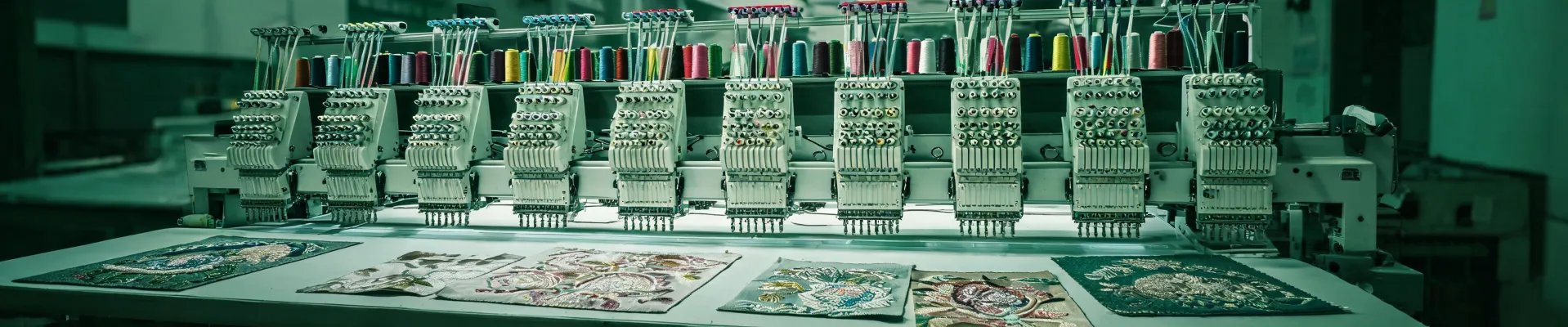
This is the question I hear most from production managers. A Barudan 8 head embroidery machine lets you stitch eight identical items at once. That's great for corporate uniforms, team orders, and anything where you need volume on the same design.
But people think a multi-head machine costs more because it's faster. That's not quite right. It costs more because it's less flexible—you're committing to running the same design on eight heads at the same time. If your day is full of one-off custom pieces, an 8-head might actually slow you down, because you've got one person managing a very expensive machine that's making eight copies of one item.
We moved to one Barudan 8 head embroidery machine in 2024 and kept two single-heads for the weird jobs. That combination gave us the volume we needed without forcing every order through the big machine. But I do not think an 8-head is the right choice for every shop.
Which Barudan embroidery machine hoops do I actually need?
This caught me by surprise when I started. Barudan hoops are not universal across every model. The hoop system depends on the machine's sewing field size and the clamps on the frame.
For our 8-head, the standard flat hoops are quick-release; you don't need tools to swap them. We also bought a set of magnetic hoops for stretchy fabrics and flat caps. Magnetic hoops speed up hooping, but they are not a replacement for proper tubular hoops when you're stitching sleeves or cuffs.
Before you buy a used machine, confirm that the previous owner's Barudan embroidery machine hoops actually match the model you're getting. Barudan changed frame connectors over the years. A hoop that fits an older machine might not click into a newer one. Check the manual, get the part number, and ask the seller to send a photo of the frame connector if you can't see it in person.
Can a comfort sewing machine do the same job as a Barudan?
No. And I say that as someone who owns a normal sewing machine for home mending. A comfort sewing machine is made for straight stitches, zigzag, buttonholes, and maybe an embroidery attachment if you're patient. It is not designed for digitized production embroidery.
The 'use a comfort sewing machine to start an embroidery business' thinking comes from an era when affordable home machines were the only real option for small jobs. That's changed. Used industrial machines have dropped in price enough that a serious shop can start with the right tool instead of fighting a machine that was never meant for production.
If someone asks me 'is there an embroidery machine that I can use at home and later grow out of?' the honest answer is: a comfort sewing machine can help you learn, but it probably won't pay for itself in production. When we calculate labor cost per piece, the industrial machine wins almost every time, even with the higher purchase price.
Is a Barudan embroidery machine affordable?
I get the 'embroidery machine affordable' question a lot. Affordable is relative, but there are ways to get into a Barudan without going bankrupt. We see used single-head machines listed around $6,000 to $18,000 depending on age and hours—don't hold me to those exact numbers; it's just what we tracked in early 2025. A used 8-head is a bigger commitment, and a new 8-head is definitely a six-figure invoice.
The real cost is not the machine itself. It's the hoop package, freight, installation, training, extra parts, and the service contract. When we budgeted for our 2024 8-head, the machine was only about 55% of the total project cost. The rest was everything needed to make it production-ready.
So if you're asking whether an affordable embroidery machine can still be a Barudan, the answer is yes—if you buy sensibly and plan the full cost. But I've only worked with domestic dealers and local service. If you're looking at a machine from an overseas auction, you're outside my experience, and I'd be very careful.
What should I check before buying a used Barudan?
Buying used is how most small shops get an industrial machine, but you have to treat it like a used car with a very particular maintenance history.
Ask for service records and hours. Find out which control system it has and whether the software is still supported. Confirm that the hoops and frame parts are included. And please, talk to a local technician before you sign anything. A machine with no local support is a huge risk no matter how good the brand is.
The biggest hidden cost we've seen is a machine sitting idle while someone waits for a technician. That's why I'd rather buy a Barudan with a documented history from a dealer who answers the phone than save a few thousand dollars on a machine that 'just needs a minor part' and then can't source that part for a month.
I can't speak to every situation, but this is what has worked for our shop. If you're doing embroidery professionally, an informed purchase is the difference between a tool that makes money and one that makes you regret Mondays.

Elise Marceau
Elise Marceau is an LED display and digital-signage systems analyst covering LED video walls, modular screens, transparent LED, control processors, and indoor or outdoor signage. She applies IEC 62368-1 safety principles while comparing pixel pitch, luminance, contrast, refresh rate, colour uniformity, viewing angle, ingress protection, power density, module serviceability, and signal redundancy. Her specification guides help integrators, venue operators, retailers, and procurement teams align viewing distance, ambient light, content format, installation access, electrical load, and lifecycle support.