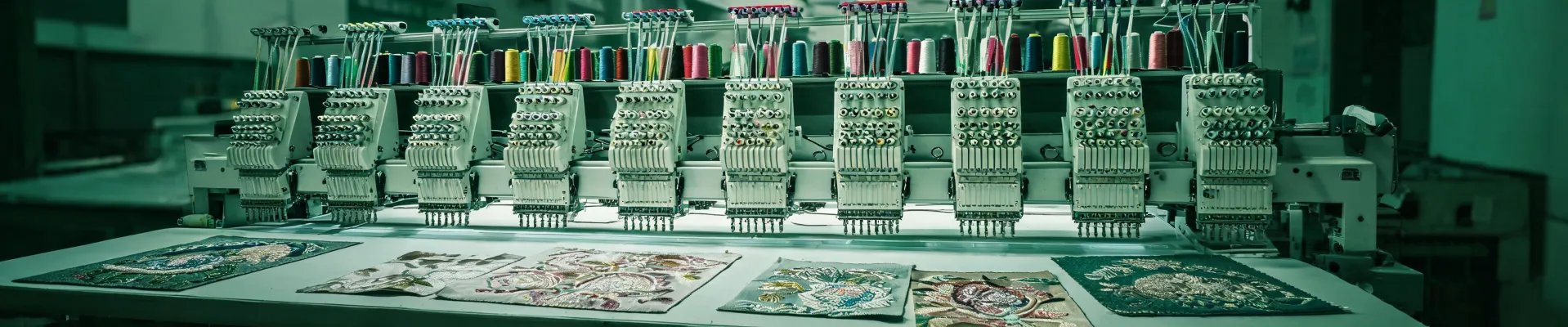
The $3,200 Hoop Mistake: What Nobody Tells You About Barudan Multi-Head Costs
Posted on 2026-09-02 by Elise Marceau
If you're shopping for a Barudan multi-head embroidery machine, here's the number that matters: budget 30–50% above the sticker price. The machine itself is rarely the biggest expense of your first two years. Hoops, installation, air supply, training, and your own beginner mistakes will eat that difference faster than any depreciation chart suggests.
I say that from experience, not as a pitch. I've been handling contract embroidery orders for seven years. I've personally made and documented 11 significant mistakes, totaling roughly $18,000 in wasted budget. Now I maintain our team's checklist so the next person doesn't repeat my errors. Whether you found this article through "barudan multi head embroidery machine," "hoops for barudan embroidery machine," or even "industriel sewing machine" from the francophone side of the internet—this applies to all of them.
Why You Should Trust This
I'm not a Barudan employee and I don't sell machines, parts, or hoops. I run a 6-head Barudan in a production shop; before that, I ran a used single-head B70 Deco embroidery machine. The $18,000 I mentioned isn't a feel-good estimate—it's the sum of 11 entries in a mistake log I keep. Every error, cause, cost, and fix we applied.
The single biggest entry in that log is a $3,200 redo caused by hoops. Let me tell you why, because the lesson applies to every purchasing decision you'll make for your shop.
"The machine is what you buy. The system is what you end up paying for."
The $3,200 Hoop Mistake
In March 2022, we took on a 2,400-piece athletic apparel order. The fabric was stretchy polyester knit—the kind that shifts if you look at it wrong. We'd been running the 6-head for about two and a half years, so I was confident. Too confident, it turns out.
The genuine hoops for Barudan embroidery machine we needed were backordered six weeks. I found aftermarket hoops at roughly 40% less, available immediately. I ordered 60 of them across five sizes without a second thought.
Day two is when the first red flag appeared. The aftermarket frames flexed under tension—barely, but enough that registration drifted between colors. On the stretch knit, fabric slipped after the first pass. We caught the problem after 400 pieces had already been sewn out.
Here's that cost, itemized: 400 pieces × $6.50 in combined labor and material = $2,600. Plus $600 in expedited shipping for replacement stock. Total: $3,200. And that doesn't factor in the credibility damage. The customer didn't leave us, but they asked for a 10% discount on the next order to stay. The real cost was closer to $4,000.
The Math Nobody Does Before Buying Hoops
Most buyers focus on per-hoop price and completely miss the tension, redo, and reputational costs that come with inferior hoops. The question everyone asks is "how much are these hoops?" The question they should ask: "what's my reject rate per hundred pieces with these hoops?"
After the disaster, I ran a head-to-head test on the same machine, same design, same thread, same fabric. Aftermarket hoop: 14 of 100 pieces needed re-hooping due to slipping. Genuine Barudan hoop: 2 of 100. Fourteen percent versus two percent.
Scale that up. Say you produce 50,000 pieces a year. A 5% higher defect rate—conservative compared to what I measured—means 2,500 extra redo pieces. At $3–4 per piece in labor and materials, that's $7,500–$10,000 every year. The $40–$60 saved per hoop disappears in the first month of full production.
Before you order a bulk batch of any hoop, test three first. Run the same hundred-piece job on the same machine and measure the reject rate. Half a day of testing will save you the kind of lesson that took me $3,200.
Hidden Costs of a Multi-Head That Nobody Quotes
The machine price is the cheapest part of the system. That sounds contradictory coming from someone who owns two Barudans, but I promise it's true. When we priced our 6-head, the quote was $82,000. Actually, no—the final invoice was $84,500 with installation and startup accessories included. I'm not mixing it up; I just don't treat the machine cost as the real investment anymore.
What people miss lives in the bits around the machine:
- Installation and rigging: $1,500–$3,500, depending on your location and building access. A basement shop costs more than a ground-floor unit.
- Compressed air system: $800–$2,500 if you don't already have one plumbed in.
- Digitizing software + training: $1,500–$5,000, and don't cheap out here—bad digitizing makes a great machine sew bad designs.
- Operator training: $1,000–$3,000 in paid hours before your team is productive, depending on their experience.
- First-year consumables and maintenance: $2,000–$4,000 for needles, bobbin cases, thread, and routine service.
- Learning-curve downtime: $0–$5,000 in lost production, depending on how patient you are with the new workflow.
Add those up: $7,000–$20,000 above the sticker. That 30–50% I opened with isn't hyperbole; it's the average range I've seen across two of my own machine purchases plus four other shops I've helped set up.
Single-Head vs Multi-Head: The B70 Deco Question
People ask whether they should start with a single-head like the B70 Deco embroidery machine or jump straight to a multi-head. It's a smart question, because the answer changes your budget by $50,000 or more.
My honest take: it depends on your sales pipeline, not your budget. The B70 Deco is excellent for sampling, monogram work, and short custom runs—I still use ours before committing production on the 6-head. But it has a hard ceiling as a production machine. A single-head can't handle 2,400-piece orders cost-effectively, period. The multi-head spreads labor across more needles per operator hour; that's its TCO advantage, and it compounds on every order.
I've watched two shop owners buy new single-heads for "flexibility" and upgrade within 14 months, paying twice for installation and training. The flexibility argument is real. It's just not always the cheapest route to profitability.
What About FDZ or Budget Machines?
I get asked about the FDZ embroidery machine and other lower-priced alternatives pretty often. I'm not going to bash them—I've seen FDZ machines turn out perfectly acceptable work for small shops with low volume and patient operators.
But run the same TCO lens. A budget machine can cost 30–40% less upfront. If parts take weeks to arrive, documentation is incomplete, and the tension system needs constant babysitting, your cost per finished piece climbs. On a busy week, that's not a cost—it's a liability.
If I ran a high-volume shop, I'd take a used Barudan multi-head over a new budget machine any day. The resale value alone justified the premium on both machines I've owned. The B70 held its value well; the 6-head hasn't been sold yet, so that part's speculative.
When the Rule Doesn't Apply
I don't want to pretend the answer is always "spend more." That's a lazy conclusion, and it's not true.
Aftermarket hoops genuinely make sense for rigid materials—caps, flat panels, luggage tags—where tension is less critical. I still use them for those jobs. And if you're doing boutique custom work, the B70 Deco is the right tool; a 6-head would be wasted capacity.
I also have mixed feelings about the "always buy genuine" advice. On one hand, my $3,200 mistake proves genuine hoops paid for themselves in the first month. On the other, I've seen shops with genuine hoops produce bad work because their tension calibration was off. The hoop is a tool; the operator is the craftsman.
Here's where I land. The brand matters less than people think. The total cost per finished, defect-free piece matters more than anything else. If a used machine, aftermarket hoops, and budget digitizing produce good work with an acceptable reject rate, that's a valid business. But run the numbers the way I didn't, and you'll save yourself a lesson that took me $18,000 of documented mistakes to learn.

Elise Marceau
Elise Marceau is an LED display and digital-signage systems analyst covering LED video walls, modular screens, transparent LED, control processors, and indoor or outdoor signage. She applies IEC 62368-1 safety principles while comparing pixel pitch, luminance, contrast, refresh rate, colour uniformity, viewing angle, ingress protection, power density, module serviceability, and signal redundancy. Her specification guides help integrators, venue operators, retailers, and procurement teams align viewing distance, ambient light, content format, installation access, electrical load, and lifecycle support.