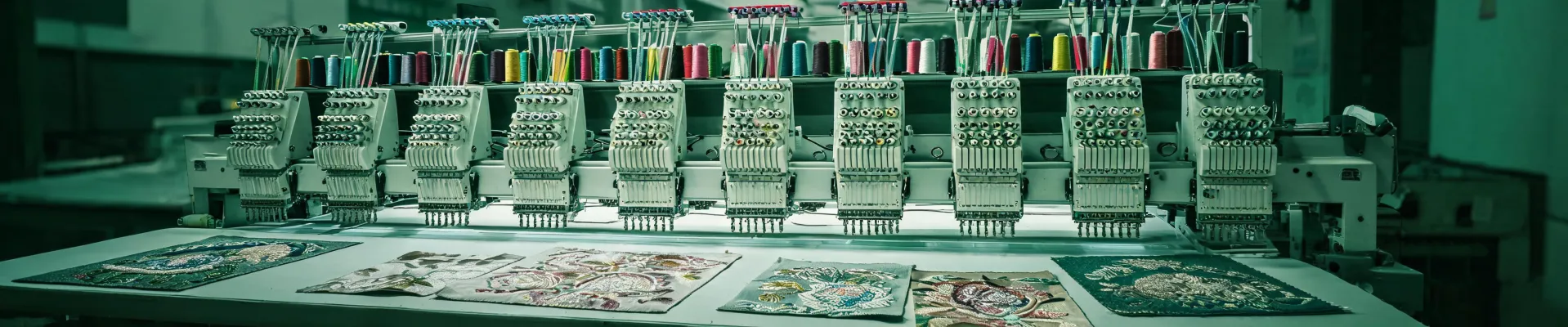
Barudan 8 Head Embroidery Machine Price: What I Check Before You Buy
Posted on 2026-10-10 by Tobias Lindgren
Start Here: The Price Isn't the Machine
If you're shopping for a Barudan 8 head embroidery machine, an embroidery machine PE900, an SE2000 embroidery machine, or a Janome MB-7, the sticker price is the least useful number on the page. The real cost is the reject rate you live with after the machine is on your floor. I've rejected about 12% of first production runs in 2024—not because the machines were bad, but because the purchase decision ignored the orders we actually run.
Honestly, I don't have hard data on every current dealer price for a Barudan 8-head. What I can tell you: the price swings more on condition, head count, year, and service history than on the brand name alone. If you're a small shop, that's actually good news. You can get into serious production without pretending you're a 20-machine factory.
Why I Trust Specific Numbers Over Broad Claims
I'm a quality and brand compliance manager at a commercial embroidery company. We run about 300 jobs a month—maybe 280, I'd have to check the system. I review every sample and first run before it reaches customers. Over 4 years of reviewing embroidery deliverables, I've learned that a machine spec sheet tells you what a machine can do under ideal conditions. It doesn't tell you what it will do on a 3,000-piece cap order with a tight deadline.
My experience is based on about 200 machine evaluations and production runs in a mid-volume shop. If you're running 12 heads around the clock, your experience might differ. But for most small and mid-size embroiderers, the pattern holds: a reliable Barudan machine with good service support usually beats a cheaper machine with a shaky parts pipeline.
For color, we use Pantone Matching System (PMS) as a reference for brand-critical colors. Industry standard color tolerance is Delta E < 2 for brand-critical colors. Delta E of 2-4 is noticeable to trained observers; above 4 is visible to most people. Reference: Pantone Color Matching System guidelines. That matters because thread color drift is one of the top reasons I reject a run. If your machine can't hold registration and thread tension consistently, your PMS match won't save you.
Barudan Machines vs. PE900, SE2000, and Janome MB-7
Let's separate the categories, because they're not interchangeable.
- Barudan 8 head embroidery machine price: This is industrial multi-head territory. Price depends on new vs. used, year, head count, and whether it includes hoops, parts, and service. I've seen used 8-head Barudan listings in the mid-five figures, but don't quote me on that—the market moves. The bigger cost is downtime if you can't get parts. A service contract or a dealer with real Barudan expertise is worth more than a $2,000 discount.
- Embroidery machine PE900: The PE900 is a single-head machine that many small shops use for samples and small orders. It's not in the same class as a Barudan 8-head. If your orders are mostly one-off names, small logos, or Etsy-style runs, it can be a fine starting point. If you're quoting 500-piece orders, you'll hit capacity fast.
- SE2000 embroidery machine: The SE2000 is another single-head option. I've seen it used for boutique work and sampling. It's pretty approachable, but don't expect it to hold up like a commercial Barudan under daily production. The SE2000 is a good tool, not a production floor.
- Janome MB-7 embroidery machine price: The MB-7 is a 7-needle home/prosumer machine. It sits in a different bracket than industrial Barudan machines. Price is lower than a used multi-head industrial, but check what's included—hoops, software, and support add up. I want to say they run in the low four figures, but pricing varies by dealer and region, so verify current quotes.
The Communication Failure That Cost Us 3,000 Caps
I said 'standard 40-weight poly.' They heard 'whatever 40-weight.' Result: sheen mismatch on 3,000 caps. The customer noticed under retail lighting before we did. We redid the run at our cost. That wasn't a machine problem—it was a spec problem. But it changed how I evaluate machine purchases. Now I ask: can this machine hold tension across the full hoop? Can it run the thread I actually use? Can I get a stitch-out sample before I sign?
So glad I asked for a stitch-out sample before signing the last machine contract. Almost approved based on a PDF spec sheet and a dealer demo. The sample exposed a registration drift on the left head. The dealer adjusted it, but we would have spent weeks chasing quality issues.
Here's what you need to know: the quote is rarely the final price. Installation, training, hoops, spare parts, and freight can add 10-20% or more. On a small order, that's the difference between a fair deal and a bad one. Small doesn't mean unimportant—it means potential. When I was starting out, the vendors who treated my $200 orders seriously are the ones I still use for $20,000 orders.
What I'd Do If You're Buying Today
- Write down your actual order mix for the last 90 days. Not what you hope to sell—what you actually sold.
- Get a stitch-out sample on your own fabric and thread. If the dealer won't do it, that's a signal.
- Ask for the service history on used Barudan machines. A well-maintained 8-head can outperform a newer machine with unknown provenance.
- Price the whole package: machine, hoops, software, training, freight, and first-year service. That's your real Barudan 8 head embroidery machine price.
- If you're small, ask about small-order support. A good dealer won't laugh. (Should mention: some won't, and that tells you something.)
Boundary Conditions: When This Advice Doesn't Apply
I've only worked with domestic vendors and mid-volume production. If you're sourcing internationally or running a 50-machine factory, your experience might differ significantly. Also, if you're buying a machine purely for hobby use, the industrial reliability argument matters less. A PE900 or SE2000 might be perfectly fine for your volume.
And if you need a Barudan 8-head for a specific contract, don't wait for the perfect price. Downtime and missed deadlines cost more than a few thousand dollars. As of Q1 2025, pricing and availability were still volatile. Verify current pricing with a dealer before you budget. I wish I had tracked total cost of ownership more carefully from the start—not just purchase price. What I can say anecdotally is that the machines with the best service support had the lowest reject rates, and that's the number I care about.

Tobias Lindgren
Tobias Lindgren is a digital inkjet systems analyst specializing in UV flatbed, roll-to-roll UV, and general inkjet printers for signage, rigid media, labels, prototypes, and promotional graphics. He references ISO 12647-7 for applicable digital proof evaluation while comparing CIELAB colour difference, resolution, droplet size, pass count, curing energy, adhesion, banding, media flatness, throughput, and ink consumption. His evaluations help print service providers and equipment buyers balance colour control, substrate compatibility, finishing requirements, productivity, maintenance burden, and cost per sellable print.