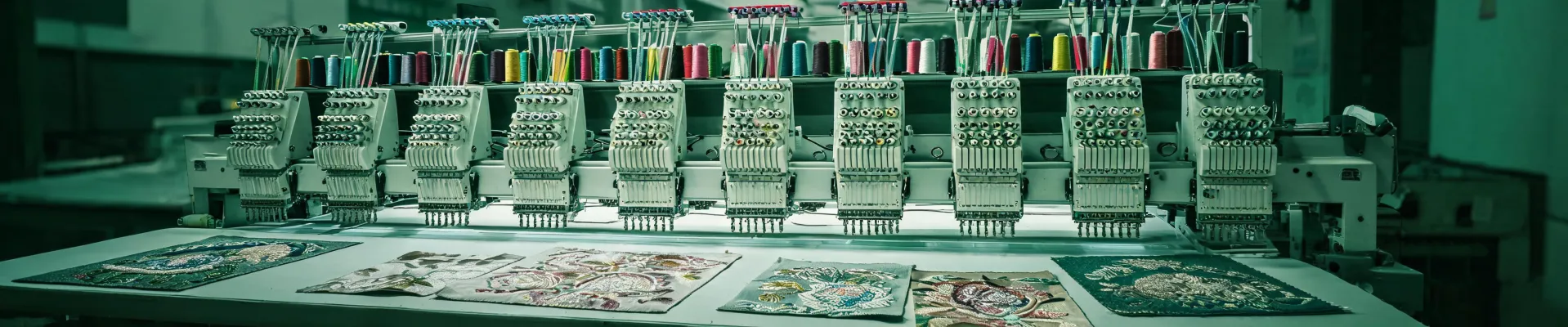
What I Learned Buying a 6-Head Barudan Embroidery Machine: The Hoops Matter More Than the Head Count
Posted on 2026-10-10 by Meera Kulkarni
If you're pricing a 6-head Barudan embroidery machine against a 12-head machine from somebody else, you're comparing the wrong number. The hoop system is what your customers actually see — and it's the part most buyers spend the least time on.
Here's the short version: two 6-head machines will usually out-produce one 12-head machine in a real shop, and the gap between OEM Barudan embroidery machine hoops and cheap aftermarket frames is wider than the gap between most machine brands. The rest of this is the reasoning.
Why I'm Confident Enough to Write This Down
I'm the office administrator for a 55-person apparel decoration company. I took over capital equipment purchasing in 2021 — about $180,000 a year across 14 vendors — and I report to both operations and our CFO. In 2024 we ran a full replacement cycle on our embroidery floor: 9 machines evaluated, 5 vendors quoted, 3 units bought.
I'm not a technician. I'm the person who has to explain to finance why the cheaper option cost more, and to the production manager why the machine I signed off on is sitting idle at 2pm. That's the angle here.
One thing before you read further: prices and lead times in this category move fast, and I'm quoting what we saw in late 2024. Verify current numbers before you build a budget around any of it.
The Hoop Is the Product
When your customer opens the box, they don't see head counts or needle counts. They see whether the logo is centered, whether there are hoop marks pressed into the fabric, and whether the stitch-out looks clean over a curved seam. All three of those things get decided before the needle ever moves.
Hooping is also the bottleneck nobody puts in the spreadsheet. A single T-shirt takes 20–40 seconds to frame properly. On a 500-piece order that's somewhere between three and five and a half hours of pure framing time — time the machine cannot run, because there's nothing loaded to sew.
This is where I'd push back on the way people shop for barudan embroidery machine hoops specifically. The instinct is to treat frames as consumables and buy the cheapest compatible set. I've watched that instinct cost us money twice.
In 2022 we saved about $600 buying aftermarket frames instead of OEM. Then a 600-piece polo order came back with hoop marks on roughly 90 units — the fabric didn't recover on its own. We paid a finishing shop to press them out and ate a three-day delay. Total cost of that experiment was around $1,800, plus a repeat order we didn't get. Saved $600, spent $1,800, lost a customer. That's the whole story.
The OEM frames aren't magic. They're just cut to tolerances that don't crush the fabric, and they hold those tolerances after a few thousand cycles. That's what you're paying the premium for — not the brand stamp.
Six Heads vs. Twelve: The Math That Actually Matters
On paper, a 12-head machine does twice the work of a 6-head machine. On a shop floor, it doesn't, and the reason is boring: somebody has to load all 12 heads.
Between color changes and between runs, that operator is standing at the machine doing nothing productive. If framing takes 30 seconds per head, a 12-head unit is down for six minutes per cycle. A 6-head unit is down for three. The 12-head only wins if you assign a second person to loading — and at that point you're paying for labor that eats most of the theoretical gain.
What actually worked for us was two 6-head units, staggered, one operator each. While machine A sews, the operator on machine B is framing the next batch. Combined output beat the single 12-head we trialed, and we kept the flexibility to run two different orders at once — which matters a lot when half your work is 40-piece jobs.
People assume more heads means a lower cost per piece. What they don't see is the idle time you're paying for on a 12-head unit running a small order, where four or five heads sit empty for part of every cycle. Empty heads don't discount.
Where Aveneer, Happy Japan, and "Latest" Actually Fit
Aveneer machines sit at the high-precision end of the market. If you're running fine lettering, dense logos, or work where a half-millimeter of drift shows up in a customer complaint, that precision is worth real money. If you're running 12,000-stitch left-chest logos on polos all day, you're paying for tolerances your customers will never notice. Neither answer is wrong — they're just different businesses.
The Happy Japan 7 needle embroidery machine is a good example of a configuration that isn't better or worse, just different. Seven needles is a specific compromise: enough colors for most work, but not the changeover flexibility of a 9- or 12-needle head. If your color sequences fit in seven, you're fine. If they don't, you'll feel it every single shift.
And on the machine embroidery latest question — newest firmware and newest model year aren't the same thing as the right machine. Our 2024 purchase was a 2019-model machine. Reasons: our operators already knew it, parts were on the shelf, and the two service techs within driving distance are trained on it. A brand-new model with no local service support is a very expensive paperweight the first time something goes wrong.
If you're shopping used at all — and a lot of people are, because used Barudan units hold value unusually well — the resale premium itself tells you something. Machines that get resold at a strong price tend to be machines that keep running.
When This Advice Doesn't Apply
Everything above assumes you're running batches of 30–50 pieces or more per design. That's not everyone.
If you're a one-person shop doing sample work and one-offs, a multi-head machine is the wrong purchase entirely — you'd be better off with a single-head unit and a better software package. The head count math doesn't rescue you from a business model that doesn't need it.
If you're a contract embroiderer running 5,000-piece programs, the calculus flips and a 12- or 15-head machine with dedicated loaders makes perfect sense. I've seen that work well. It just isn't our business.
And if your customers are buying on price alone and genuinely can't tell the difference in stitch quality — that happens — then paying for premium hoops and precision heads is a cost you'll never recover. I'd rather say that out loud than pretend quality always pays for itself. It pays for itself with customers who are looking.
Meera Kulkarni
Meera Kulkarni is a textile-printing equipment analyst covering DTF, DTG, dye-sublimation, and eco-solvent printers with their pretreatment, powdering, curing, pressing, and finishing workflows. She uses ISO 105-C06 laundering tests for applicable printed textiles while tracking colour difference, ink laydown, transfer temperature, dwell time, curing profile, washfastness, nozzle reliability, media tension, and production yield. Her process guides help decorators, apparel producers, and print shops select equipment, inks, films, fabrics, and operating windows for repeatable output.