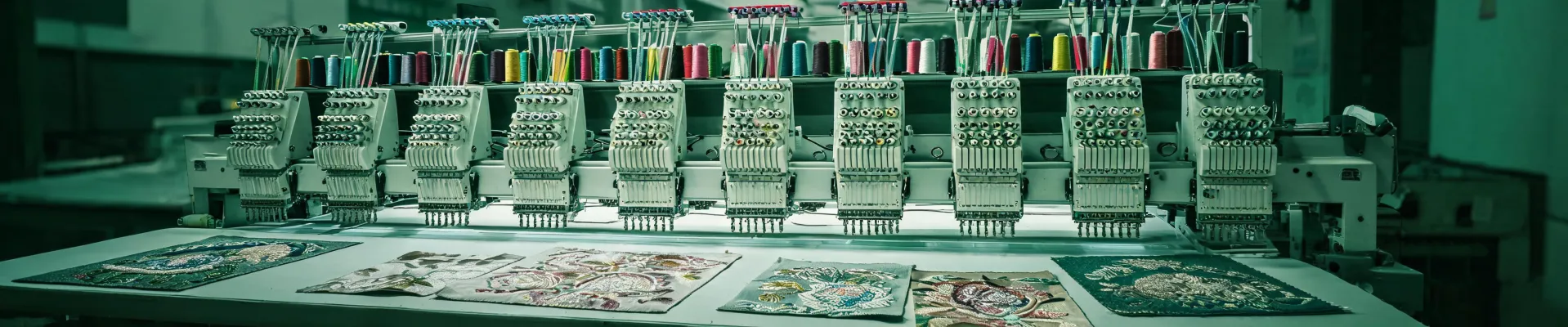
Buying a Used Commercial Embroidery Machine: The 9-Step Checklist I Wish I Had
Posted on 2026-09-30 by Gabriel Moretti
-
The 9 Steps
-
1. Confirm the actual head count and configuration
-
2. Ask for machine hours — not just "lightly used"
-
3. Run a test stitch file — bring your own, not theirs
-
4. Inspect the synchronizer and timing components
-
5. Get the barudan 4 head embroidery machine price in writing — with everything included
-
6. Verify hoop and frame compatibility with your existing setup
-
7. Check the pneumatic and vacuum systems
-
8. Request the service history — then verify it with the dealer
-
9. Do the math on total cost, not sticker price
-
1. Confirm the actual head count and configuration
-
Things People Get Wrong
I handle equipment sourcing for a mid-size contract embroidery shop. Over eight years, I've personally made (and written down) 11 significant buying mistakes, totaling roughly $8,400 in wasted budget — mostly on used machines that looked fine in the listing photos and weren't. What follows is the exact checklist we now run before any used commercial embroidery machine purchase, whether it's a used Barudan embroidery machine, a 4-head unit off a local shop closing down, or a single-head starter rig.
This is built for shops doing contract work or in-house production for apparel brands — not hobby sewers. If you're just upgrading from something like a PE545 embroidery machine or a Viking Epic 95Q sewing and quilting machine 1, some of these steps will feel like overkill. Skip them at your own risk.
The 9 Steps
1. Confirm the actual head count and configuration
A "Barudan 4 head embroidery machine" listed on a marketplace can mean three different things: 4 heads with 9 needles each, 4 heads with 15 needles, or a 4-head with mixed-needle retrofits that someone did in a garage. Ask for a photo of the needle case on every head. If the seller won't send it, walk.
One of my 2019 purchases was listed as a 4-head Barudan. Turned out head #3 had been rebuilt with a different needle bar assembly. Cost us $1,100 to bring it back to spec — and three weeks of downtime waiting on the part.
2. Ask for machine hours — not just "lightly used"
Every industrial embroidery machine logs stitch counts and running hours. Ask. If the seller says "I don't know how to pull that," that's your answer. A machine with 40,000 hours is a different animal from one with 8,000.
Reference point: most Barudan commercial heads are rated for roughly 20,000–25,000 running hours before major bearing and rotary hook service. Above 30,000 without documented service history, budget for a rebuild.
3. Run a test stitch file — bring your own, not theirs
Sellers always have a sample file that runs beautifully. Bring a dense 8-color design with small text and tight registration. Watch for thread breaks, bird-nesting, and how the machine handles color changes. Ten minutes of test stitching tells you more than any inspection report.
4. Inspect the synchronizer and timing components
The sewing machine synchronizer is the part buyers ignore and then pay for later. On a used machine, check the synchronizer belt tension, the encoder signal (if it's a servo-driven head), and whether the timing has been re-set with OEM parts or aftermarket knockoffs. Mismatched timing components are the #1 cause of "mystery" registration problems in the first 90 days.
I learned this the hard way in November 2021 — a machine ran perfectly during the demo and started drifting 3mm off-register on every 4th item after two weeks of production. $620 in rework plus a three-day delay.
5. Get the barudan 4 head embroidery machine price in writing — with everything included
Posted prices for used Barudan 4-head machines typically run $9,000–$22,000, depending on head count, year, and hours. But the posted price is rarely the real price. Ask for an itemized quote covering:
- Machine base price
- Hoops and hoop sets (magnetic hoops add $800–$2,500)
- Spare parts kit
- Freight and rigging
- Installation and initial calibration
- Any software / digitizing licenses being transferred
Two of my mistakes came from ignoring the last item. A $14,500 machine became a $17,300 machine after rigging, install, and the hoop package we assumed was included.
6. Verify hoop and frame compatibility with your existing setup
Barudan hoops don't always cross-fit older and newer frames. Bring measurements. If you're buying a used Barudan embroidery machine to add capacity next to an existing Barudan, confirm the hoop mounting arms match. If you're mixing brands, assume nothing fits until you measure.
7. Check the pneumatic and vacuum systems
Ask when the compressor was last serviced and whether the machine has a built-in vacuum table or external trim system. On used machines, the trim system is often the first thing to fail and the last thing sellers mention.
8. Request the service history — then verify it with the dealer
Any legit Barudan will have been serviced by an authorized tech at some point. Get the serial number, call the regional dealer, and ask what they show. This takes 15 minutes and has saved me from two purchases where the seller's "recent full service" was actually a $200 oil change by a local mechanic.
9. Do the math on total cost, not sticker price
My rule of thumb after eight years: the cheapest used machine I've bought has cost, on average, 40% more over 24 months than the mid-priced option. Not because of major failures — because of small ones. Missing parts. Wrong hoops. Software that had to be re-licensed. A $1,800 savings turned into a $900 net loss once you count the hours my team spent chasing parts.
What I mean is: the sticker price is maybe 65% of what you'll actually spend in year one, and closer to 40% of total cost of ownership across five years. Budget accordingly.
Things People Get Wrong
Trusting the listing photos. Every machine looks clean in a photo. Fifty percent look clean in person. Maybe 20% actually are. Get eyes on it.
Believing "it just needs a tune-up." That phrase translates to "I don't know what's wrong with it." Price a tune-up at $400–$800 with an authorized tech, and add it to your offer.
Skipping the demo because the seller is a nice guy. Some of the worst machines I've bought came from the friendliest sellers. Nice people sell bad machines all the time. Not because they're lying — because they genuinely don't know what's wrong. Run the test file anyway.
Ignoring used market signals. If a specific model — say, a particular used Barudan embroidery machine — is suddenly flooding every marketplace in your region, ask why. Either a large shop just closed (good, prices drop) or a known failure pattern is pushing people to offload (bad, run).
My experience is based on roughly 40 used equipment purchases, mostly in the $8,000–$25,000 range for apparel and home-textile shops. If you're buying at the luxury end or sourcing internationally, your mileage will differ. That said — the nine steps above have caught 23 potential problems in the past 18 months. That's roughly $14,000 in avoided losses, based on what similar mistakes cost us before the checklist existed. Use it.

Gabriel Moretti
Gabriel Moretti is a laser-processing equipment analyst specializing in fibre and CO2 laser cutting, marking, engraving, and welding machines for sheet metal, tubes, polymers, wood, and coated components. He applies ISO 11553-1 laser-safety requirements while comparing wavelength, rated power, beam quality, spot size, focal tolerance, cutting speed, kerf width, heat-affected zone, assist-gas demand, enclosure design, and extraction capacity. His engineering guides help fabricators and equipment buyers align source type, material response, process window, automation, guarding, and throughput expectations.