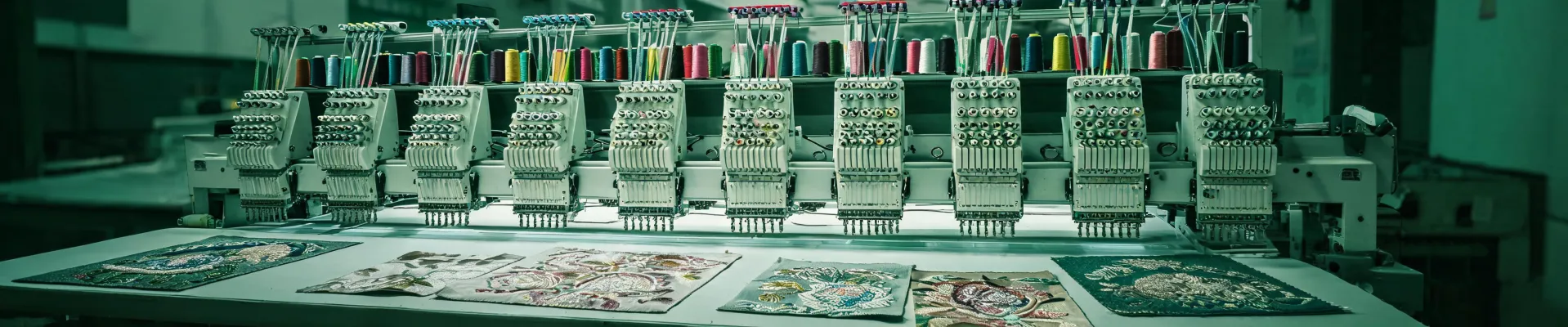
The Barudan 6-Head Price Tag Isn't the Number That Matters — Here's What I Check Instead
Posted on 2026-10-08 by Henrik Solberg
The Price on the Quote Is the Least Important Number
I've signed off on more industrial embroidery equipment purchases than I can count, and I'll say this plainly: the purchase price of a Barudan 6-head machine tells you almost nothing about what it'll cost you.
That's the sticker everyone fixates on. What's the price? What's the discount? Can we get it lower? Meanwhile the numbers that actually determine whether your embroidery machine workshop survives year three get ignored until they show up as repair invoices.
I learned this the expensive way. Now I run every purchase through a total cost of ownership model before I even respond to a vendor's quote. And when someone asks me about the "barudan 6 head embroidery machine price," I tell them they're asking the wrong question first.
What the Sticker Price Hides
A 6-head commercial embroidery machine quote might look like a clean number. It isn't. Here's what I've found gets left out:
- Installation and training — not every vendor includes it, and not every technician knows flatbed embroidery machine setups properly
- First-year consumables — needles, bobbin thread, backing, the specialty threads your designs actually need
- Downtime cost per hour — if a head goes down during a rush order, what does that lost production cost you?
- Parts availability lag — cheap machine, six-week wait for a replacement tension assembly
- Resale recovery — what the machine is worth in three years when you want to upgrade
That last one matters more than most people realize. I've watched used Barudan machines hold value in a way that off-brand equipment simply doesn't. That's real money back on the table when you sell.
The Math That Changed My Mind on Cheap Machines
Back in 2019, we almost went with a cheaper multi-head option for a second workshop. The quote was roughly 30% less than the Barudan we were also considering. My operations lead was pushing hard for it — the savings were real, and our volume didn't justify the premium.
Then I ran the numbers. Three years of projected downtime, parts sourcing delays, and the resale value gap. The "cheaper" machine wasn't cheaper. Not even close. What I mean is that the total cost gap flipped — the budget option ended up costing us more per year when you accounted for lost production.
We bought the Barudan. And I still kick myself for how long it took me to see that the sticker price was never the number I should have been comparing.
The Stitch Quality Argument Nobody Makes
Here's the position that gets me pushback from other quality folks: stitch consistency on a machine is a cost variable, not just a quality variable.
Why? Because inconsistent stitching means rework. Rework means labor hours, thread waste, and — worse — customers who notice. I've documented specific examples: when our flatbed embroidery machine tension drifted mid-run, we lost roughly 8% of a 2,000-piece order to visible puckering. That's 160 pieces that had to be redone.
The "machine embroidery stitches names with pictures" guides are useful for training new operators on stitch types — running stitch, satin stitch, fill stitch, the whole catalog. But they rarely talk about how stitch quality degrades as machines age, and how that degradation maps directly to your rework line.
A reliable machine that holds tension across all six heads means fewer surprises. That reliability shows up in your accounting as reduced rework hours and preserved customer relationships.
"The $500 quote turned into $800 after shipping, setup, and revision fees. The $650 all-inclusive quote was actually cheaper."
That quote is about print jobs, but the logic is identical for embroidery equipment. The lowest quoted number is almost never the lowest total cost.
"But Not Everyone Needs a Barudan"
Fair. I'm not saying every workshop should buy one. If you're running 200 pieces a week on a single-head setup, a premium multi-head machine is probably overkill. And honestly, I'm not sure why some shops justify the jump to a 6-head when their order volume hasn't grown to match. My best guess is they're buying for the business they hope to have, not the one they have.
But here's the thing. If you are in the market for a multi-head machine — a 6-head, an 8-head, or a 12-head — the TCO calculation matters whether you're buying new or buying used. A used Barudan with documented service history often beats a new budget machine on total cost, because the depreciation hit is already taken and the reliability is proven.
That said, buy from a seller who can show service records. A used machine without history is a gamble, not a value.
What I Actually Compare Before Signing Off
Every machine purchase that crosses my desk gets the same treatment:
- Five-year total cost projection — purchase, installation, maintenance, parts, projected downtime
- Resale value curve — what comparable machines are selling for after 3-5 years of use
- Service network proximity — how far is the nearest technician, and what's their average response time?
- Parts lead time — confirmed with the vendor in writing, not assumed
- Rework rate — reviewed from service logs on machines of similar age and head count
Notice what's not on that list: the quoted purchase price in isolation.
The price is one input. It's not the decision.
If you're evaluating a Barudan 6-head machine and the conversation starts and ends with the number on the quote, you're going to make a decision you regret. I've watched it happen. In our Q1 2024 quality audit, the single biggest source of unplanned cost across our workshop floor wasn't labor or materials — it was equipment downtime that a TCO conversation would have predicted before the purchase.
Run the full numbers. Then decide.

Henrik Solberg
Henrik Solberg is a commercial machinery safety, reliability, and procurement analyst covering display, audio, printing, sewing, cleaning, laser, welding, and supporting automation systems. He applies ISO 12100 risk-assessment principles and IEC 60300-3-3 lifecycle-costing guidance while comparing uptime, MTBF, MTTR, energy use, consumable demand, preventive-maintenance intervals, spare-parts lead time, training burden, installation constraints, and residual risk. His decision frameworks help plant managers, integrators, and procurement teams compare quotations, validate operating assumptions, plan acceptance tests, and select equipment on total delivered value.