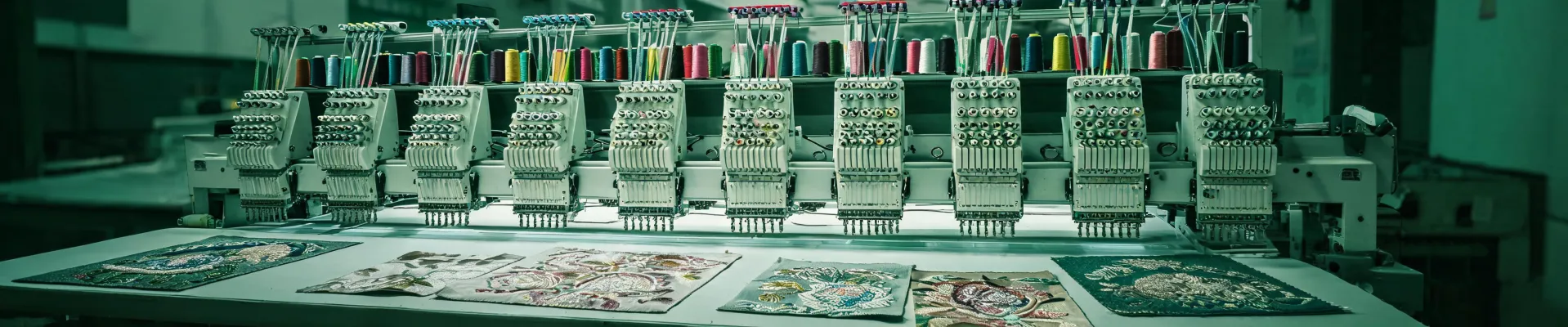
Barudan Embroidery Machines: A Rush-Buyer's Checklist
Posted on 2026-10-09 by Elise Marceau
Conclusion First
If you need a Barudan embroidery machine today — for a rush order or to replace a broken unit — here's the decision I make in the first hour: lock in the head count, verify parts and hoop availability, then pick the machine. Price negotiation comes last. The machine itself is rarely the bottleneck. What gives out under a deadline is the supporting ecosystem: Barudan embroidery machine hoops in the sizes you actually run, spare needles for the gauges you're using, and a service path that doesn't depend on shipping a part from across the ocean.
Order of operations: heads, hoops, service, price. Skip the first three and the fourth one doesn't matter.
Why I Care About This
I'm a production manager at a contract embroidery shop in the Northeast. Over the past six years I've coordinated 400-plus rush jobs — everything from a 20-piece jacket reprint to a full 15,000-piece run with 72 hours on the clock. My job, basically, is figuring out what to buy and who to call when on-time delivery matters more than saving money.
In March 2024, our largest client called at 11 a.m. on a Friday. They needed 2,400 custom caps for a corporate event after a vendor failure. Deadline: the following Thursday. We had two 6-head machines running. A third was down waiting on a drive shaft that had been on backorder since January.
We made it. But we made it because a broker I know called in a favor and pointed us to a used 8-head Barudan about 90 minutes away — mid-shift on a 13-hour run. Since then, we keep a written protocol. Here it is.
What Actually Drives a Rush Buy
Head count is the biggest lever
Barudan machines come in 1, 4, 6, 8, and 12-head configurations. Each additional head roughly adds throughput, but also footprint, operator attention, and maintenance load. For rush jobs that skew toward caps, left-chest logos, and small lettering, a 4 or 6-head is the sweet spot. For flat goods with large fields — jacket backs, banners, uniforms — an 8 or 12-head is where per-piece cost starts making sense.
The math per job is simple: total stitch count divided by (heads × stitches per minute). A 6-head running at 700 spm produces about 4,200 stitches per minute. Rush orders usually average 8,000–12,000 stitches per piece. That puts a fully running 6-head at roughly 30–35 pieces per hour. Do the arithmetic on the gap you need to close, then size up.
Hoops and parts are the hidden bottleneck
Here's something the sales folks won't tell you: the longest lead time in a rush buy is usually not the machine — it's the hoop set that matches it. Barudan embroidery machine hoops, particularly magnetic models and specialty frames for caps, sleeves, or footwear, carry stock cycles that are often worse than the machines themselves.
If you're looking for an embroidery machine online, don't assume "I'll just order hoops separately." Ask the seller point-blank: which hoops ship with this machine, which hoops cover 90% of my order mix, and what's the current stock on those specific sizes. Otherwise you'll end up with a machine in two weeks and the right hoops in six.
Used vs. new doesn't work the way people think
People assume used Barudan machines are cheaper because they're older. Actually, used Barudan machines hold value because they're reliable. The causation runs the other way. A well-maintained Barudan commands a high resale premium because buyers trust it to keep running. That reliability — driven by service and parts support — is priced directly into the used market.
Practical takeaway for a rush buy: if time beats savings, a documented used Barudan will usually outperform waiting on a new unit. If time isn't the constraint, new makes sense because warranty and parts channels stay simple.
A Real Rush Case
August 2024, Tuesday, 1 p.m. A client calls. A 1,800-piece embroidered sweatshirt order for a retail drop was falling apart at their current shop. Must ship Friday morning. By 2 p.m. we'd taken it. By 3 p.m. we were hunting for spare capacity.
Our biggest machine was already loaded. A second 6-head had thrown a needle-bar assembly two days earlier. Our third was out on contract.
Our local dealer had a new 6-head Barudan — five-day lead. The broker had two options: a used 4-head with two full hoop sets (48-hour delivery), or a used 8-head with a single general-purpose hoop set.
We took the 4-head. The hoops were there. The 8-head was theoretically faster, but we couldn't get usable cap frames for it by Friday.
We air-freighted the 4-head, paid $600 in expedited shipping, started stitching Thursday at 4 p.m., and finished at 1 a.m. Friday. 11,000 stitches per piece. Client happy. We could have made more margin with the 8-head — if we could have run it. We couldn't.
That's the arithmetic: capacity advantage only counts if you can feed it.
On "Buying an Embroidery Machine Online"
Honestly, most people searching "embroidery machine online" aren't shopping for industrial Barudan equipment. They want a home machine or a comfort sewing machine that doubles as embroidery. That's a completely different category. Industrial multi-head iron isn't plug-and-play the way a domestic unit is.
If you are looking for an industrial Barudan online and not finding much, that's expected. Industrial dealers don't chase Google keywords the way consumer brands do. Your best channels are regional dealers, trade association boards, and direct referral networks through used-machine brokers.
Same applies to sourcing thread. Searching "where to buy machine embroidery thread" lands you in the consumer aisle. Most industrial shops buy direct from thread manufacturers or through wholesale distributors. That decision path doesn't live inside an online machine search.
When I Don't Recommend Barudan
This is where the specialist line matters. I'd rather work with a vendor who knows their limits than a generalist who promises everything.
Barudan is excellent for high-repeat cap and flat embroidery where machine uptime is non-negotiable, parts networks are stable, and resale value holds. If what you actually need is a beginner-friendly unit that you can thread in your kitchen, go look at home embroidery brands. Different tool, different tradeoff.
If you are buying industrial: buy from a dealer who'll commit in writing to a parts and hoop lead time. Verbal promises don't count. Without a written timeline, "availability" tends to mean "we'll get to it when we get to it."
Edge Cases Worth Naming
- Don't buy if you need a sewing surface. Industrial Barudan embroidery machines don't sew flat seams. That's the comfort sewing machine category — separate purchase, separate purpose.
- Don't buy without a technician. Multi-head industrial machines need alignment, needle changes, and tension management. Not a plug-and-play product.
- Don't buy under ~500 pieces per week of volume. Below that, contracting out is cheaper than owning. Capital tied up in iron isn't earning.
- Verify power and floor space before you commit. A 12-head needs three-phase power, serious square footage, and airflow. Check the building before you check the machine.
On pricing: used Barudan machines for sale vary widely based on location, head count, and which hoops and spare parts come with the unit. As of early 2025, listings for used 6-head units range from "reasonable" to "that's clearly a scam." Confirm pricing directly with a dealer. Don't trust sticker prices — they're often lead-generation bait. (Prices as of early 2025; verify current rates.)
Last Thing
A rush buy always costs you something. Money, time, or sleep. If you decide in advance which of those you're willing to lose, the decision takes hours instead of days. That's the whole trick. Decide early. Execute clean.

Elise Marceau
Elise Marceau is an LED display and digital-signage systems analyst covering LED video walls, modular screens, transparent LED, control processors, and indoor or outdoor signage. She applies IEC 62368-1 safety principles while comparing pixel pitch, luminance, contrast, refresh rate, colour uniformity, viewing angle, ingress protection, power density, module serviceability, and signal redundancy. Her specification guides help integrators, venue operators, retailers, and procurement teams align viewing distance, ambient light, content format, installation access, electrical load, and lifecycle support.