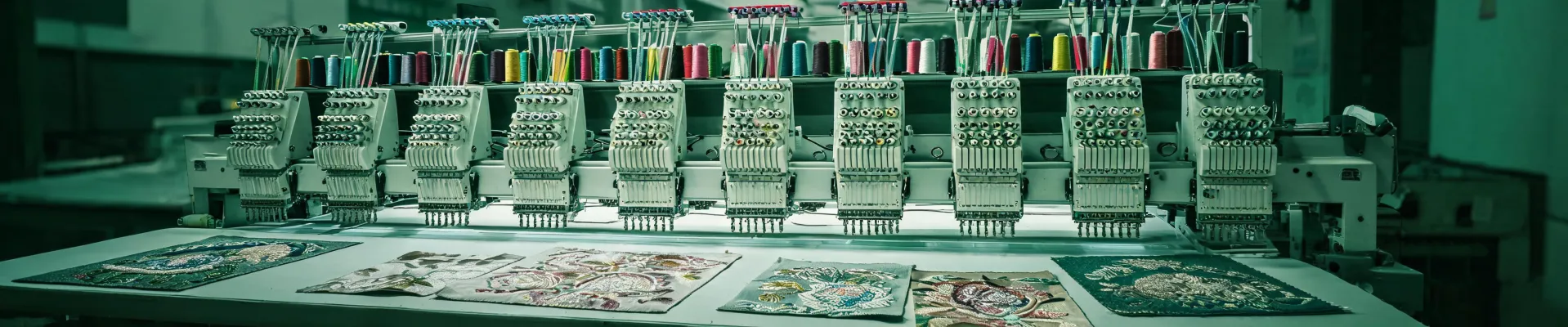
The Barudan 6 Head Embroidery Machine Price Isn't the Number That Matters
Posted on 2026-09-29 by Pavel Novak
The Number That Looks Like the Answer
When I sat down in early 2024 to plan our next equipment cycle, I found myself staring at the same spreadsheet I'd built in 2019. Vendors down the left column. Prices across the top. Clean. Simple. Wrong, as it turns out.
Because when most people compare embroidery machines, they compare three things: number of heads, number of needles, and price. Barudan 6 head embroidery machine price on one row. A Brother machine on the next. Maybe a used listing on the third. Then pick the middle number and move on.
I did exactly that in Q4 2022. It cost us in ways the quote never showed.
The number on a quote is a starting point, not a decision. And the gap between those two things is where most embroidery machine purchases go sideways.
What the Quote Doesn't Tell You
It's tempting to think you can compare machines on price per head. But two machines with identical head counts and the same needle configuration can produce wildly different numbers once they're on your floor.
Here's what doesn't appear on the quote:
- Consumables over your first 18 months — rotary hooks, needle plates, tension springs. These aren't fixed assets.
- Service call rates, and how many are bundled into your warranty versus billed at $150–$220 per visit.
- How long a replacement part takes to ship when the machine goes down. Not the average — the worst case.
- Software format compatibility if your designs come from outside your shop.
- Whether the head timing holds after 2,000 hours of 6-head production.
In late 2022, we requested quotes for a 6-head machine from three suppliers. The numbers came back at $32,000, $28,500, and $26,000. We picked the $26,000 unit. Same head count, similar specs on paper.
(Should mention: "similar specs on paper" turned out to be doing a lot of work in that sentence.)
Eighteen months later, running that machine alongside two others through our total cost of ownership model, the "cheap" option was costing us roughly 41% more per production hour than the more expensive alternatives.
The Cost Nobody Calculates: Downtime
This is where the spreadsheet math gets uncomfortable.
Machine downtime in a contract embroidery shop isn't an inconvenience. It's a bill that comes due three different ways:
- The production hours you lose on that machine.
- The downstream orders that slip because one job missed its window.
- The client who quietly starts sending work elsewhere because this is the third delay this quarter.
In 2023 — the year I have the cleanest records on — we lost approximately 170 production hours to machine-related issues. Our internal rate at the time was $95–$130 per machine-hour depending on the job mix. Call it $110 as a working average. That's $18,700 in lost capacity, not counting the two clients who reduced their order volume.
I want to say we recovered one of them six months later, but don't quote me on the timeline — I'd have to pull the CRM notes.
So that $2,500 we "saved" on the original quote was gone in roughly two weeks of unplanned downtime.
The Second-Hidden Cost: Parts Velocity
This is the one I didn't see coming in 2019.
Machine quality is half the story. The other half is how fast you can get a spindle motor, a tension assembly, or a control board when something fails.
That's why some brands carry a premium they can't justify on features alone. Barudan machines cost more partly because Barudan maintains parts inventory in regional warehouses. Happy Japan and SWF have their own coverage. Brother (yes, the sewing brand — they make commercial embroidery equipment too) has a different support structure that works better for some shops than others. None of this shows up on the purchase quote.
We had a machine from a smaller brand go down in 2021. The replacement motor took 19 days. Nineteen. We outsourced about $4,300 worth of work in the meantime to a competing shop that now knows our biggest client by first name.
What I Actually Do Now
After rebuilding our procurement process around TCO instead of unit price, here's the framework I use for every embroidery machine purchase:
- Acquisition cost — actual cash out the door, including shipping and install.
- 36-month consumables estimate — based on our own utilization data, not vendor averages.
- 36-month downtime impact — using our actual hourly production value, not a generic industry figure.
- Parts lead time — ask for the last five order-to-delivery times for common failure parts.
- Written service response commitment — in the contract, not in the pitch deck.
Then compare total cost per production hour. Not total cost. Not unit price. Cost per hour of actual output.
This sounds obvious. It isn't. Of the shop owners I've talked to about equipment decisions over the past three years, the vast majority still tell me their last purchase was driven primarily by the price on the quote.
My experience is based on 14 machines across four production rooms, mostly in the 4-head to 12-head range. If you're running a single-head operation or a 15-needle Barudan for specialty work, your cost drivers will look different.
Where This Ends Up
You're not buying a number on a quote. You're buying a promise that it won't hurt you later. That's the whole thing.
The best brand of embroidery machine is the one whose failure modes you can live with — because every machine fails eventually. The question is whether the failure is a two-day annoyance or a two-week disaster.
Barudan earned its reputation for reliability over decades, and the resale market reflects that — used Barudan machines hold value for a reason. But reliability alone isn't the argument. The argument is: how much does unreliability cost you per hour, and how much are you willing to pay up front to avoid it?
Answer that honestly, and the quote comparison gets a lot simpler. (Finally.)

Pavel Novak
Pavel Novak is a commercial floor-care equipment analyst specializing in walk-behind and ride-on scrubbers, sweepers, pressure washers, and combined cleaning machines for retail, hospitality, logistics, and industrial sites. He applies IEC 60335-2-72 to applicable floor-treatment machines while comparing cleaning path, brush pressure, solution and recovery capacity, filtration, runtime, productivity rate, maneuvering envelope, gradient limit, noise, and charging time. His selection guides help facility teams size equipment around floor type, soil load, aisle geometry, shift duration, operator access, and maintenance resources.