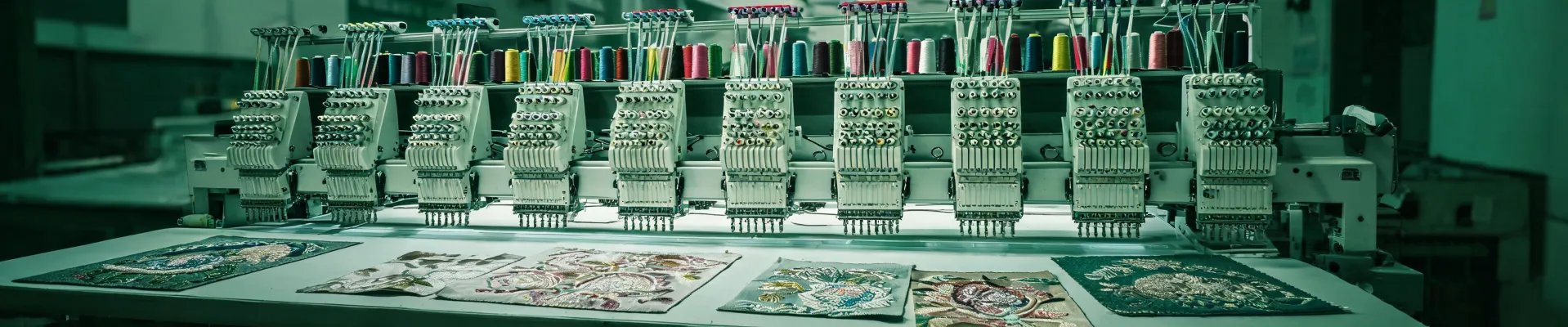
Barudan Multi-Head Embroidery Machine Price: The Real Comparison a Procurement Manager Would Make
Posted on 2026-08-19 by Jane Smith
Searching for “barudan embroidery machine price” usually isn't about a number. It's about a choice. You're probably deciding between a Barudan multi-head embroidery machine and something less expensive—or between new and used, or between industrial and hobby-grade. I've spent the last 6 years managing equipment purchases for a 40-person apparel decoration company, and I've tracked enough invoices to know that the first quote is never the full story.
This is the comparison I run when someone asks whether Barudan is worth it. I compare three things: total cost, throughput, and support. Not spec sheets. Not brand logos. Those three dimensions have saved us money—and, when I ignored them, cost us money.
1. Price vs. Total Cost of Ownership
Here's something vendors won't tell you: a quoted price for a multi-head machine is only the beginning. Rigging, electrical work, compressed air, training, and initial thread/needle stock can add 10-15% before the first stitch. I've watched a $90,000 quote become a $103,000 invoice.
In 2024, I compared a new Barudan 6-head quote with a less expensive 6-head machine. On paper, the cheaper option was about 40% lower. But when I added projected downtime, spare parts lead time, and resale value, the cost gap shrank to under 15% by year two. Then the repairs started. Hoop alignment drifted, thread breaks climbed, and the “savings” disappeared into a third-party technician's invoice log.
That's not a knock against lower-priced brands—some are fine for lighter production. But as a cost person, I do not mean “cheaper” when I say “cost-effective.” The Barudan multi head embroidery machine has one big advantage in my spreadsheet: it holds its value. We sold a 2018 Barudan 4-head in 2024 for 62% of its original price. The cheaper machine we replaced had no resale market at all.
2. Throughput vs. Flexibility
I get why people search “brother se700 embroidery machine review” right after “barudan multi head embroidery machine.” They're hoping the cheaper combo can handle production. It can't. Not because the Brother SE700 is bad—it's a solid beginner machine. But it is a sewing/embroidery hybrid, not a production system.
That idea—that a sewing machine with an embroidery function is enough—comes from an era when embroidery was a weekend hobby. Today, commercial embroidery is about repeatability. A Servis sewing machine, to use another example, is built for garment construction. It does a good job at that. It is not a tool for stitching 500 caps with a consistent satin stitch.
When I compared a single-head machine and a 6-head machine side by side on the same order, I finally understood why head count matters. It's not that the needles move faster. It's that one operator tends four, six, or twelve stations at once. The thread breaks and hoop changes happen in parallel. That's where the real bottleneck lives. A 6-head Barudan doesn't just multiply output—it multiplies the value of the person standing in front of it.
If your volume is ten shirts a month, a single-head combo is probably the right answer. If your volume is ten dozen shirts a month, the math flips. There's no comparison.
3. Support vs. Specs
Now let's talk about the phrase “ai embroidery machine.” It's showing up in more brochures, and it usually means one of two things: real automation or a marketing sensor. Per FTC guidelines (ftc.gov), advertising claims have to be truthful and substantiated. So when a vendor says “AI,” I ask: what does it actually do, and can I test it?
If it means an AI-assisted digitizing tool or automatic color sorting, that's useful. If it means a light that blinks when the thread breaks, that's not AI—it's a sensor. I've seen those labels inflate prices by thousands of dollars.
A Barudan multi-head embroidery machine is not an AI machine. It's a mechanically built workhorse. Some people assume that's a weakness. I'd argue the opposite: in a production environment, the most advanced feature is a machine that doesn't stop randomly. You can add AI design tools later. You cannot add reliability with a software update.
And here's where my “specialist beats generalist” bias shows up. I'd rather trust a company that says “we're really good at industrial embroidery” than one that claims to do everything. Barudan isn't trying to be an all-in-one apparel factory. That's why I trust it for embroidery.
Which One Should You Buy?
After all of this, the boring-but-true conclusion is that “Barudan is always better” is not a smart buying rule. It depends on your orders, your labor, and your tolerance for downtime. Here's how I'd decide:
If you're running production jobs six or more hours a day with deadlines, compare Barudan head configurations. The difference between a 4-head and a 6-head is often less than the cost of one rush shipment you'll miss with a slower machine.
If you're starting a small embroidery business and demand is uncertain, consider a used Barudan 4-head instead of a new low-cost machine. You get industrial reliability without paying new-machine premiums. Just budget for a technician's inspection before you commit.
If you're a home hobbyist, the Brother SE700 or a Servis sewing machine might genuinely be the right machine for you. I'm not going to tell you to buy a $90,000 piece of equipment for a craft room. That would be irresponsible.
Granted, a cheaper machine can make sense if your volumes are low and your budget is fixed. That's exactly why I'm not giving you a one-size-fits-all answer. It took me about 6 years and 40+ vendor evaluations to understand that the “best” machine is deeply situational. The same Barudan that saves one shop a fortune is overkill for another. Good suppliers know this. They'll tell you the machine's limits, and they'll tell you when you'd be better off elsewhere. That honesty is worth more than any spec sheet.

Jane Smith
I’m Jane Smith, a senior content writer with over 15 years of experience in the packaging and printing industry. I specialize in writing about the latest trends, technologies, and best practices in packaging design, sustainability, and printing techniques. My goal is to help businesses understand complex printing processes and design solutions that enhance both product packaging and brand visibility.