500 Polos in 72 Hours: What a Last-Minute Rush Taught Me About Used Barudan Machines, Hoops, and Asking for Help
Posted on 2026-08-19 by Jane Smith
Thursday, 4:38 PM
My phone rang at 4:38 on a Thursday afternoon. It was a client I hadn't heard from in six months — a regional sales director who needed 500 embroidered polo shirts for a corporate launch event in Chicago. Monday morning. That was 72 hours away, minus the weekend, minus shipping time, minus the margin for error.
"Can you do it?" she asked.
Let me be honest with you: my first instinct was to say no. But the penalty clause on that contract was $15,000 if we missed the deadline. The job itself was $8,750. That's a $23,750 swing between success and failure. So I said yes, hung up the phone, and immediately started sweating.
Here's the thing — I run a small contract embroidery shop with three Barudan machines. A 6-head, a 4-head, and a single-head we keep around for samples and small runs. Normal turnaround on 500 pieces is 7 to 10 days. We've pulled off 3-day turnarounds before, but only when every machine was free and nothing went sideways.
That week, both the 6-head and the 4-head were already booked on jobs for other clients. The single-head was available, but at a realistic pace, 500 pieces through a single-head wasn't happening in the time we had. It just wasn't.
The Used Barudan That Saved the Order
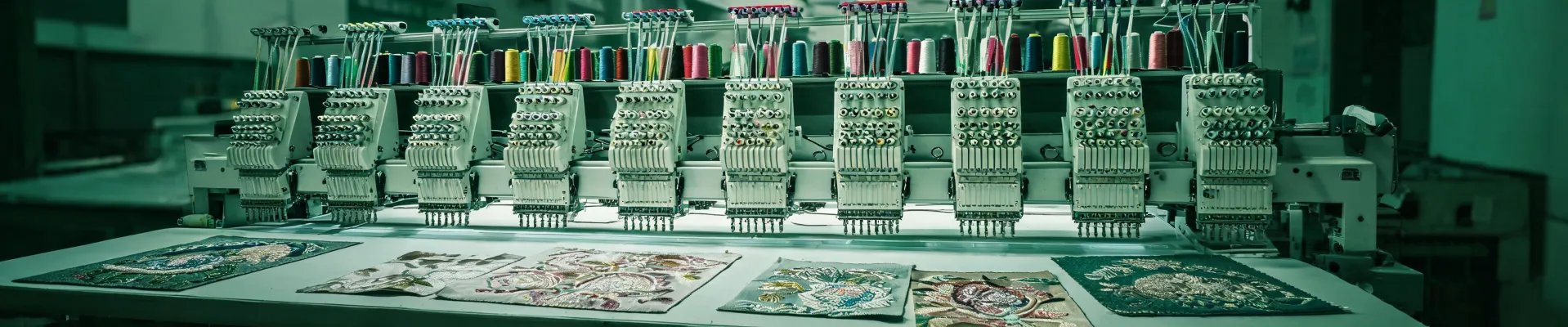
Two weeks earlier, I'd gotten a call from a shop owner about 30 miles away who was closing his business. He had a used Barudan embroidery machine for sale — a 2018 Barudan BEVY-4004 four-head model, roughly 18 million stitches on the counter, some cosmetic wear on the tabletop, but mechanically clean. He was asking $12,500. I'd gone to look at it, told him I'd think about it, and walked away convinced the price was too high.
Then Thursday 4:38 happened.
I called him back at 5:15 PM. He'd dropped the price to $11,000 because he needed it gone by the end of the month. I didn't negotiate. I sent a deposit via wire transfer before I even got off the phone.
The machine arrived Saturday at 7:00 AM on a flatbed. Three riggers spent four hours getting it positioned, leveled, and wired up. By 1:00 PM we were running test stitches.
What came with the machine — and what didn't
The used Barudan came with a mixed bag of hoops: two genuine Barudan hoops, a tube frame, a cap frame, and several aftermarket hoops the previous owner had picked up online. You know the type — they look like the real thing, cost a third of the price, and show up in packaging with typos. I looked at them, thought a hoop is a hoop, and moved on.
That assumption nearly cost me the entire order.
The Registration Problem
At 6:30 PM Saturday, my senior operator Dana started a test run. The digitized files were loaded, thread colors matched to Pantone 286 C and 349 C from the client's brand guidelines, and the fabric was a cotton/poly blend we'd hooped exactly the way we always do.
Ten minutes in, she walked into the office with that look. You know the look. The one that says there's a problem and it's not going to be a small one.
"Registration is off," she said. "About two millimeters on the left edge of the logo."
Two millimeters doesn't sound like much. On a logo that's three inches wide, it's the difference between looking professional and looking like a knockoff. The client would have rejected every single piece.
We spent an hour checking everything: thread tension, machine calibration, hooping pressure, backing thickness, stabilizer. All of it looked normal. That's when Dana picked up one of the aftermarket hoops and ran her finger along the rim. Then she compared it to a genuine Barudan hoop from the 6-head. There was a subtle difference — maybe half a millimeter in the channel depth. Enough to slightly change the tension on the fabric. Enough to make the fabric shift mid-stitch and throw off registration.
I would never have believed a hoop could make that much difference. I believe it now. I only believed it after ignoring that possibility for an hour and eating the consequences. It was the kind of lesson you can't get from a spec sheet — you have to live through it.
The fix: genuine Barudan embroidery hoops
Dana walked to the spare cabinet and pulled out three genuine Barudan magnetic hoops, the 5x7 size we use on the 6-head. She loaded one onto the 4-head, ran a sample, and the registration was dead-on. No slipping. No shifting. The fix wasn't the machine, wasn't the digitizing, wasn't the thread tension. It was the hoops.
We'd just spent two hours proving that the cheapest part of our setup was also the most important one.
Wait — How Do You Remove a Sewing Machine Foot?
While Dana was working through the registration issue, our part-time helper Marcus hit a wall at the basting station. We use an older Servis sewing machine — the single-needle lockstitch workhorse that's been in the shop for years — to run a quick basting stitch around each garment before hooping. It makes the whole process faster because the fabric stays put once the hoop tension goes on.
Marcus came over looking sheepish. "Hey, I need to switch to the open-toe foot on the Servis, but I can't get the current foot off. How do you remove a sewing machine foot?"
I almost laughed. But then I realized — not everyone grew up around these machines. If you've never been shown, it's not obvious.
Here's how it works. On the Servis, like on most standard single-needle machines, there's a small lever at the back of the presser foot assembly. Press it down gently, slide the foot forward slightly, and lift up. It pops right off. To install a different foot — say, an open-toe foot — line up the connecting pin with the slot, press down, and it clicks into place. No tools needed.
Marcus had been trying to unscrew it, which was the right instinct but the wrong location. He'd also been fiddling with the screw on the toe of the foot itself, which does nothing while the foot is still mounted. I showed him once. He did the next one himself. The whole detour cost us maybe four minutes. During a 72-hour rush, four minutes feels like a lot — but it was still the fastest possible way to solve it correctly. (Mental note: we're finally printing a reference card and taping it above the basting station. We should've done that a year ago.)
Why Not a Happy Japan Machine?
Someone in an industry group later asked me: "Did you consider a Happy Japan embroidery machine?" Yes, I did. There were a couple of used Happy Japan machines listed nearby, and they're genuinely solid. Happy Japan's engineering is good, and I've seen their multi-head machines run impressively clean.
But here's the practical reality, and I told Dana exactly this when she asked: my mechanic knows Barudan. I know Barudan. Every operator who's ever worked in my shop came up on one. We stock spare parts for Barudans, and our entire digitizing workflow is built around Barudan's stitch engine. For an emergency order, I wasn't looking for the best machine on paper. I was looking to minimize variables. A used Barudan gave me continuity with everything we already know how to do.
A different machine might have been "better" on paper. But it would have brought a learning curve with it, and a learning curve doesn't fit in a 72-hour window.
The All-Night Run
By 2:00 AM Sunday, all 500 polos were hooped, inspected, and staged. We fired up the 4-head and it ran through the rest of the night at 750 rpm without a single thread break. I've been around Barudans for over a decade now, and that kind of reliability is exactly why I stay with the brand. When I said earlier that efficiency is the real competitive advantage — this is what I mean. It's not about being fast. It's about the machine not being the reason you're slow.
At 6:00 AM, I walked into the shop carrying a box of donuts and found Dana asleep on the office couch. She still had a hoop in her hand. I didn't wake her. We started tagging and packing the first finished pieces at 8:00 AM.
They Made It
The order shipped at 9:00 Sunday morning via overnight courier. The client's event team in Chicago confirmed delivery Monday at 10:30 AM. 72 hours total. Twenty hours of setup and problem-solving, 48 hours of actual production.
We didn't just meet the deadline. We beat it.
What I Learned
If you're reading this because you're considering a used Barudan embroidery machine for your own shop — or because you've got a rush order breathing down your neck — here's what I'd tell you, the short version, so you maybe don't have to learn it the way I just did:
- Hoop quality is non-negotiable. The difference between genuine Barudan embroidery hoops and cheap aftermarket ones is the difference between smooth production and a 2 AM crisis. Check channel depth. Check clamping pressure. Check the magnets. Replace anything that looks worn.
- Inspect the hoops before you buy a used machine. We were so focused on stitch count and mechanical wear that we never questioned the random hoops included in the deal. Those "free" aftermarket hoops ended up costing us about $600 in new Barudan magnetic hoops plus several hours of lost production. The classic penny-wise, pound-foolish mistake.
- Ask the "dumb" questions. Marcus asking how to remove a sewing machine foot — a question that seemed obvious to me — is exactly the kind of thing that prevents an order from going sideways. Nobody gets embarrassed in my shop for asking. It's the guessing that causes the damage.
- Know your equipment the way you know your team. Whether you pick Barudan, Happy Japan, or anything else, the best machine is the one your people can troubleshoot in their sleep. That's the real efficiency lesson. It isn't about doing things faster. It's about removing everything that makes you slow.
Would I take this order again? I'd try to negotiate the timeline first, honestly. We got through it because a used Barudan happened to be available at the critical moment — and because Dana caught a problem most operators would have missed until the polos came off the hoop. But if this happens again, after that weekend, I know exactly what to check first. That's the thing about a story with a happy ending — it hands you lessons you can't get any other way.

Jane Smith
I’m Jane Smith, a senior content writer with over 15 years of experience in the packaging and printing industry. I specialize in writing about the latest trends, technologies, and best practices in packaging design, sustainability, and printing techniques. My goal is to help businesses understand complex printing processes and design solutions that enhance both product packaging and brand visibility.