The 72-Hour Rush: What It Really Takes on a Barudan 6 Head Embroidery Machine
Posted on 2026-08-20 by Jane Smith
-
The Phone Call That Started It
-
Why the Barudan 6 Head Embroidery Machine Earned the Job
-
The Library Embroidery Machine That Reminded Us About the Art
-
The Proof Rule and the Gap in Our Process
-
Color, Thread, and the Pantone Reality
-
What Happened in the Final 24 Hours
-
What I'd Tell Someone Facing the Same Deadline
The Phone Call That Started It
At 8:40 on a Wednesday morning in March 2024, our receptionist transferred a call that started with the sentence every shop owner knows: 'I need this by Saturday.' The client was a regional manager for a beverage company. They were hosting a sales event on Saturday night and needed 600 embroidered beanies as swag. Their overseas supplier had just quoted four weeks. That was not going to work.
I told them I would call back in 15 minutes. In my role coordinating production for a commercial embroidery shop, I have handled more than 50 rush orders in the last 12 years, including same-day turnarounds for event clients. The worst way to start a rush job is to say yes without knowing what is already on the schedule.
If you have ever received a call like this, you know the first fifteen minutes are the most expensive. Every minute we spent thinking was a minute we were not stitching. The normal turnaround for 600 beanies is ten business days. We had about 72 hours.
Why the Barudan 6 Head Embroidery Machine Earned the Job
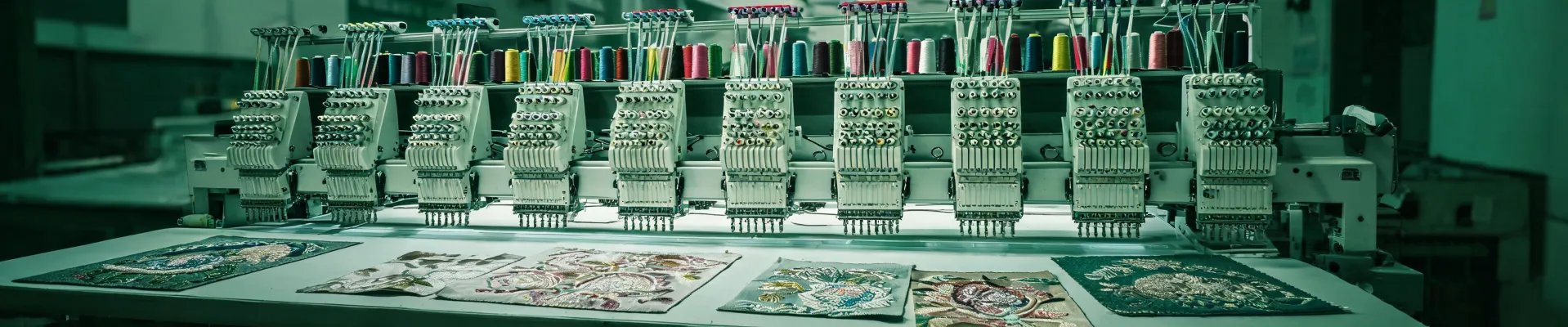
Our production floor has several machines, but the workhorse is a Barudan 6 head embroidery machine. Six heads means six beanies per run. For a job like this, there is no substitute. The Barudan 6 head embroidery machine has been in our shop for eight years, and it is the reason we can say yes to orders that other shops turn away.
People think a 6-head machine is faster because it runs at a higher stitch speed. Actually, the per-head speed is pretty similar to a single-head machine. The advantage is that it stitches six items at once. The real throughput win is not having to stop between pieces. A 6-head does not make one shirt faster; it makes six shirts at the same speed as one. That changes the math on a rush order.
We did the math for the beanies. The logo was 8,200 stitches and six colors. At 750 stitches per minute, one run of six hats took about 11 minutes, not counting color changes. For 600 hats, that was 100 runs, or just over 18 hours of actual run time. If we ran two shifts and kept the setup clean, we could do it. The pressure was on the support team, not the machine.
Everything I've read about rush orders says to throw more labor and more machines at the problem. In practice, that was not the bottleneck. The bottleneck was file preparation and tension. The 6-head can outrun the people feeding it, but it cannot outrun a bad logo file.
The Library Embroidery Machine That Reminded Us About the Art
Next to the production line, we keep a single-head Barudan Pacesetter embroidery machine on a reinforced industrial sewing machine table stand. We call it our library embroidery machine because it is loaded with every approved design file from the past decade. It is also our backup production unit and our test station. The table stand is an industrial sewing machine table stand that we picked up secondhand. It is overbuilt for the job, but with embroidery, stability is not a luxury.
When the client said 'same logo as the last order,' I assumed we had the file on the network. I did not check the library. That was my first mistake. I said 'sure, we've got it.' They heard 'we have a file that is ready to stitch.' We pulled up the archive on the Pacesetter and found the design. Looking at it on the screen, I knew something was off, but I could not place it. My instinct said run a test sample before committing 18 hours of machine time.
We stitched a test beanie on the library machine. That is where the Pacesetter is worth its weight. The test came out clean on the hat, but when I held it next to the old sample, the phone number on the logo was wrong. The client had changed numbers two years earlier. We were using the same words—'same logo'—but meaning different things. They meant the logo as it currently appears on their website. I meant the file we used in 2021. Discovered this when the test stitch was sitting on the table.
We corrected the file, sent the client a revised proof, and only then started loading the 6-head. That cost us two hours. Two hours we did not have. But it saved us from stitching 600 hats with the wrong phone number.
The Proof Rule and the Gap in Our Process
Here is the part that still bothers me. We have a production checklist that says a printed proof must be signed off before a long run. But when the client says 'just run it' and the clock is ticking, it is tempting to skip the formality. We did not formally skip it—we just sent the proof by text and got a thumbs-up. That is not a sign-off; that is an emoji.
The third time we had a reorder issue like this, I finally changed the policy. Now, even on a same-day rush, we send a dated PDF proof and require a reply that says 'approved.' If the client will not do that, we take it as a warning, not a green light. We did not have a formal reorder verification process before this job. It cost us two hours of production time. Should have been in place after the first near-miss.
To be fair, the client was not being difficult. They were in a hurry and assumed we had accurate records. The mistake was mine. I treated a reorder as a simple job when it deserved the same checking as a new order.
Color, Thread, and the Pantone Reality
While the beanies were running, we had to switch thread colors. The client wanted a specific royal blue. We had a close match, but embroidery thread does not map perfectly to Pantone chips. According to Pantone's Color Matching System guidelines, Delta E below 2 is the tolerance for color-critical matches. We did not have a spectrophotometer on the floor, so I held the thread card next to the Pantone chip under daylight-balanced light. I'm not 100% sure it was within Delta E 2. It was close enough for a logo on a beanie, and the client approved the sample. But if you work with a strict brand team, get the thread measured before you start a large run.
I also asked the digitizer to export a render at 300 DPI, since that is the print-resolution standard we use for internal proofing. That is not a requirement for embroidery, but it helped us see potential stitch-density issues. The render showed that the fine letters in the logo were going to be too dense for the knit fabric. We simplified the lettering and adjusted the density. The Barudan machine could stitch the original design, but the beanie would have puckered.
What Happened in the Final 24 Hours
The 6-head ran through Thursday night without a major issue. Friday morning, the tension on head 4 drifted. I called Barudan's support line, and a technician walked me through a calibration in about 20 minutes. That was the moment I was grateful we bought from a brand with real parts backup. The machine was back up by 11 AM.
The last 50 hats finished at 5:15 PM on Saturday. We boxed them, shrink-wrapped them, and loaded the client's van by 5:50. The delivery address was on the way to the venue. They arrived around 7:00, about 30 minutes before doors opened.
We paid about $800 in overtime and a rush thread delivery, but the client's event budget was more than $12,000. Missing the deadline would not just have meant a refund. It would have meant a room full of sales reps without the giveaway that the whole campaign was built around.
Last quarter alone, we processed 47 rush orders with a 95% on-time rate. This was not our highest-value invoice—it was around $4,800—but it taught me the most about our workflow.
What I'd Tell Someone Facing the Same Deadline
- Check the file before you count stitches. The fastest machine in the world is slow when the logo is wrong.
- Proof even in a rush. A texted thumbs-up is not an approval.
- Keep a library machine if you can. The single-head Pacesetter cost us very little to operate, and it saved us from a production run on a bad design.
- Respect the table stand. The industrial sewing machine table stand under our sample machine is not the star of the show, but if it wobbles, your sample will lie to you.
One last thing. I understand why people think rush orders are about panic and heroics. In my experience, the opposite is true. The successful ones are boring and procedural. By procedural, I do not mean slow. I mean every step gets checked once. The machine did what it was supposed to do. The support team did what they were trained to do. The only panic was in my head.
Granted, a single-head machine can do the same job if you have a week. With three days, the 6-head was the only realistic option. I'm not gonna pretend the first 24 hours went smoothly. But if you are choosing a multi-head machine, do not buy on speed alone. Look at the support network, the resale value, and the little things like color-change reliability. I'm not saying everyone needs a Barudan 6 head embroidery machine. I'm saying that when you are 72 hours from a deadline, you want a machine that will not be the reason you fail.

Jane Smith
I’m Jane Smith, a senior content writer with over 15 years of experience in the packaging and printing industry. I specialize in writing about the latest trends, technologies, and best practices in packaging design, sustainability, and printing techniques. My goal is to help businesses understand complex printing processes and design solutions that enhance both product packaging and brand visibility.