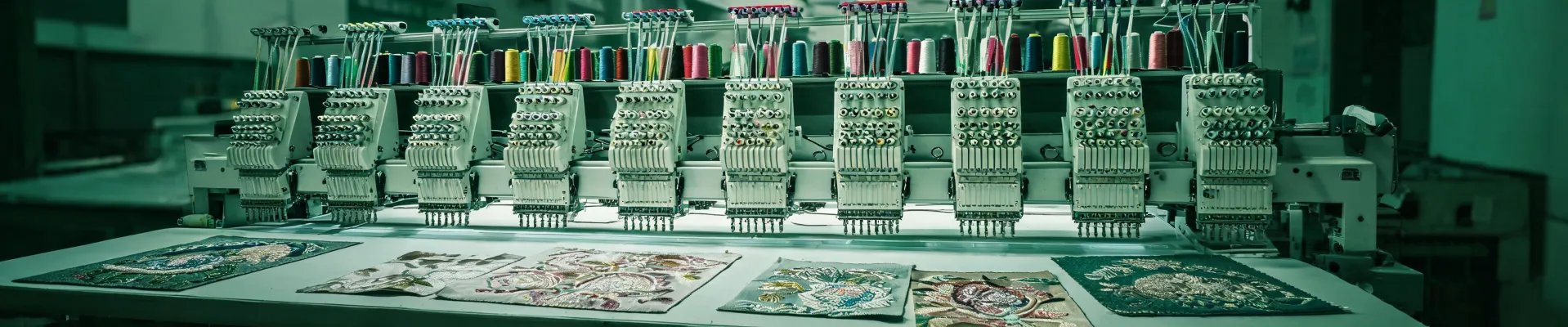
Why a Barudan 8 Head Embroidery Machine Won My Bidding Process: It Wasn't the Sticker Price
Posted on 2026-08-21 by Jane Smith
It was Thursday, March 6, 2025, and the accountant did not yell. That was the thing that worried me. She slid a one-page printout across the table and said, 'explain this.' The line item read 'Equipment upgrade - 8-head embroidery machine - $119,500.' I had signed that purchase order. I still believed it was the right call. But for a 14-person contract embroidery shop, a six-figure decision deserves a better explanation than 'it seemed right.'
The order that pushed us
Last October, a regional retailer asked if we could produce 4,800 fleece zip-ups with a left-chest logo, a small back design, and sewn-in labels. The due date was June. Our six-head machine could handle the volume if we ran nights, but only if nothing broke. I started looking for an eight-head before we committed.
Our sample room still uses a Husqvarna Viking for one-off proofs, the same machine type you'll see on the www.husqvarnaviking.com embroidery machine page. It's a good home machine. I have nothing against it. But you don't run 4,800 pieces on a home machine, and you don't build a production schedule on one either.
The search
I began with 'barudan 8 head embroidery machine,' because that's what our operators already know. Barudan embroidery machines have a reputation for reliability. The used market proves it. I've watched people sell them because they needed more heads, not because the machine was bad. That sort of resale value matters when I build a total-cost-of-ownership model.
One spec I kept seeing was 'hd embroidery machine.' I assumed it was marketing. It's not. The Barudan controller processes stitch data at a higher resolution, which means small lettering and dense gradients stay crisp. For 8 mm letters on a jacket back, that's not a luxury.
Three quotes, one real number
By January 31, I had three options. The authorized Barudan dealer quoted $119,500. The line items included delivery, rigging, installation, two-day operator training, a full hoop kit, one-year parts and labor, software updates, and a spare take-up lever. The only things missing were thread and the air compressor. I mentally checked 'air compressor' off as a later problem. That was a mistake.
The second option came from a reseller offering a comparable eight-head under a different badge. Base price: $84,000. That looked like a strong number until I asked the five words I now ask every vendor: 'What is not included?' The reply started with 'Good news, the machine is in stock.' Then it listed the items 'needed to get you running.'
- Freight and rigging: $3,100
- Installation: $5,400
- Operator training: $2,900
- Hoop kit: $4,800
- Software and USB dongle: $3,200
- One-year service contract: $5,900
- PC/network upgrade: $2,500
- Extended warranty (recommended): $4,800
- Unloading and crate disposal: $850
Total add-ons: $33,450. Final price: $117,450. That is $2,050 less than the Barudan. The 'cheaper' machine was almost exactly the same price once it was actually equipped to run. And unlike the Barudan quote, the reseller's list did not specify what the PC/network upgrade included or what the service contract covered.
The third option was a used Barudan eight-head for $59,000 plus shipping and inspection. The upside was substantial. The risk was an unseen maintenance history. I kept asking myself: is $60,000 in savings worth potentially missing a June deadline? The math said it might work. The schedule said it was a gamble.
The spreadsheet that made the decision
I've tracked every equipment purchase in a cost spreadsheet since 2019. I compared the three options using a simple TCO model. Used Barudan: best case $59,000, worst case $77,000 and three weeks of downtime. Reseller alternative: $117,450 with unknown service response time and unclear PC specs. Barudan dealer: $119,500 with every line item on one page.
I also used the FTC's truth-in-advertising principle (ftc.gov) as a sanity check. A price that requires three emails to become real is not a real price. B2B quotes aren't consumer advertisements, but the standard still works: if a vendor won't put the full number on the first page, the full number is probably going to hurt.
The decision became obvious. The upside of the reseller's machine was $2,050 in savings. The risk was a brand our operators didn't know, a support phone number that went to a salesperson, and a controller that might be hard to source parts for. I did not want to explain to a client that their fleece order was late because I saved two thousand dollars.
The decision and the doubt
We signed with the Barudan dealer on February 14. Even after signing, I second-guessed it. What if the reseller's machine was actually solid? What if I was paying a premium for a name? I didn't relax until March 28, when the crate arrived and the installer ran a 12-hour test with zero machine-caused thread breaks.
The HD capability proved out in production. The small lettering under the back logo looked clean on the 23rd piece, the 400th piece, and the 4,300th piece. Our older machines would have turned those letters into blobs by the end of a shift.
What got missed
I still kick myself for the air compressor. The Barudan spec sheet said it needed a continuous air supply. Our old compressor could hit the pressure but could not keep up with eight heads. We got a low-air alarm on day four and had to add a $3,100 auxiliary unit. The dealer had mentioned it. I had written it down as 'not a contingency.' It became a contingency in the worst way. If I had included it in the original budget, I wouldn't have had to fill out another purchase order in the middle of production.
The other thing I almost missed was the finishing department. The fleece order required sewn-in labels and a straight stitch finish on the cuffs. Our industrial sewing machine straight stitch units were functional, but one needed two new feed dogs and a timing check before production started. That repair cost $280. A colleague mentioned it offhand. Without that comment, an eight-head line could have been sitting idle waiting on a $280 part. (note to self: always audit the finishing department before buying a faster embroidery machine.)
What I'd do differently
I have mixed feelings about extended warranties, so I skipped the three-year extension the dealer offered. My logic was simple: if a machine is going to break, it usually breaks early, and the first year was already covered. So far, that logic is holding. But I acknowledge it's a bet.
If I were starting the search from scratch, I'd ask every vendor the same question on the first call: 'What is not included?' I'd ask for the maintenance log on used machines before looking at photos. I'd audit the air compressor before ordering. And I'd remember that a home embroidery machine can make a beautiful sample, but it cannot make payroll.
Barudan embroidery machines are not cheap. But in six weeks of eleven-hour days, the only mechanical issue we had was a thread break from a bad bobbin case. That's the reliability I was paying for. The transparent quote was just the first sign of it.

Jane Smith
I’m Jane Smith, a senior content writer with over 15 years of experience in the packaging and printing industry. I specialize in writing about the latest trends, technologies, and best practices in packaging design, sustainability, and printing techniques. My goal is to help businesses understand complex printing processes and design solutions that enhance both product packaging and brand visibility.