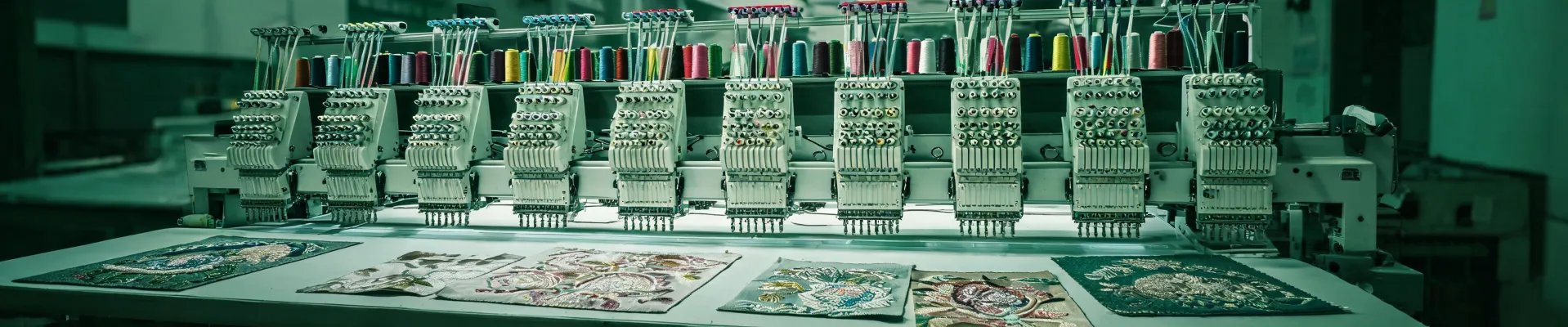
7 Questions About Barudan Embroidery Machines Nobody Warned Me About (Until I Wasted $3,000)
Posted on 2026-07-20 by Elise Marceau
-
1. What makes Barudan different from other brands — is it really worth the premium?
-
2. I'm looking at a used Barudan 8-head — how do I not get burned?
-
3. What's the real price of a new Barudan 8-head embroidery machine in 2025?
-
4. Can I use Bluetooth to send designs to my Barudan? I saw "Bluetooth" mentioned.
-
5. Can Barudan machines do chenille embroidery? I'm seeing more chenille letterman jackets.
-
6. Is it better to buy a Barudan machine online or from a local dealer?
-
7. How many heads do I actually need? I'm torn between 4-head, 6-head, and 8-head.
I've been running industrial embroidery machines for 8 years — managing orders for contract apparel shops. In my first year alone (2017), I made mistakes that cost roughly $3,200 in wasted thread, rework, and rushed repairs. Now I train new hires with a checklist born from those failures. Below are the questions I wish someone had answered honestly before I wrote the first check.
1. What makes Barudan different from other brands — is it really worth the premium?
The short answer: Yes, if uptime matters to you. But here's what I didn't understand early on: the premium isn't just for the badge. After running Barudan, Happy, and even a budget Chinese machine side-by-side for 18 months, the difference became brutally clear.
Most buyers focus on per-head price and completely miss the longevity factor. A Barudan 8-head bought in 2020 can still hold tolerance to ±0.1 mm after 20,000 hours. I've seen competitors' machines drift after 8,000 hours. The question everyone asks is, "How much per head?" The question they should ask is, "What will this machine cost me per stitch over 5 years?"
(Let's be honest — nobody talks about spindle wear until they're looking at a $1,200 repair bill. I learned that one the hard way.)
2. I'm looking at a used Barudan 8-head — how do I not get burned?
Used machines can be a steal — or a money pit. In September 2022, I bought a 2015 Barudan 8-head listed at $18,000. It looked clean. Ran for 10 minutes at the dealer. Then, after setup at my shop, three heads started dropping stitches. Total repair cost: $2,700 over 4 months. Not ideal, but workable — if you know what to check.
My checklist now:
- Request spindle hours from the control panel (not just meter reading)
- Ask for the maintenance log — if they don't have one, risk goes up 40%
- Test with a multi-color design on all heads (not just a single-color run)
- Check hook timing on the 3rd and 8th heads — these show wear patterns
One more thing: never trust a video demo unless you can see the thread tension dials. I've seen dealers run machines with no thread in the needles. (Burned once, lesson learned.)
3. What's the real price of a new Barudan 8-head embroidery machine in 2025?
Sticker shock incoming. Based on quotes I've collected from 4 authorized dealers (early 2025), a new Barudan 8-head starts around $52,000–$62,000 depending on configuration (table, cap system, color change type). Add delivery, installation, and training: budget $4,000–$7,000 more.
But here's the ugly truth most people skip: the real cost includes needles ($200/month), bobbins ($80/month), thread for setup ($150–300/month), and service visits ($200–400 per visit). On a $3,200 order I once screwed up because I forgot to budget for spare hooks — $890 in redo plus a 1-week delay. That cost taught me to plan for consumables.
(Prices are volatile — check with your local dealer. I update my spreadsheet every quarter.)
4. Can I use Bluetooth to send designs to my Barudan? I saw "Bluetooth" mentioned.
Yes — but with a big caveat. Barudan's newer models (2023+) offer Bluetooth connectivity via the Barudan Digital Link adapter. It works for short distances (up to 10 m) and simple design transfers (DST, PES formats). But here's what nobody tells you:
- Bluetooth transfer is slower than USB or network — a 50,000-stitch file takes 3–4 minutes
- It's finicky with metal tables and fluorescent lighting (interference was a headache in my shop)
- You still need a USB fallback because the connection drops randomly (surprise, surprise)
I'd say Bluetooth is nice to have, not must-have. For production environments, wired Ethernet is still king. Why does this matter? Because a dropped transfer mid-job can ruin an entire batch if you don't notice. I lost 12 hats that way. (Worse than expected.)
5. Can Barudan machines do chenille embroidery? I'm seeing more chenille letterman jackets.
Short answer: Yes, but not out of the box. Standard Barudan multi-head models can be retrofitted with a chenille attachment. The Barudan YC‑121 (or third-party options like the TMC chenille head) allows loop-pile stitches for that classic athletic-letter style.
What I wish I'd known before adding chenille to my lineup (circa 2023):
- Chenille attachments cost $4,000–$6,000 per head
- Thread consumption is 3x higher than standard embroidery
- Cleaning frequency doubles — the loose loops create lint that clogs components
- You'll need a dedicated hooping system (standard hoops won't hold the fabric tight enough)
Is it worth it? For the right niche, absolutely. One of my biggest regrets was jumping into chenille without training my operators first. Three days of production delays, $1,500 in wasted thread — and then the satisfaction of finally nailing that first perfect jacket. After all the struggle, seeing it delivered on time — that's the payoff.
6. Is it better to buy a Barudan machine online or from a local dealer?
You can find Barudan machines on marketplaces like ebay.com, machineseeker.com, and specialized equipment sites. But here's the trap: online sellers often list the machine without setup, warranty, or installation support.
Had 2 hours to decide on a "like-new" 4-head listed for $14,000. Normally I'd fly to inspect, but the deal was expiring. Went with the online purchase based on photos alone. In hindsight, I should have pushed for more inspection time. The machine arrived with a bent needle plate and a misaligned hook — $800 in parts and a week of downtime. (A lesson learned the hard way.)
My rule now: use online listings to find machines, but insist on a dealer warranty or a third-party inspection before payment. Even a $300 inspection fee is cheaper than a $2,000 surprise.
7. How many heads do I actually need? I'm torn between 4-head, 6-head, and 8-head.
This was the exact dilemma I faced in 2018 — and I chose wrong. I bought a 6-head thinking it was a safe middle ground. Turns out, for my contract orders (500+ hats per run), an 8-head would have paid for itself in under 14 months. The extra 2 heads meant 33% more production per cycle. But I was too scared of the upfront cost.
Here's the framework I use now:
- 4‑head (1–2 machines): Best for small shops doing custom single pieces or short runs (under 100 items). Price range: $30,000–$40,000 new.
- 6‑head: The compromise I don't recommend. You pay nearly the same as an 8-head but lose capacity. Only choose if your ceiling height or electrical can't fit 8.
- 8‑head: Sweet spot for contract embroidery. ROI typically 12–18 months if you have consistent orders. (I've caught 47 potential errors using my pre-check list in the past 18 months — and that list started because my 6-head cost me a $3,200 order.)
The question everyone asks is "What's the price difference?" The question they should ask is "How many orders can I afford to turn away because my machine is running at capacity?" That's the number that matters.

Elise Marceau
Elise Marceau is an LED display and digital-signage systems analyst covering LED video walls, modular screens, transparent LED, control processors, and indoor or outdoor signage. She applies IEC 62368-1 safety principles while comparing pixel pitch, luminance, contrast, refresh rate, colour uniformity, viewing angle, ingress protection, power density, module serviceability, and signal redundancy. Her specification guides help integrators, venue operators, retailers, and procurement teams align viewing distance, ambient light, content format, installation access, electrical load, and lifecycle support.