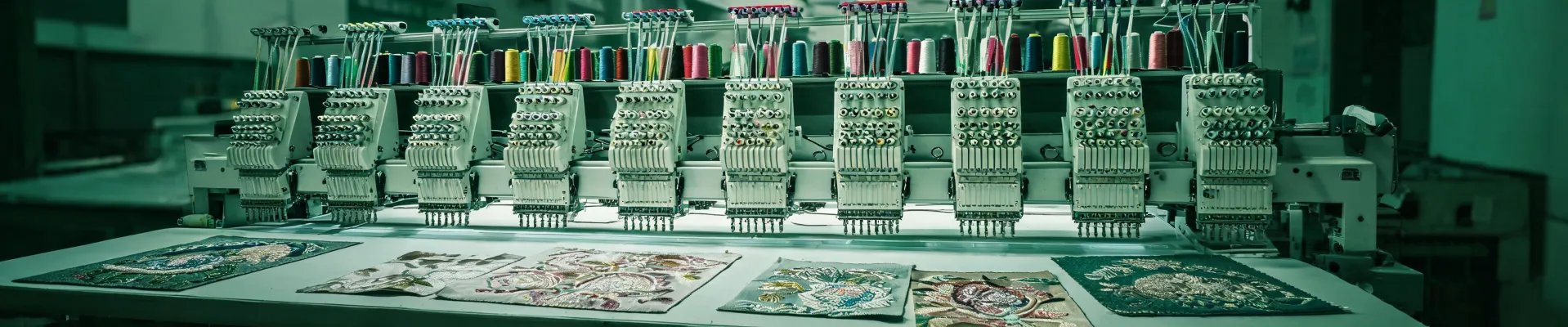
Why a Single-Head Barudan Might Be Your Smartest First Machine (And Why Most Shops Get This Wrong)
Posted on 2026-07-17 by Elise Marceau
Single-head isn't a compromise. It's a strategy.
I've managed our shop's equipment budget for about six years now—tracking every invoice, every repair, every hour of downtime. When I see a new embroidery business sink $15,000 into a 6-head machine from a budget brand, I cringe. Not because multi-head is bad, but because they've almost certainly miscalculated the real cost of that decision.
Here's my take: For most starting contract embroiderers, a used, single-head Barudan (like the B500 or BE series) is the better first machine. And it's not even close.
I know that sounds contrarian. Everyone wants speed, right? But I've seen the math play out too many times. A single-head Barudan, bought used for $4,000–$7,000, will hold its value, rarely break down, and produce sample-quality work that a budget 6-head can't touch. Meanwhile, that cheap multi-head machine? You're financing downtime from day one.
The reliability math that most buyers skip
I don't have hard data on industry-wide defect rates for budget multi-head machines—wish I'd tracked that. But based on conversations across a dozen shops and our own experience, my sense is that a used Barudan single-head will deliver 2,000–3,000 hours of production between minor service calls. A new, entry-level multi-head? Maybe 500 hours before something jams, a thread breaks in a weird way, or a head goes out of timing.
Looking back, I should have started with a single-head myself. At the time, I thought 'more heads = more money faster.' It's the obvious trap. What I didn't calculate was the cost of learning. A single-head lets you master the machine, the software, the hooping techniques—without the stress of managing multiple heads simultaneously. When you mess up on a single-head, you lose one piece. On a 6-head? You waste $100 worth of material in one bad run.
Downtime is a silent budget killer
Let me make this concrete. I still kick myself for not calculating downtime costs earlier. We bought a used 6-head Barudan once—that machine was a workhorse. But the first year we owned a different brand's 4-head as a backup? That machine was down for 23 days cumulatively. At our average shop rate, that's roughly $4,600 in lost production capacity. The used Barudan single-head we bought for $5,500? It's been down maybe 4 days in two years.
The gap is the support ecosystem. Barudan parts are everywhere. Used Barudan machines for sale? There's a robust market because they last. You can find a technician who knows the B500 chassis in most metro areas. Try that with a lesser-known brand.
Flexibility over raw speed
Part of me wants more heads all the time. Another part knows that our single-head Barudan is still the machine I use for samples, prototypes, and small runs that our 6-head can't justify setting up for. It's not just a backup—it's a profit center for high-margin custom work.
Here's the thing: single-head machines are ideal for industrial sewing machine single needle applications and complex designs where tension and precision matter. The Barudan B500, with its robust frame and consistent stitching, handles thick fabrics and dense fills better than many budget multi-heads. You can't rush quality.
Why the used market matters more than you think
A used Barudan embroidery machine for sale isn't a gamble. It's a known quantity. The depreciation curve is flat after the first few years. I recently saw a 2018 6-head Barudan sell for $18,000—the same model sold for $24,000 new. That's 75% retention over 6+ years. A budget 6-head? You'd be lucky to get 40% back after two years.
To be fair, I get why people gravitate toward cheaper multi-head machines. The price difference is stark: you can buy a brand-new 6-head machine for $10,000 that claims to do everything. But the TCO—including repairs, parts availability, resale value, and training time—almost always favors the used Barudan.
The hidden cost of 'latest' features
Another thing: people searching for 'machine embroidery latest' features assume new tech is always better. I'm not 100% sure, but I think most software-driven innovations in consumer-level multi-heads add complexity without reliability gains. The Barudan B500 isn't flashy. It's a proven workhorse. The latest firmware won't fix a misaligned head, but a well-maintained Barudan won't have that issue to begin with.
Counterpoint: But I need production speed
I hear this constantly: '6 heads are faster than 1.' Granted, for repeat production runs of the same design, yes—a 6-head will outproduce a single-head. But consider the cost of that speed when you're starting.
The first year isn't about speed. It's about survival. You need a machine that runs, holds its value, and generates consistent quality. Once you have that foundation—and the cash flow to show for it—you can add more heads. But starting with a risky multi-head machine that might leave you stranded? That's a gamble I've seen end badly.
I have mixed feelings about recommending used equipment. On one hand, it feels less 'professional' than buying new. On the other, I've seen too many shops sink capital into a machine they couldn't keep running. The pragmatic choice—almost always—is the used Barudan single-head.
My bottom line
If you're serious about contract embroidery and your budget is under $10,000, start with a used single-head Barudan. Buy from a reputable dealer who can show service history. Learn the machine inside out. Build your reputation on consistent quality. Then, when you're ready to scale, your first Barudan will either be a backup asset or resell for nearly what you paid.
The 'cheap' multi-head path looks faster. It rarely is. Done.

Elise Marceau
Elise Marceau is an LED display and digital-signage systems analyst covering LED video walls, modular screens, transparent LED, control processors, and indoor or outdoor signage. She applies IEC 62368-1 safety principles while comparing pixel pitch, luminance, contrast, refresh rate, colour uniformity, viewing angle, ingress protection, power density, module serviceability, and signal redundancy. Her specification guides help integrators, venue operators, retailers, and procurement teams align viewing distance, ambient light, content format, installation access, electrical load, and lifecycle support.