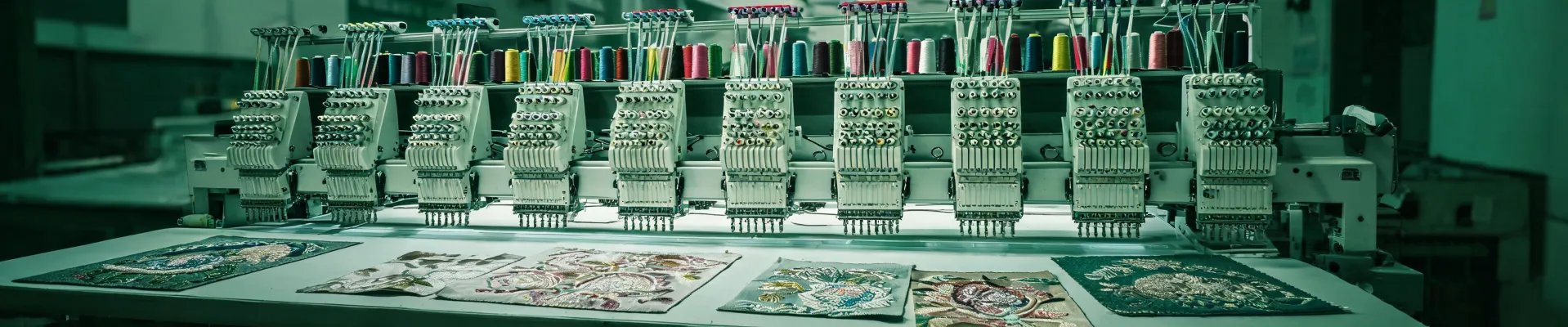
8 Questions About Barudan Embroidery Machines I Wish I'd Asked Before Buying
Posted on 2026-07-22 by Elise Marceau
-
1. Is a Barudan single-head embroidery machine worth it for a small shop?
-
2. How many heads should I get—4, 6, 8, or 12?
-
3. How do I set up the Barudan logo or my own logo on the machine?
-
4. What about beaded embroidery machines? Can I do beadwork on a Barudan?
-
5. What lubricant should I use for my Barudan embroidery machine?
-
6. How do I choose between a sewing and embroidery combo machine and a standalone industrial machine?
-
7. What about buying a used Barudan machine? Any gotchas?
-
8. Is Barudan really more reliable than other brands?
1. Is a Barudan single-head embroidery machine worth it for a small shop?
When I first started, I assumed a single-head machine would be a good entry point. I was wrong—at least for our volume. The Barudan single-head (like the BE-1201 series) is a solid machine, no doubt. But if you're running more than 200 pieces a week, you'll hit capacity fast. We bought a single-head in 2019, and within six months we were scrambling to outsource overflow. (Should mention: the single-head is excellent for samples, small runs, and personalized items. Just know your order volume before buying.)
2. How many heads should I get—4, 6, 8, or 12?
That depends on your order profile, not just budget. I used to think more heads = more profit. Reality check: a 12-head machine running 1,500 stitches per minute sounds great, but if half your orders are under 50 pieces, you're burning thread changes and setup time. For a typical contract shop doing 100–500 piece runs, a 6-head (like the Barudan BE-1206) hits the sweet spot. A 4-head works well if you do a lot of sampling. A 12-head? Only if you're churning out uniform orders of 1,000+ pieces. Our 8-head sits idle about 30% of the time—not ideal, but workable for peak season.
3. How do I set up the Barudan logo or my own logo on the machine?
This is something I messed up early on. The Barudan logo file (typically a .dst or .pes format) needs to be digitized properly. You can't just import a JPEG and expect it to stitch cleanly. We paid $85 for a rush digitizing job that came back with thread breaks everywhere. Lesson: always test your logo on scrap fabric first. Oh, and the machine's built-in fonts are fine for small text, but for a custom logo, invest in professional digitizing. If I remember correctly, we spent about $40 per design from a reliable digitizer—well worth it.
4. What about beaded embroidery machines? Can I do beadwork on a Barudan?
Straight answer: Barudan doesn't make a dedicated beaded embroidery machine. Their machines can handle sequins (with attachments), but true bead embroidery requires a different mechanism. I've seen shops try to retrofit, and it rarely ends well. The vendor who said "this isn't our strength—here's who does it better" earned my trust for everything else. If beadwork is your core business, look at Tajima's bead attachment or a specialist. We outsource our bead orders to a shop that only does bead embroidery. Focus on what you're best at.
5. What lubricant should I use for my Barudan embroidery machine?
I once saved $12 buying generic sewing machine oil from a big-box store. Big mistake. The machine started making a grinding sound within 200 hours. Barudan recommends their own lubricant (part #LUB-001 or similar), but any high-speed sewing machine oil that meets ISO VG 32 or 46 works—provided it's synthetic, stain-free, and has anti-wear additives. I switched to Mobil 1 synthetic (rated for industrial sewing) after a tech recommended it. Our head mechanic logs every oil change now. Cost: about $18 per liter. Don't cheap out on this. The repair bill for a damaged rotary hook was $890.
6. How do I choose between a sewing and embroidery combo machine and a standalone industrial machine?
This question comes up a lot, especially from people transitioning from home sewing. A combo machine (like a Brother Innov-ís or Janome) is fine for crafts and one-offs. But if you're running a business, a dedicated industrial embroidery machine like Barudan is the only route. Why? Speed, durability, and multi-head capability. Sewing-embroidery combos top out at around 1,000 stitches/min with a single head. Barudan runs 1,200–1,500 stitches/min per head. More importantly, commercial machines handle 8–10 hour shifts without overheating. We ran our 6-head for 14 hours straight during a rush order once—no issues.
7. What about buying a used Barudan machine? Any gotchas?
Used Barudans are everywhere—just search "used Barudan for sale" and you'll find dozens. They hold value well, but I've been burned. In 2022, I bought a used 4-head that looked pristine. The seller claimed 5,000 hours. After a week of intermittent thread breaks, we discovered the main board had been repaired with non-original components. Cost to fix: $1,200. Three things I check now: (1) Request a service log with hour meter photos. (2) Run a full stitch-out test with multiple colors. (3) Ask about the needle drive assembly—that's a common wear point. A reputable dealer will provide a 30-day warranty.
8. Is Barudan really more reliable than other brands?
Everything I'd read said Barudan is the gold standard. In practice, I've found it depends on how you maintain it. Yes, the frame construction is heavy-duty, and the head drive system is robust. But I've seen Tajima machines run just as reliably with proper care. The real difference? Parts availability and service network. Barudan has an extensive dealer network in the US (and globally), so you can get a replacement part within 48 hours. That matters when your order is due Friday. Is Barudan perfect? No. The touchscreen on our 2021 model gets slow after 4,000 hours. But I'd rather have a machine I can fix quickly than one that never breaks but takes two weeks to repair. That's the trade-off.
Oh, and one more thing: prices as of March 2025—new single-head starts around $8,000; a 6-head runs $35,000–$45,000. Verify current rates with your dealer. Don't quote me on the exact numbers, but that's what we saw last quarter.

Elise Marceau
Elise Marceau is an LED display and digital-signage systems analyst covering LED video walls, modular screens, transparent LED, control processors, and indoor or outdoor signage. She applies IEC 62368-1 safety principles while comparing pixel pitch, luminance, contrast, refresh rate, colour uniformity, viewing angle, ingress protection, power density, module serviceability, and signal redundancy. Her specification guides help integrators, venue operators, retailers, and procurement teams align viewing distance, ambient light, content format, installation access, electrical load, and lifecycle support.