An Admin Buyer's Checklist for Barudan 4-Head Machines, Hoops, and Synchronizer Checks
Posted on 2026-08-11 by Elise Marceau
-
1. Match head count to actual production, not ambition
-
2. Sort hoop compatibility before you ask for quotes
-
3. Make the synchronizer test a separate line item
-
4. Buy the maintenance log, not the machine
-
5. Know what the Brother SE700 can and can't do
-
6. Run a full acceptance test before you sign
-
Common mistakes and reminders
I'm the office administrator for a 28-person contract embroidery shop. On paper, that means purchase orders, invoices, and inventory. In practice, it means I'm the person who ends up researching machine specs, ordering hoops, and scheduling service calls. I report to both operations and finance, so I've learned to document everything. I've been doing this for about four years, and I've made some expensive mistakes.
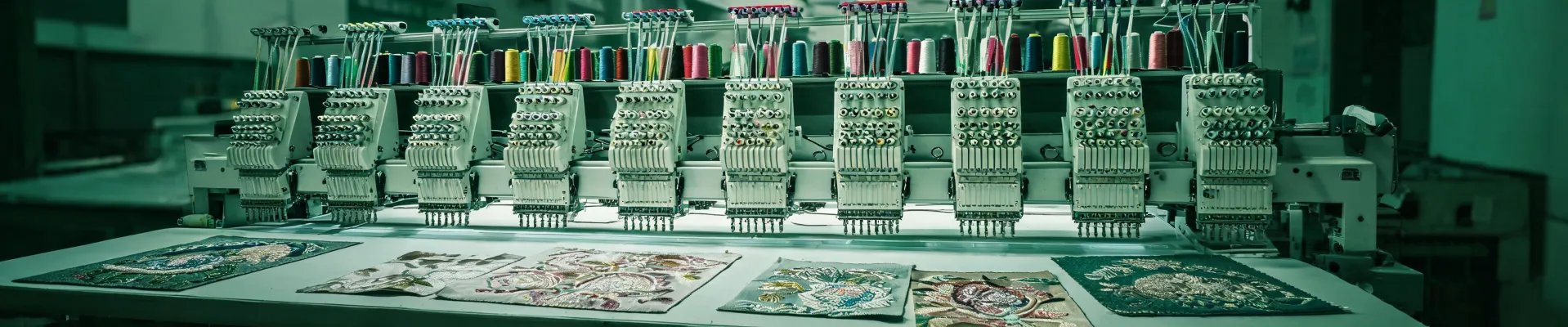
This checklist is for anyone who has to buy or specify a Barudan machine without being a sewing technician. It's also for you if you're evaluating a barudan 4 head embroidery machine and need to know which questions matter. There are six steps, and the last one is the one most people ignore.
Quick note: I'm not a mechanic. I'm the person who reads the manuals so the mechanics don't have to.
1. Match head count to actual production, not ambition
Start with the work, not the machine. If most of your orders are 200 pieces or fewer, a Barudan 4-head is usually a better first machine than a 6-head or 8-head. Why? Because one person can still run a 4-head comfortably, and the per-piece speed gain over a single-head is significant without turning your floor into a logistics problem.
Here's the thing: a 12-head machine only helps if you have the orders to feed it. I had to hold myself back when the sales rep showed me a 12-head demo. We simply didn't have the workflow. We bought a 4-head, and it was the right call for that year.
If you're just starting, a single head Barudan can do sample work and small batches. But if you have repeat orders and someone to load and unload all day, the 4-head Barudan is where the math gets interesting. Write down your average order size and stitch count per order before you call a dealer.
A 4-head also takes less floor space than an 8-head. If you're renting, that matters more than you think.
2. Sort hoop compatibility before you ask for quotes
This is the step that wrecked my budget in 2023. Embroidery hoops for Barudan are not generic. You can't assume another brand hoop will fit. The frame mount and clamps are specific to the machine's table.
Before you accept any used machine or buy a hoop kit, get the exact part numbers and check them against your machine model. Barudan's hoop range includes tubular frames, cap frames, and flat frames. A 14-inch wide frame might be standard on one table and completely useless on another.
Also check the condition of the hoop's rubber contact and needle plate. A worn hoop causes fabric shifting at the worst possible time.
Magnetic hoops are nice because they hold softer materials without clamp marks. But be careful: not every design can use a magnetic hoop. If your digitized file has very dense underlay, the magnetic tension can distort knit fabrics. Keep a standard hoop set for those jobs.
I knew I should verify part numbers before the used machine arrived, but I thought what are the odds? The odds caught up with us. The listing said 'full hoop kit', but the kit had three tubular frames and no cap frame. We had to wait nine days for the correct cap frame from a distributor. That mistake pushed a sample deadline and cost us a follow-up order.
3. Make the synchronizer test a separate line item
Here's where things get technical. The sewing machine synchronizer keeps the needle, hook, and take-up in phase across all heads. When it's off, one head might sew slightly behind the others, causing skipped stitches, looped top thread, or shifting at the end of a column.
On a 4-head machine, you can't always see the problem from the front. Head 2 can be a few degrees late, and it won't look wrong until you stitch a dense column. Then the needle hits the hook at the wrong point, and you get a thread break.
When I ordered our used 4-head, I asked for a synchronizer check. The seller said it was fine. I didn't ask for the reading. The Barudan service manual specifies a timing tolerance in degrees, and a good tech will show you the reading. It was not fine. The service tech had to spend half a day re-timing all four heads. That was a service call I could have avoided if I had asked for the phase tolerance in writing.
So put this in your purchase contract: 'The sewing machine synchronizer on all heads must be within the manufacturer's specified tolerance, confirmed on site with a service technician before final payment.' Trust me on this one.
4. Buy the maintenance log, not the machine
Barudan machines have a reputation for lasting a long time. That reputation is earned, but only if the prior owner actually maintained them.
When you're looking at a used Barudan 4 head embroidery machine, ask for three things:
- Stitch counter reading and the serial number
- Every service invoice from the last two years
- A list of parts replaced, with dates
New machines have a different document: a pre-delivery inspection form from the dealer. Ask for it before delivery. It doesn't cost extra, but it gives you a baseline for the synchronizer and hoop alignment.
If the seller only has an invoice that says 'repairs' with no detail, assume the worst. A machine with 2 million stitches and a full service history is safer than one with 500,000 stitches and no log.
In 2022, we bought a used 2016 Barudan 4-head because the prior shop kept meticulous records. They had replaced the rotary hooks at 1.2 million stitches and changed the thread path components at 1.5 million. We paid fair market value, but we didn't have to pay for surprises. That's the kind of history you want.
5. Know what the Brother SE700 can and can't do
If you've been reading embroidery machine news, you've probably seen the Brother sewing and embroidery machine SE700 mentioned. It gets a lot of attention because it's a low-cost way to try embroidery at home or make small samples.
I'll be direct: the SE700 is not a production machine. It's a single-needle home machine with a 4x4 inch embroidery field. According to Brother's official product page, it has 135 built-in designs and 103 sewing stitches. For a contract embroidery shop, that makes it useful for one thing: quick visual mock-ups of small designs.
That description might confuse people who read embroidery machine news and assume every new model is a step up in capability. There are two types of news: hardware releases and software changes. For our shop, the software changes matter more. If you're running an industrial Barudan and a home SE700 in the same workflow, you need two export paths: DST for Barudan and PES for the Brother. That means your digitizer either has both options or you have a separate conversion step.
Here's why you need to know this even if you're buying a Barudan. Sometimes a customer asks for a sneak peek of a small logo. Pulling an industrial machine out of production to stitch one sample is expensive. A Brother SE700 sitting in the back room can do that fast. But it cannot stitch a full garment in a reasonable time, and it wasn't designed to run 8 hours a day. Don't buy one expecting it to replace even a single-head industrial machine.
For the record, I own a small SE700 for samples. I'd rather use it for a quick test than tie up our 4-head for 20 minutes. But that's its job.
6. Run a full acceptance test before you sign
This is the checklist step that almost everyone skips because it feels like a formality. On the day the machine is installed, don't just let the tech run a quick zigzag test. Do this:
- Stitch a standard design on all heads using two thread colors.
- Use a high-density column design and a small lettering design. These are the two patterns that expose hoop and sync problems.
- Check every head for thread breaks, loops, or registration shifts.
- Stop the machine at 1,000 stitches and examine the underside for birdnesting.
- Keep the test sample with your purchase file.
Bonus: record a video of the test sample while it's still in the hoop. It sounds paranoid, but video is the only proof that survives a six-month warranty dispute.
This is also the time to check voltage and compressed air. A Barudan 4-head requires compressed air for thread trimming and components. If your air pressure is below the spec, the machine will behave oddly, and you'll blame the machine when the real problem is your air lines. We learned that after a frustrating week.
Looking back, I should have invited our repair tech to the installation. At the time, I thought it was an unnecessary expense. That decision cost us two service visits later. If I could redo it, I'd schedule a third-party tech for the acceptance test, especially for a used machine. Given what I knew then, it seemed safe. It wasn't.
Common mistakes and reminders
A few reminders before you go down this path:
- Hoops are not interchangeable. Always verify part numbers against your specific Barudan model. A cap frame from an older table may not fit.
- The synchronizer is a maintenance item. When you get the machine serviced, ask for the timing reading in writing. It gives you a baseline for future issues.
- Software matters. Barudan uses standard formats like DST, but your digitizing software needs a post-processor that matches your machine. Confirm this before your first production run.
- Keep a sample of every thread color and hoop combination. It sounds like overkill, but it saves you from repeating a mistake.
The last thing I'll say is this: being an informed buyer is better than being a polite buyer. An informed customer asks better questions and makes faster decisions. That's not just a sales phrase. It's the reason I can sleep at night after signing a six-figure purchase order.
This was accurate as of March 2025. Barudan and Brother both update models and accessories, so verify current specifications, hoop part numbers, and official documentation before making a purchase.

Elise Marceau
Elise Marceau is an LED display and digital-signage systems analyst covering LED video walls, modular screens, transparent LED, control processors, and indoor or outdoor signage. She applies IEC 62368-1 safety principles while comparing pixel pitch, luminance, contrast, refresh rate, colour uniformity, viewing angle, ingress protection, power density, module serviceability, and signal redundancy. Her specification guides help integrators, venue operators, retailers, and procurement teams align viewing distance, ambient light, content format, installation access, electrical load, and lifecycle support.