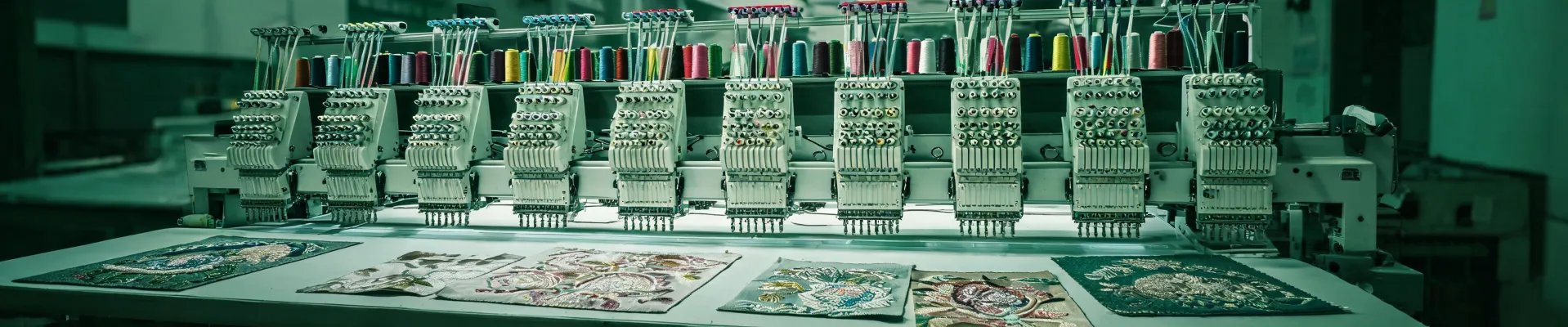
I Almost Bought a Cheaper Embroidery Machine. My Barudan Decision Changed My Shop
Posted on 2026-08-11 by Elise Marceau
I remember the exact moment I stopped being a price buyer. It was a Tuesday morning in October 2024. Our 8-head machine was down again, and I was staring at a spreadsheet that said the machine had cost us more in lost production over the past year than it cost to buy in the first place.
I'm the procurement manager at a 12-person contract embroidery shop. I've managed a $180,000 annual operating budget for the last six years. I track every invoice, every service call, every hour of downtime. That spreadsheet is the reason I ended up with a Barudan embroidery machine. It's also the reason I almost didn't.
Why the price tag almost won
When it became clear we needed to replace our old machine, I started where most people do: I searched for "Barudan embroidery machine for sale." Barudan machines have a reputation in the embroidery world, and I knew the name. But I didn't start with Barudan. I started with the budget. And that's almost where it went wrong.
I looked at three categories. The first was a used Barudan. The second was a new Barudan. The third was a set of lower-priced alternatives—including a ProEmb embroidery machine and an XTool embroidery machine. I'm not going to bash those brands here, because they have their place. But for the kind of production we run, they didn't add up the way I expected.
The lowest quote came in about 40% below the used Barudan. I'll be honest: I almost signed it. Actually, I did more than almost—I called the sales rep and asked him to send a contract. My boss saw me getting excited and said, "Show me the math." So I did.
The day the math changed
Why does this matter? Because the math proved I was about to make a mistake. I built a simple total cost model in the same spreadsheet I use for everything. It was based on quotes we collected in Q4 2024, so the numbers are real for us, but the market changes fast—verify current prices before you plan around them.
The model included:
- Base purchase price
- Freight and installation
- Training for our operators
- Expected maintenance over three years
- Estimated downtime cost at $185 per hour of loaded labor
- Resale value after five years
The "cheap" machine looked great on the base price. But it needed a third-party technician who lived two states away. Parts required a two-week wait. Training was an extra charge. No one could tell me what the resale value would be because, to be honest, there wasn't much of a used market for it. The Barudan dealer, on the other hand, had a local technician who could be at our shop within 24 hours. Parts were in stock. And the used Barudan already had buyers lining up before we even signed the check.
When I compared the quotes side by side—not sticker price, but five-year total cost—I finally understood why so many used Barudan machines are for sale. It's not because people are dumping them. It's because they hold value. You can run one for years, maintain it, and still sell it again. Try that with a machine no one is likely to support in a few years.
The surprise wasn't the price gap. It was how much hidden value came with the "expensive" option. The used Barudan included installation, basic training, and a service check as part of the sale. The cheaper machine didn't include any of that.
What we bought and what happened
We ended up buying a used 6-head Barudan. It still cost more than I wanted to spend. I remember telling my wife, "We just bought a used machine for the price of a new SUV." But then the machine arrived, and the numbers started moving in the right direction.
Over the first six months, our machine downtime dropped by about 70%. Our first-pass embroidery quality went up, which meant fewer redos. We stopped missing deadlines. In Q1 2025, our customer retention rate was the highest we'd ever measured. That last one might not sound like a machine stat, but it is. When you're making embroidered hats and jackets for a client's corporate event, the quality of the stitching is the product. If the thread is crooked or the color registration is off, the customer notices—even if they can't name why.
That's when I fully landed on the "quality is brand image" side of the argument. It's not about buying the most luxurious equipment. It's about the fact that your output is your face to the customer. A slightly higher machine cost is easy to measure. A damaged client relationship is not.
I still kick myself for one thing: I didn't push for a service contract when we bought the old machine years ago. If I'd done that, we might have avoided the emergency replacement in the first place. I treated a repair as a one-time problem instead of a recurring cost. That was a mistake I won't repeat.
What I'd do differently
If you're in the middle of your own equipment search, here's what I'd tell you:
Look, I'm not saying budget machines are always bad. I'm saying you have to calculate total cost, not just the price on the invoice. Include downtime, parts availability, technician access, operator training, and what the machine will be worth when you want to sell it. The machine that "saves" you money upfront can easily cost you more by the time you hit a production deadline and the parts aren't there.
And if you're searching for a "sale sewing industrial machine" at the same time? That's a different decision. I've bought industrial sewing machines too. The same rule applies: TCO beats sticker price. (Prices mentioned here were accurate as of Q4 2024. The market changes fast, so verify current quotes before budgeting.)
One last thing. I'm glad we chose Barudan, but I'm not a brand fanboy. If another manufacturer could prove their machine would run harder, get serviced faster, and hold a better resale value, I'd take a hard look. For us, Barudan simply won the spreadsheet. That spreadsheet is the reason I sleep a little better now when I hear the machines running.

Elise Marceau
Elise Marceau is an LED display and digital-signage systems analyst covering LED video walls, modular screens, transparent LED, control processors, and indoor or outdoor signage. She applies IEC 62368-1 safety principles while comparing pixel pitch, luminance, contrast, refresh rate, colour uniformity, viewing angle, ingress protection, power density, module serviceability, and signal redundancy. Her specification guides help integrators, venue operators, retailers, and procurement teams align viewing distance, ambient light, content format, installation access, electrical load, and lifecycle support.