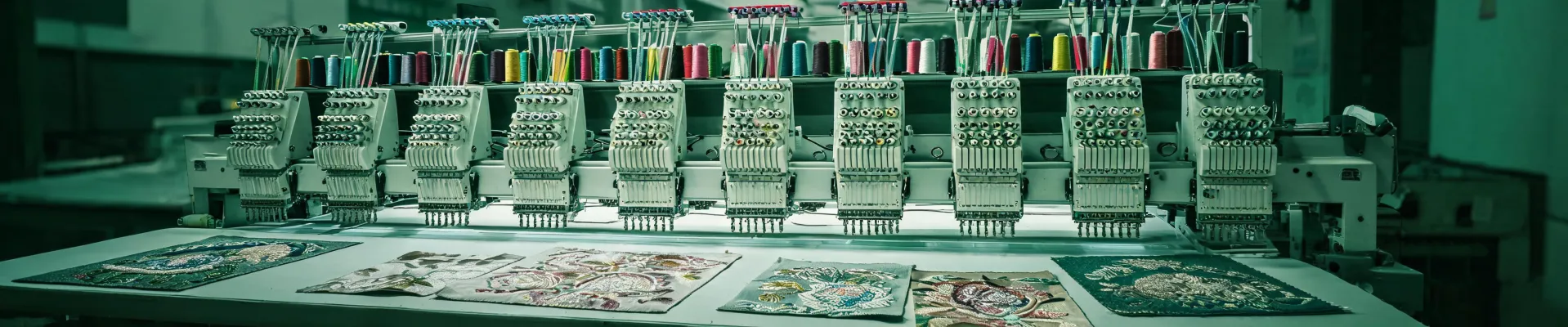
Barudan 6 Head Embroidery Machine: A Quality Manager's View Before You Buy for Your Workshop
Posted on 2026-09-07 by Elise Marceau
If your embroidery machine workshop needs consistent multi-head output, a Barudan 6 head embroidery machine is a strong choice—but only if you test it the same way you would test a cheaper machine. A reputable badge is not the same as a quality process.
I am a quality manager at a contract embroidery operation. I review roughly 2,000 pieces every week before they ship. In the Q1 2024 quality audit, 7.4 percent of first-article samples failed on registration, stitch formation, or hooping alignment. Those failures were not limited to one brand. They mostly came from machines that were purchased before stitch quality was properly verified.
It took me about four years and three machine purchases to understand that the lowest acquisition price was the weakest predictor of total cost. What I mean is this: a machine that drifts at the outer edge of the embroidery field or needs an extra rehoop on two percent of pieces is not cheaper at any price.
Why I look at total cost before I look at price per head
Price per head feels efficient, but it ignores what creates quality output: frame stability, tension repeatability, thread path design, and support response.
Purchase price + installation + tooling + training + scheduled maintenance + unscheduled downtime + rework + labor - realistic resale value = total cost.
Using that formula, a machine that is 30 percent lower on the quote can still be the higher-cost choice after two service calls and a rush redo. The machine with the lower number at signing is not necessarily the machine with the lower number at the end of the year.
I am not a technician, so I cannot walk you through a needle-bar adjustment. From a quality acceptance perspective, I care about the evidence a machine produces under production pressure. That evidence can be tested before you sign.
What I inspect before I recommend a Barudan 6 head embroidery machine
New or used, the starting point is the same. I ask for the machine to earn approval with a full multi-head stitch-out, not a one-head sample.
- Stitch out all six heads. Run the same design at the speed you plan to use in production. At least 10,000 stitches in two or three colors is a reasonable start.
- Check the full embroidery field. Measure registration near the center and near the outer edge. If any head drifts enough to be visible on a dense satin border, do not pass it.
- Use fabric close to your real production. A stable test run on stiff twill tells you little about stretch fabric or fleece.
- Ask for service records and a live run. If a seller of a used machine will not allow an independent technician to inspect it, walk away.
I have watched the best machine purchase decision happen when the buyer brought his own thread, hoop, and fabric to the demo. The dealer agreed. The buyer ran the design, measured the output, and then made an offer. I have also watched the worst kind of purchase: trusting a seller-provided sample from one head and then spending the first month trying to get six heads to match.
An embroidery machine workshop should write down this protocol before looking at a 'barudan embroidery machine for sale'. Otherwise, the quote drives the decision and quality becomes an afterthought.
First 30 days after installation
After a new 6-head machine is running, I track three numbers for the first 30 days: first-article failure rate, average time between tension corrections, and actual output relative to schedule. These numbers tell you whether the machine fits the workflow, not just whether it can stitch a sample. If the failure rate is above 3 percent in week two, I do not blame the operator automatically. I want to see whether the fault repeats on the same head, the same thread color, or the same design area.
It is not a showroom issue. A machine can look excellent in a demonstration and still struggle when it is expected to run eight hours with real deadlines. That is why the first month needs a review point, not a final payment that is already gone.
The Aveneer embroidery machine and Brother EMV embroidery machine question
Search results around a Barudan 6 head embroidery machine often include an Aveneer embroidery machine and the Brother EMV embroidery machine. I do not assume that Barudan is automatically better for every shop. The machine becomes better after it proves it can hold the quality standard you need.
I have not operated every Aveneer model or every Brother EMV model long enough to judge the whole category. A machine's value shows in the stitch-out, the support network, and the total-cost formula above, not in the brand alone.
Those searches usually come from someone trying to fit a machine into a budget. That is legitimate. But the same inspection method applies. If the lower-priced machine passes and the Barudan fails, choose the lower-priced machine. If the Barudan passes and the lower-priced machine cannot finish a full production simulation, the price gap is not the real problem.
When a Barudan 6 head embroidery machine is not the right fit
If your work is mostly one-off personalization and short runs, a 6-head machine can waste your day in changeover time. A single-head or smaller machine is a smarter fit. A 6-head earns its place when you have enough volume to keep the heads running and enough operator skill to balance tension across all of them.
Do not let me overstate the skill part. I have seen modest shops do excellent work because their workflow and inspection routines were disciplined, and I have seen shops with expensive machines burn through money because nobody checked the first fifty or hundred pieces. The machine is one part of the system.
If you are looking at a used machine, the same discipline applies. An older 'barudan embroidery machine for sale' with low stitch hours and a clean service history can be a sensible buy. An attractive price on a machine with unknown maintenance can become the highest-cost purchase in your workshop after head alignments, replaced thread paths, and lost production. Have a technician with embroidery-specific experience inspect it before the purchase, not during the first production week.
Even after we approved our last 6-head Barudan purchase, I kept second-guessing. What if our two shifts could not hold the same tension settings? The first weeks were tense. I only relaxed after we finished a 6,000-piece order at a 1.8 percent rework rate. The machine was right for us, but the process around it made the machine right.
If you choose a Barudan 6 head because of the name and skip the stitch-out test, you are treating quality as a logo. If you choose an Aveneer embroidery machine or a Brother EMV embroidery machine for the same reason, you are doing the same. The machine that earns the order is the one that proves itself in your workshop with your fabric, your people, and your target for rework.

Elise Marceau
Elise Marceau is an LED display and digital-signage systems analyst covering LED video walls, modular screens, transparent LED, control processors, and indoor or outdoor signage. She applies IEC 62368-1 safety principles while comparing pixel pitch, luminance, contrast, refresh rate, colour uniformity, viewing angle, ingress protection, power density, module serviceability, and signal redundancy. Her specification guides help integrators, venue operators, retailers, and procurement teams align viewing distance, ambient light, content format, installation access, electrical load, and lifecycle support.