Barudan 8 Head Embroidery Machine Price: What a Quality Inspector Would Ask First
Posted on 2026-09-07 by Elise Marceau
-
Barudan Machines: Match the Setup to Your Order Mix
-
Scenario 1: Small Runs, Quick Changes, and Lettering — Start With a 1501 Single-Head
-
Scenario 2: Repeated Batch Work — When an 8-Head Barudan Starts to Make Sense
-
Scenario 3: Long-Run Production — 12 Heads or Two 8-Heads
-
How to Inspect a Used 8-Head Before You Pay
-
Which Barudan Scenario Are You In?
I look at every embroidered piece before it reaches a customer—roughly 400 items a week in 2025. I've rejected a little over 2% of first-article samples this year because registration or stitch density did not match the approved master. That job changes how I read a search like "barudan 8 head embroidery machine price." The price is not the starting point; the setup is.
One filter before anything else: a Barudan industrial embroidery machine is not the same product as a lego vintage sewing machine or a home desktop unit. Those are hobby machines or collectibles. This guide is for commercial embroidery businesses, contract embroiderers, and apparel makers.
Most commercial shops fit into one of three scenarios: small-run lettering, repeated batch work, or long-run production. Each needs a different head count, and each has a different sensible budget.
Barudan Machines: Match the Setup to Your Order Mix
When I help evaluate a production line, I use three factors:
- Average pieces per run. This single number rules out more machines than any budget.
- Color changes per design. More colors mean more needle changes, not necessarily more heads.
- Changeovers per shift. If you set up more often than you sew, head count is not your bottleneck.
An 8-head Barudan can produce eight garments at once. That's excellent when the design is loaded and you have 400 caps to finish. It's a very expensive shelf when you change designs every 15 minutes. Different businesses should not buy the same machine.
Scenario 1: Small Runs, Quick Changes, and Lettering — Start With a 1501 Single-Head
If your typical order is under 25 pieces—names for team rosters, sample hats, monogrammed bags—a multi-head machine is usually the wrong starting point. Look at a single-head with 15 needles. In Barudan machine listings, this is often called a 1501 embroidery machine: 15 needles, one head. That needle count lets you run multicolor lettering and small logos without stopping to rethread after every color change.
I hear from people who search for an "embroidery letters machine." A Barudan does not work like a typewriter with letters on a keyboard. The lettering is digitized in your production software. The machine's job is to stitch that file cleanly. A 1501 class machine is the practical entry point because 15 needles cover the color combinations a lettering shop normally sees.
One common mistake is treating hoops and registration tools as optional add-ons. We tried to save $1,200 on hoop sets for a single-head line and spent the saving again on wasted caps after the hoops shifted. Cheap hoops were the expensive part of that project. The machine was fine.
Is scenario 1 ever wrong? Yes—if within a year you expect to run the same design in 200-piece quantities, a 1501 will become your sample or overflow machine. But for typical custom lettering, start with the smaller setup and add heads when the order book proves you need them.
Scenario 2: Repeated Batch Work — When an 8-Head Barudan Starts to Make Sense
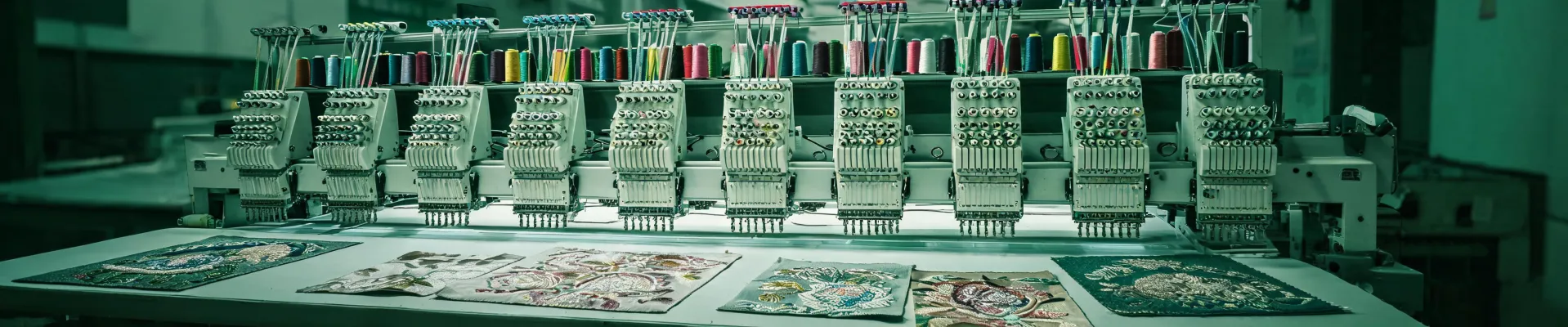
If your week depends on 100- to 500-piece runs of the same school logo, corporate emblem, or cap design, an 8-head Barudan should be on your shortlist. Eight heads mean you get eight pieces per cycle. Even more important: after the test run, all eight heads should match the approved sample. Consistency is easier to control when one operator runs one tested file on one machine. That is the quality story behind the head count.
Let's talk about the "barudan 8 head embroidery machine price" specifically. I keep these ranges in my notes from public listings reviewed in January 2025:
- Used 8-head Barudan machines in fair operational condition: roughly $28,000-$55,000, depending on age, controller, stitch count, and included cap and hoop systems.
- New 8-head machines with a factory warranty and installation support: usually $75,000-$110,000.
Current quotes will vary. Do not treat the range as a firm quote. When you see an unusually low price, ask why. The owner might be retiring and pricing to sell, or the machine might need $8,000 of service work. A test run on all heads with your own materials tells you which one it is.
I almost bought a used 8-head that looked honest at $31,000. During the test, heads 3 and 7 had noticeably different tension, and my technician found a rotary hook timing issue. The seller said "every machine needs tuning"—not this much tuning. We walked away. The machine we bought later cost $3,400 more and had a full service log. Dodged a bullet.
While we're on quality: check thread colors against the approved physical sample, not a screen. A Pantone reference helps, but embroidery thread and substrate change perception. The physical sample is your truth.
Scenario 3: Long-Run Production — 12 Heads or Two 8-Heads
When orders repeat at 1,000 pieces or more, a 12-head machine is the usual answer. It gives you 12 pieces per cycle instead of 8. But I would rather see a planner compare a 12-head against two 8-heads. For a similar investment, two 8-heads give you schedule flexibility: run two different jobs, split colors, keep one machine going while the other is serviced. Downtime costs more per hour than a machine payment.
At this level, efficiency is not about machine speed. It is about workflow. Automating order entry and scheduling cut our turnaround from five days to two. It also made quality checks easier because the operator never guessed which file, hoop, or thread color was next. That is the advantage of an efficient process: it removes the errors that used to show up late in production.
The old-school approach of buying one giant production machine can be right. But I have seen enough maintenance events to value split capacity when the business can absorb it.
How to Inspect a Used 8-Head Before You Pay
If you are comparing used Barudan machines, put these items on your checklist:
- Total stitches and service records. Stitch count is closer to actual use than engine hours.
- Controller model and data-transfer method. Are your design files compatible before you buy?
- Hoop sizes and cap frame compatibility. Confirm they fit your actual products.
- One full test run on all heads with your own fabric, backing, thread colors, and digitized file.
A used machine can be a great value. It can also cost more in downtime than the new one you avoided. Check the things that affect stitch quality, not the paint.
Which Barudan Scenario Are You In?
If you are still on the fence, look at the last 30 to 60 days of orders:
- Average pieces per order under 25, with design changes every hour or two? Start with a single-head 1501 class machine. Head count is not your constraint; setups are.
- Average pieces per order from 100 to 500, repeating monthly? Start with an 8-head Barudan and make the test run part of the deal.
- Average pieces per order over 500 on stable schedules? Compare one 12-head against two 8-heads using your projected utilization, not today's backlog.
The right Barudan setup is the one that lets your quality team say yes to production without guessing. That is the same reason I reject a bad first article: a pattern that slips now will slip at scale. Buy the machine that keeps the pattern stable, and the price becomes an easier conversation.

Elise Marceau
Elise Marceau is an LED display and digital-signage systems analyst covering LED video walls, modular screens, transparent LED, control processors, and indoor or outdoor signage. She applies IEC 62368-1 safety principles while comparing pixel pitch, luminance, contrast, refresh rate, colour uniformity, viewing angle, ingress protection, power density, module serviceability, and signal redundancy. Her specification guides help integrators, venue operators, retailers, and procurement teams align viewing distance, ambient light, content format, installation access, electrical load, and lifecycle support.