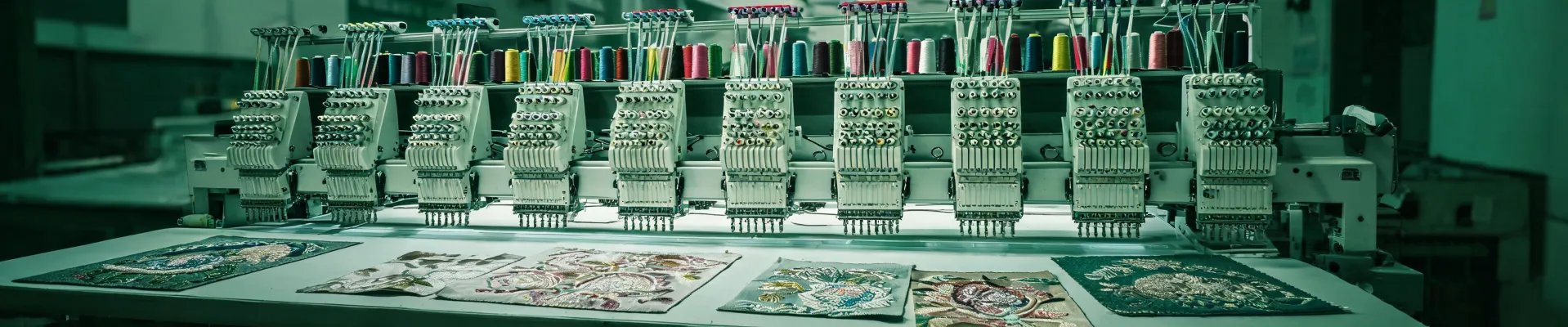
Barudan 6 Head Embroidery Machine vs. Prosumer Machines: Lessons From 70 Rush Orders
Posted on 2026-08-10 by Elise Marceau
In my role coordinating production for a contract embroidery shop, I've learned that rush orders are won or lost before the deadline appears. A Barudan 6 head embroidery machine is, in most production scenarios, the difference between delivering and apologizing. I can say that because I've handled 70+ emergency rush jobs in eight years—including same-day turnarounds—and last quarter alone, we processed 47 rush orders with 95% on-time delivery. Prosumer machines have their place, but for commercial deadlines, they're usually not it.
That position isn't based on hype. In March 2024, a client called 36 hours before a corporate awards dinner needing 48 embroidered shirts. Normal turnaround is five to seven business days. We put the order on a 6-head Barudan, paid an extra $230 for rush garment delivery, and delivered finished shirts at 3:45 the following afternoon. The alternative was blank shirts at the event and losing a $14,000 annual contract. When I think about whether an expensive machine is worth it, that's the number that sticks.
What Rush Orders Actually Test
From the outside, rush orders look like they're about speed. The reality is they're about staying up. In production, the bottleneck is rarely the maximum stitch rate. It's the time lost to hoop changes, thread breaks, tension headaches, and a mechanical issue that shows up at 11 p.m. when no technician is in the building.
Why does that matter? Because a prosumer embroidery machine is designed for flexibility, not continuous production. It's a good entry point. But when a customer needs 72 caps by Friday, you don't want a machine that needs attention every twenty minutes. You want a machine that can run a full jacket back without deciding to tangle its bobbin on the lower left corner. That's why I use the phrase 'time certainty premium' when I talk about industrial embroidery equipment.
How I Triage a Rush Order
When I'm triaging a rush order, I ask three questions in order. First, how many pieces need to be done and by what time? Second, how many of those pieces are already prepped—hooped, backed, and ready? Third, which machine can run the job without a shutdown halfway through? If the answer to the third question is a prosumer machine, I get nervous. If it's a Barudan 6 head, I feel a lot better.
The order of those questions matters. Most people start with 'Can this machine handle the design?' But in a rush, the design is usually easy. The hard part is the production flow. A complex logo on a cap is not what kills a tight deadline. The killer is an unprepared hoop, a wrong needle size, or a machine that decides to stop at 10 p.m. So before I touch a design file, I check the machine and the accessories.
The Prosumer Question: What About the Brother PE545?
Let's talk about the Brother PE545 embroidery machine, because it comes up a lot. It's a popular prosumer embroidery machine, and I understand the appeal. It's accessible, it doesn't require a workshop, and it's easier to learn than a multi-head industrial unit. I've also seen it used for small personalization jobs, sample work, and one-off gifts. For that, it's a fine tool.
The problem is when you try to turn a prosumer machine into a production machine. It's tempting to think you can buy two or three and run the same number of pieces. But the math ignores the hidden costs: every additional machine means another hoop-up, another operator, another set of tension settings, another thread break to hunt down. In a rush, that's not extra capacity. That's extra risk.
I want to be clear: I'm not here to bash the PE545. I'm here to say it's the wrong tool for a different job. If you're operating a business with real deadlines, the choice between a prosumer model and a Barudan 6 head isn't about stitching quality. It's about whether you can get six garments off the machine at once and walk away for twenty minutes.
Why the Barudan 6-Head Wins in a Deadline
Barudan's published machine lineup includes configurations from 1 to 12 heads. As of early 2025, that still holds true. The 6-head sits in a practical middle ground: enough capacity to handle a serious order, but not so many heads that you need a warehouse. For my shop, it's become the first choice whenever a customer says 'I need this sooner than your standard lead time.'
Here's the counterintuitive part: a 6-head machine isn't about higher stitch speed. It's about completing a whole set of garments in one cycle. Instead of hooping a single item, waiting, removing it, and starting over, one operator manages six pieces at once. That means fewer starts, fewer stops, fewer opportunities for something to go wrong. In rush production, every reduction in changeover time is a reduction in uncertainty.
There's also a maintenance angle. Barudan machines are known for reliability, and reliability is what creates predictability. Our 6-head has been running for years with scheduled maintenance as the main interruption. I'm not saying it never needs service. I'm saying that when the deadline is real, I know what to expect from the machine.
The Quiet Hero: Accessories for Embroidery Machine
If you're putting together a production setup, don't forget the accessories for embroidery machine. The machine gets the glory, but the hoops, backing, needles, and bobbin cases are often the reason a rush order succeeds. A wrong hoop can misalign a cap. A cheap backing can cause pulling that turns a four-hour job into an eight-hour redo.
In 2023, we switched to Barudan magnetic hoops after struggling with a cap order that took twice as long as it should have. Magnetic hoop setup saved about 15 minutes per job. On a day with three rush orders back to back, that's almost an hour. That's not a convenience. That's capacity.
My advice: if you buy a Barudan 6 head, order the accessories at the same time. Get the hoops you know you'll need, the right needles, and enough backing for your first batch. It's a larger upfront cost, but it's exactly the kind of certainty that pays for itself when the customer says 'by Friday.'
What I Wish I'd Done Differently
Looking back, I should have argued for the 6-head earlier. At the time, the budget owner kept comparing the price to a single-head machine and couldn't see the difference. We tried to make do with additional single-head machines, thinking it gave us flexibility. It gave us more setup time, more thread changes, and more stress.
If I could redo that decision, I'd invest earlier and skip the 'let's try to make it work' phase. But I'll also be honest: I understand the hesitation. A Barudan 6-head is a real investment. It doesn't make sense for a hobbyist or for a shop that only does occasional customization. I'm not going to tell you to buy one if your volume is a handful of orders a month.
When a Prosumer Machine Is the Right Answer
If you're just getting started, if you're doing gifts and samples, or if you're testing designs before they go into production, a Brother PE545 or a similar prosumer machine is a reasonable place to start. It won't give you the same production flow, but it also won't demand the same learning curve or capital. For low volume and high variety, it's often the intelligent choice.
The line gets crossed when customers start having deadlines. The moment you miss one—or come close—the conversation changes. We missed a deadline in 2021 because I tried to stretch a prosumer machine beyond its comfort zone. It cost us a client and a $4,000 order. That was the moment our policy became 'if it has to be done on time, use the machine that gives you time certainty.'
So here's my final take. For production, for commercial embroidery, and for any job where 'probably on time' isn't good enough, the Barudan 6 head embroidery machine is the tool I choose. For samples, side projects, and one-offs, a prosumer embroidery machine like the Brother PE545 is fine. The key is knowing which side of that line you're on before the phone rings. Because when a customer calls in a rush, you don't get to define a new workflow. You only get to use the one you built.

Elise Marceau
Elise Marceau is an LED display and digital-signage systems analyst covering LED video walls, modular screens, transparent LED, control processors, and indoor or outdoor signage. She applies IEC 62368-1 safety principles while comparing pixel pitch, luminance, contrast, refresh rate, colour uniformity, viewing angle, ingress protection, power density, module serviceability, and signal redundancy. Her specification guides help integrators, venue operators, retailers, and procurement teams align viewing distance, ambient light, content format, installation access, electrical load, and lifecycle support.