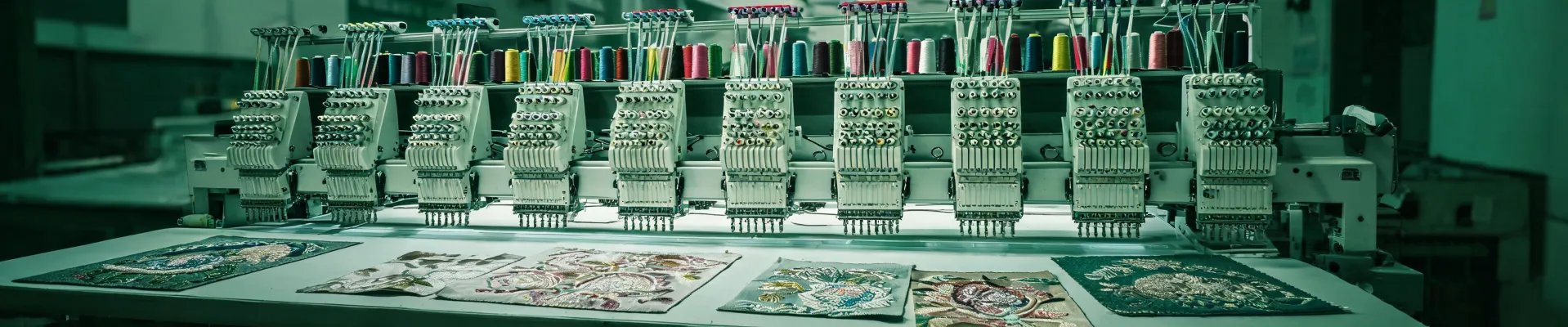
The Barudan Embroidery Machine Price Is the Least Interesting Number
Posted on 2026-08-07 by Elise Marceau
-
Price Is What You Pay Before the Machine Actually Works
-
Efficiency Is the Only Number That Matters
-
The B500 Embroidery Machine Became Our Emergency Machine
-
Free Machine Embroidery Fonts Aren't Free in Production
-
What to Watch For When You Buy an Embroidery Machine Online
-
Fine, But Isn't Barudan More Expensive?
-
The Real Cost of Inefficiency Shows Up Under Pressure
-
Stop Asking About Barudan Embroidery Machine Price
If your first question is 'what's the lowest Barudan embroidery machine price?' you're already asking the wrong question.
Let me be direct. I've spent 12 years running production for a contract embroidery shop. I've handled 300+ rush orders, including same-day turnarounds for corporate apparel clients. When I'm triaging a rush order, I don't think about what a machine cost to buy. I think about what it costs to operate when everything is on fire. Based on our internal data from 300+ rush orders, most delays happen before the first stitch. Last quarter alone, we processed 47 rush orders with a 95% on-time delivery rate.
Price Is What You Pay Before the Machine Actually Works
Barudan embroidery machine price is the first number everyone sees—and the one that tells you the least. As of January 2025, used 6-head Barudan machines were listed between $25,000 and $60,000 on major embroidery equipment marketplaces (Source: marketplace listings, January 2025). New multi-head configurations can push well past $150,000. Verify current prices before you make a decision.
It's tempting to think the price is the main difference between embroidery machines. That's a simplification. The machine is only as good as the support around it.
Most buyers focus on the sticker price and completely miss the costs that show up later: parts availability, dealer support, and how fast a machine can change over between jobs. The question everyone asks is 'What's your best price?' The question they should ask is 'What happens when a hoop breaks on a Friday afternoon?'
If a 12-head machine is down for one day, that's not just a repair bill. That's lost production capacity. At a conservative $80 per hour shop rate and an 8-hour day, the downtime costs $640 before the first part is ordered. Repeat that a few times a year, and a 'cheaper' machine stops being cheaper.
This is why we standardized our floor on Barudan. I'm not saying they never break. I'm saying the support network and parts availability make the difference between a four-hour repair and a four-day wait.
Efficiency Is the Only Number That Matters
In my role coordinating production, I've watched shops buy machines for the wrong reason. They compare head counts and prices. They don't compare changeover time, thread break rates, and how easy it is to load a file.
Efficiency isn't a soft idea. It's measurable. When I compared our Q1 and Q2 production data side by side—same customers, same order volume—I realized our changeover time had dropped by 35% after we standardized on Barudan hoops and magnetic hoop systems. That's when I understood why equipment consistency matters as much as stitching speed.
The B500 Embroidery Machine Became Our Emergency Machine
When we bought our first B500 embroidery machine, I thought of it as a sample machine. I was wrong. It's become the first machine I turn to when a client calls with a four-hour deadline.
In March 2024, a client called at 9 AM needing 50 custom beanies for a private event the following morning. The order was small, but the account was big. Normal turnaround on beanies is two days. On our 6-head, setup alone would have taken 25 minutes. The B500 was set up and stitching in 12. We delivered at 8 PM, and the client renewed their annual contract the next week.
I didn't fully understand the value of a dedicated B500 until that order. The event wasn't huge. The account was.
Free Machine Embroidery Fonts Aren't Free in Production
I know the search term machine embroidery fonts free download because our customers use it. I've also seen the aftermath. Free fonts are tempting. Sometimes they're fine for a one-off gift or a sample. But in a production environment, they're a gamble.
A font design that looks great on screen can be a disaster on fabric. If the underlay is missing or the density is wrong, you'll get thread breaks, puckering, or letters that look like they're drowning in thread. On a multi-head machine, one bad file can stop all heads mid-run. That's not a font problem anymore. That's a production problem.
Trust me on this one: the cheapest way to use a free font is to have it digitized properly before it touches production.
What to Watch For When You Buy an Embroidery Machine Online
You can buy an embroidery machine online, but you can't buy dealer support with a click. Search results will show you used Barudan machines, newer models from other manufacturers, and a handful of listings that look too good to be true. The too-good-to-be-true ones are usually exactly that.
If you're comparing an embroidery machine online, here's what I'd check before you send a deposit:
- Stitch hours and service records, not just photos.
- Whether the seller has a physical location you can visit.
- How many years the dealer has supported Barudan equipment.
- Whether the price includes installation, training, and a warranty period.
That last one is the one most buyers miss. A machine that arrives and runs on day one is worth more than a machine that arrives in a crate and sits there because nobody set it up correctly.
Fine, But Isn't Barudan More Expensive?
Yes. Sometimes a lot more. I won't pretend otherwise. But I've learned to calculate cost over five years, not five months.
In 2022, we lost a $45,000 annual contract because we skipped a scheduled service on one machine to save $1,800. The needle bar seized mid-run on a 6-head. We finished the order late, but the client didn't care about the reason. That's when I implemented a policy: preventive maintenance and genuine parts are non-negotiable.
I'm not saying you must buy new. A well-maintained used Barudan can be an excellent investment. But the maintenance history matters more than the initial price. If the previous owner didn't keep records, assume the machine needs a full service before you rely on it.
The Real Cost of Inefficiency Shows Up Under Pressure
Here's the part that's hard to see until you've lived it. Efficiency is about how a machine performs when you don't have time to make up for its weaknesses.
Color matching is one example. According to Pantone Color Matching System guidelines (pantone.com), brand-critical colors should be within a Delta E of less than 2. That's a measurable tolerance, not an opinion. On a machine with inconsistent tension or frequent thread breaks, holding that tolerance is nearly impossible.
Your digitized artwork also matters. Industry-standard embroidery artwork is 300 DPI at final stitch size. A machine can't fix a file that was never prepared correctly.
This is why I don't buy a machine based on specs alone. I buy the whole system: machine, hoops, support, and workflow. When all of those are aligned, a rush order becomes a normal day.
Stop Asking About Barudan Embroidery Machine Price
Barudan embroidery machine price is a useful number. It's just not the most important one. What matters is whether the machine will be there when you need it, whether the dealer will pick up the phone, and whether your workflow can turn an impossible deadline into a delivered order.
I've lost sleep over fewer production issues since we standardized on Barudan. The B500 stays ready for small emergencies. The multi-head machines run the big jobs. And the calculation I make on every order isn't 'what did we pay for the machine?' It's 'can we deliver on time and still make a profit?'
That's efficiency. And efficiency is the only competitive advantage that shows up on every invoice.

Elise Marceau
Elise Marceau is an LED display and digital-signage systems analyst covering LED video walls, modular screens, transparent LED, control processors, and indoor or outdoor signage. She applies IEC 62368-1 safety principles while comparing pixel pitch, luminance, contrast, refresh rate, colour uniformity, viewing angle, ingress protection, power density, module serviceability, and signal redundancy. Her specification guides help integrators, venue operators, retailers, and procurement teams align viewing distance, ambient light, content format, installation access, electrical load, and lifecycle support.