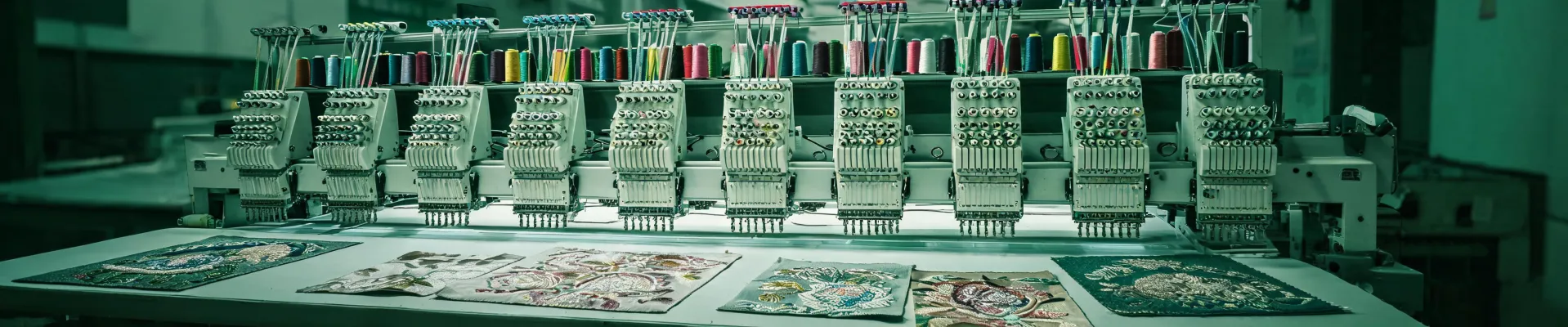
Barudan 8 Head Embroidery Machine vs Single-Head: A Procurement Manager’s 6-Year Comparison
Posted on 2026-09-28 by Meera Kulkarni
-
What We’re Comparing, And Why
-
1. Cost Per Piece — 8 Heads Win, But Only At Volume
-
2. Labor Leverage — 8 Heads Decisively Wins
-
3. Order Flexibility — Single-Head Wins, And It’s Not Close
-
4. Footprint And Maintenance — A Split Decision
-
5. Resale Value — Barudan Holds Up, But Configuration Matters
-
What To Choose — It Depends On Your Order Book
What We’re Comparing, And Why
I run procurement for a 42-person contract embroidery shop. We’ve spent roughly $140,000 on Barudan machines and accessories since 2019, and I’ve logged every quote, invoice, and service ticket since then. About 30 machine purchase decisions, give or take — I’d have to check the system for the exact count.
Two configurations keep coming up whenever we evaluate an embroidery machine for apparel work:
- The Barudan 8 head embroidery machine — the mid-range workhorse for volume apparel production
- Single-head configurations — either a Barudan single-head or something comparable at entry level
I’m not a mechanical engineer. I can’t speak to spindle RPM tolerance or thread tension calibration — that’s a job for your service tech. What I can tell you is how these two configurations perform in a real cost model, backed by our internal TCO spreadsheet. A couple of partner shops also mentioned the embroidery machine SE700 when we were benchmarking — I haven’t run one, so I’m not going to pretend I have.
Here’s each dimension, and which one wins.
1. Cost Per Piece — 8 Heads Win, But Only At Volume
This is the calculation most buyers get wrong. You see a price tag on a Barudan 8-head machine and assume it needs 8x the volume to justify itself. Per-piece cost doesn’t work that way.
From our 2023 apparel orders, we averaged around $0.42–$0.58 per piece on the 8-head machine (medium-density logo work, roughly 12k stitches). On the single-head, closer to $0.71–$0.94. That’s roughly a 35–40% difference.
But here’s the caveat: this only holds if you’re running the machine at least six hours a day. If your orders are fragmented — three designs a day, 20 pieces each — changeover time eats that advantage. I’ve seen shops buy an 8-head and then spend more time scheduling changeovers than they saved in per-piece cost.
I still kick myself for pushing an 8-head into a mixed-order workflow back in 2023. If I’d tracked changeover time in the TCO model from the start, we would’ve kept that job on the single-head and saved close to $1,800 in lost output.
2. Labor Leverage — 8 Heads Decisively Wins
Both an 8-head and a single-head machine need roughly the same headcount: one operator per machine. That’s the entire ballgame.
Our own data: an 8-head operator produces around 220 garments per shift. A single-head operator, around 32. Same wages, roughly 7x the output. On a $22/hour fully loaded labor rate, that’s approximately a 93% reduction in labor cost per garment — from about $5.50 down to $0.40 per piece. I should add that this assumes consistent order flow; the ratio collapses during slow weeks.
Yeah — this is the biggest cost lever of any dimension we track. Bigger than electricity, maintenance, and depreciation combined.
3. Order Flexibility — Single-Head Wins, And It’s Not Close
If the first two dimensions made you think I’m shilling for the 8-head, this one will fix that.
Nothing beats a single-head for sampling, one-off custom runs, and “customer wants one logo in six colors by tomorrow” scrambles. Running those on an 8-head is painful and wasteful.
Case in point: in 2023 we took a premium client order — mixed apparel, four pieces per design, three colorways, 12 garments total. Running that on the 8-head, we spent 90 minutes on setups and thread changes alone. That job was a loss. On a single-head, we’d have cleared it in under two hours clean.
If a meaningful chunk of your apparel volume is under 50 pieces per design, the single-head is the right machine. I’d rather admit that than push an 8-head into a workflow where it doesn’t belong.
4. Footprint And Maintenance — A Split Decision
An 8-head machine eats three to four times the floor space. Ours takes roughly 12 square meters including head clearance and operator station; the single-head takes about 3.5.
For maintenance, complexity cuts both ways. Per-head annual maintenance came in at about $95 on the 8-head based on 2024 numbers. Per-machine, the single-head ran closer to $180. So the single-head is cheaper to service in absolute terms — but the 8-head is cheaper per head.
I don’t have hard data on industry-wide numbers here — our sample is six machines. But directionally, the gap is wide enough that I’d bet on it holding.
5. Resale Value — Barudan Holds Up, But Configuration Matters
This one surprised me.
Based on what I see in the used Barudan embroidery machines channel (as of January 2025), 8-head units hold roughly 55–65% of original value with a clean service history. Single-head resale is closer to 30–40%.
Part of it is the buyer pool. Someone shopping for a used 8-head is usually an experienced shop looking to add capacity — they know what they want. Someone shopping for a used single-head is often a first-time buyer, and first-time buyers typically lean toward new equipment with a warranty. That shrinks the secondary market for single-heads.
So the 8-head’s higher sticker price gets clawed back at the back end. In our TCO model, the effective five-year cost of ownership on a Barudan 8 head embroidery machine is closer than the sticker price suggests — the upfront gap narrows from roughly 3.5x down to about 2x once resale, labor, and per-piece cost are all factored in.
What To Choose — It Depends On Your Order Book
No universal answer here, because the right machine depends on your order structure, not on which spec sheet looks better.
Choose the Barudan 8 head embroidery machine if:
- Your apparel orders run 100+ pieces per design
- You’re running 1–3 colorways per job
- You’ve got steady dispatch volume — at least 5–6 hours of machine time per day
Choose a single-head if:
- Sampling, prototyping, or on-demand customization is a big part of your revenue
- Your average order is under 50 pieces
- You’re just entering the embroidery machine market and want to learn on a lower-risk platform
One last thing. I have a rule now: I won’t accept a quote from a supplier who hasn’t asked about my order structure first. A rep once told me flat out, “this configuration isn’t our strength for your mix of orders — the single-head is a better fit for you.” That sentence earned them every volume machine order we’ve placed since. Saying no to the wrong fit is a feature, not a weakness.
Meera Kulkarni
Meera Kulkarni is a textile-printing equipment analyst covering DTF, DTG, dye-sublimation, and eco-solvent printers with their pretreatment, powdering, curing, pressing, and finishing workflows. She uses ISO 105-C06 laundering tests for applicable printed textiles while tracking colour difference, ink laydown, transfer temperature, dwell time, curing profile, washfastness, nozzle reliability, media tension, and production yield. Her process guides help decorators, apparel producers, and print shops select equipment, inks, films, fabrics, and operating windows for repeatable output.