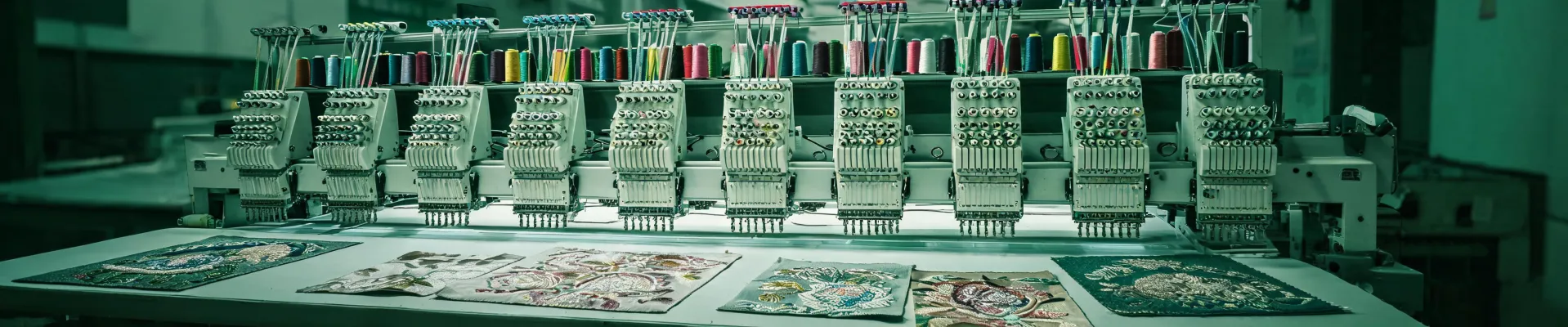
Barudan 8-Head Embroidery Machine Price: What I Learned Buying Equipment for a 45-Person Shop
Posted on 2026-09-20 by Elise Marceau
-
Short Answer: Budget $18K–$35K Used, $45K–$70K New — But Price Is the Wrong First Question
-
Why You Should Trust This (And Where My Perspective Comes From)
-
The Decision That Kept Me Up at Night
-
What I Actually Learned About Barudan Pricing and Support
-
The Hidden Costs Nobody Puts in the Proposal
-
What This Means If You're Buying Right Now
-
About Those Hoops for Barudan Machines
-
What About ProEmb and Other Options?
-
Where This Advice Might Not Apply
Short Answer: Budget $18K–$35K Used, $45K–$70K New — But Price Is the Wrong First Question
If you're pricing a Barudan 8 head embroidery machine right now, here's the range I've seen in actual quotes: $18,000–$35,000 for used, $45,000–$70,000 for new. Embroidery hoops for Barudan machines run another $800–$2,500 depending on what you need. Those numbers reflect quotes I received in late 2024 and early 2025.
But here's what nobody puts in the spreadsheet: in this industry, the purchase price is maybe 40% of what you'll actually spend. The other 60% is downtime, parts availability, and whether your machine is running when that $15,000 contract order needs to ship.
Why You Should Trust This (And Where My Perspective Comes From)
I'm an office administrator for a 45-person apparel manufacturing company in Southern California. I manage all equipment and service procurement—roughly $300,000 annually across 8 vendors. I report to both my operations director and our CFO, so I've had to defend every major purchase I've made since I took over purchasing in 2020.
I've been through three embroidery equipment purchases. The first was a used Barudan 4-head in 2021 that looked like a great deal. The second was an 8-head setup in late 2023. The third was a backup single-head earlier this year. I've learned something from each one, mostly the hard way.
The Decision That Kept Me Up at Night
I went back and forth between a used Barudan 8-head from a broker and a new machine from an authorized dealer for about three weeks. The used one was listed at $22,000; the new one came in at $52,000 with installation and a year of service included.
On paper, the used machine made obvious sense. We'd save $30,000—that's not nothing when you're reporting to a CFO who scrutinizes every capital request. My original analysis even showed we'd break even faster on the used option.
But then I talked to our lead machine operator, who'd worked with Barudan and other brands for 15 years. He said something that changed my thinking: "A used machine that's down for two weeks while you wait for a part doesn't save you anything if you miss a ship date. The customer doesn't care that you saved $30,000 on the machine. They care that their order was late."
We went with the new machine. I'm not saying that's right for everyone—I'll get to that.
What I Actually Learned About Barudan Pricing and Support
Barudan machines hold their value for a reason. When I was researching, I kept seeing used machines from the late 1990s and early 2000s still selling for $12,000–$20,000. There aren't many industrial machines with that kind of staying power.
What I learned about pricing through actual quotes:
- Used Barudan 8 head machines: The range depends heavily on the year and hours. I saw 1990s models around $10K–$15K, 2000s models at $15K–$28K, and anything from the last 8–10 years going $28K–$40K.
- New Barudan 8 head machines: I couldn't get a firm quote without going through a dealer, but the range was $45K–$70K depending on configuration. The ENT model seemed to sit in the middle of that range.
- Embroidery hoops for Barudan: Original Barudan hoops run $80–$150 each. You need multiple sizes—we bought a set covering 4 sizes, which was about $1,200 total. Aftermarket hoops exist and are cheaper, but tolerance matters. For fringe designs, hoop stability is everything.
The Hidden Costs Nobody Puts in the Proposal
Let me give you the numbers I didn't have when I started:
Installation and setup: $1,500–$3,000 if you don't negotiate it into the purchase. This includes leveling, electrical connection, and initial calibration.
Training: If your operators haven't run Barudan specifically, expect 1–2 days of training. Some dealers include it; some charge $800–$1,500 per day.
Parts and maintaining a spares kit: I budget $2,000 annually for consumables and spare parts. We keep a full set of needles, tension springs, and a spare hoop arm set on hand. If a $15 part can stop production for two days, you want it on the shelf.
Downtime: This is the real number. Our shop runs about $2,800 per production hour when we're busy. If we're down for a day (8 hours), that's $22,400. One day. That's part of why I stopped negotiating so hard on the machine price and started negotiating on service response times instead.
What This Means If You're Buying Right Now
Here's my advice, with the caveat that I'm one person in one shop. If you're a smaller operation—say, 1–2 machines and 10 employees—a well-maintained used Barudan is probably a great call. The economics are different because your downtime cost per hour is lower.
But if you're running multiple machines and you have contracts with delivery dates, I'd argue for paying the premium on a new machine or an extremely well-documented used one from a reputable dealer. The certainty of service and parts availability is worth real money.
I've now been through three emergency part orders in the past 18 months. Two arrived within 24 hours. One took four days because it shipped from overseas. That four-day wait cost us an estimated $6,000 in overtime to catch up. The year of service included in our new machine purchase paid for itself in that one incident.
About Those Hoops for Barudan Machines
One more thing that surprised me: Barudan hoop compatibility isn't as universal as you'd think. Not all Barudan models take the same hoop attachments. We have both magnetic and standard hoops, and the magnetic ones are faster to change—but they're also more expensive and require more care.
For machine embroidery fringe designs specifically, you'll likely want wider hoops than you'd use for standard embroidery. We use a 15.7" × 15.7" (400mm × 400mm) hoop for larger fringe designs, though smaller fringes work fine in standard 12" hoops. The key is that fringe work moves material more than flat embroidery, so your hoop tension needs to be consistent across the entire field.
If I remember correctly, our full set of Barudan hoops (four sizes, both magnetic and standard versions for two of them) ran about $2,400. That was in early 2024, so it may have shifted.
What About ProEmb and Other Options?
When I was researching the machine embroidery latest options, a ProEmb embroidery machine came up more than once. I looked into it. The specs were competitive and the price point was lower. What I couldn't get comfortable with was the service network—I couldn't find a technician within 150 miles who worked on them regularly.
That might not matter if you're in a major metro area with multiple dealers. It mattered for us.
I'm not saying ProEmb is a bad choice. I'm saying that when you're comparing machines, compare the service network as carefully as you compare the stitch speeds. The machine is the easy part. Getting it fixed at 4 PM on a Friday before a Monday ship date is the hard part.
Where This Advice Might Not Apply
I can only speak to our situation, which is domestic, contract-based embroidery with relatively predictable order flow. If you're dealing with seasonal peaks—say, you do a lot of promotional work before holidays—the calculus is different. You might need faster service response times, or a backup machine, or both.
And if you're buying used from a private seller, verify that a service provider in your area will work on it. Not every technician will service every machine, and if you're in an area with only one dealer, you're captive. That's a risk I didn't fully understand until I started making phone calls.
Finally, this pricing was accurate as of my most recent research in Q4 2024 and Q1 2025. Machine prices and parts availability change, so verify current numbers before you build a budget. I've learned that the hard way more than once.

Elise Marceau
Elise Marceau is an LED display and digital-signage systems analyst covering LED video walls, modular screens, transparent LED, control processors, and indoor or outdoor signage. She applies IEC 62368-1 safety principles while comparing pixel pitch, luminance, contrast, refresh rate, colour uniformity, viewing angle, ingress protection, power density, module serviceability, and signal redundancy. Her specification guides help integrators, venue operators, retailers, and procurement teams align viewing distance, ambient light, content format, installation access, electrical load, and lifecycle support.