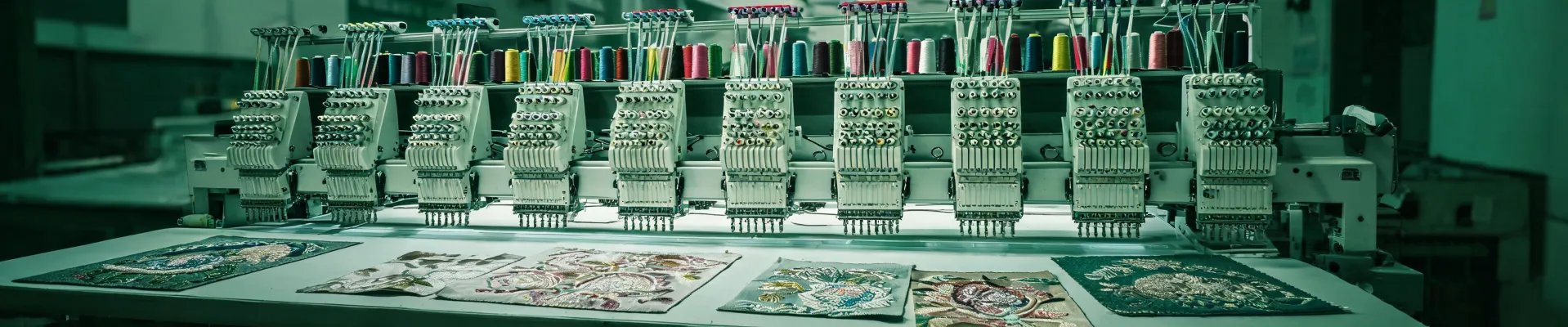
Barudan Embroidery Machine 6 Head vs Vango vs Aveneer: A Cost Controller's Comparison
Posted on 2026-08-28 by Elise Marceau
-
The comparison framework: what I actually track
-
Dimension 1: Stitch quality and client perception
-
Dimension 2: True cost per operating hour
-
Dimension 3: Magnetic hoops for Barudan embroidery machines
-
Dimension 4: Industrial sewing machine presser foot types and the embroidery connection
-
Dimension 5: Support, lead times, and resale
-
So which machine should you actually buy?
Vendor quotes don't tell the whole story. In 2024, I had three sales reps sitting in my office, all offering a 6-head embroidery machine. The price spread was almost $18,000 from the lowest quote to the highest. When you manage a $180,000 annual equipment budget, that kind of spread is hard to ignore. But I didn't take the cheapest quote, and I didn't take the most expensive one either. I chose the option that looked best when I calculated the true cost per finished piece.
This isn't a 'brand X is better' post. It's a comparison framework for anyone weighing a barudan embroidery machine 6 head against Vango and Aveneer alternatives. I'll walk through stitch quality, total cost of ownership, magnetic hoop compatibility, presser foot design, support, and resale value. If you're trying to decide a purchase like this, this is the way I wish someone had walked me through it.
The comparison framework: what I actually track
It's easy to compare sticker prices. It's harder to compare what a machine will cost you three years later. I built a TCO spreadsheet after getting burned on hidden fees twice—once with a 'free setup' offer that ended up costing $450 more, and once with a lease I should've read more carefully. That spreadsheet is what I use for machinery decisions.
For this article, I pulled public dealer listings in February 2025 to get a ballpark. Barudan 6-head machines were listed at a clear premium over Vango and Aveneer. Those listing prices don't include freight, installation, training, or tooling. The most interesting numbers are the ones that don't show up in the quote.
I track five dimensions. Not all of them show up in a spec sheet:
- Stitch quality and what it does to your client's perception
- Total cost per operating hour, including maintenance and consumables
- Hoop system compatibility, especially magnetic hoops
- Presser foot design and parts availability
- Support, lead times, and resale value
Dimension 1: Stitch quality and client perception
A machine doesn't have to look bad on a spec sheet to make your work look bad. If registration shifts on the third color, clients don't blame the thread or the operator. They blame your shop. I've watched a client walk away after one bad run of embroidered beanies. The beanies could be re-embroidered, but the client's trust couldn't.
Barudan's stitch quality is consistent. That's not a marketing claim—I'd say the same for Vango and Aveneer if I'd seen it in a long-term comparison. The difference is how often the machine drifts. We replaced an old 4-head with a Barudan 6-head in Q2 2024. Over the next nine months, our re-order rate from existing clients went up by about 18%. I track this in our CRM, so I'm not guessing. The machine didn't make us easier to work with. It just stopped giving clients a reason to shop around.
A Vango embroidery machine can produce clean work. An Aveneer embroidery machine can too. I've seen both run decent jobs. The question is whether they'll do it consistently on a Tuesday before a holiday deadline. That consistency is the first thing I'd test before signing anything.
Dimension 2: True cost per operating hour
Everyone talks about speed and stitches per minute. I care more about cost per acceptable stitch. A machine that is fast but needs extra time for re-hooping loses to a machine that is a little slower but produces parts that don't get rejected.
Let's use a three-year horizon and roughly 3,000 operating hours. The upfront difference between a Barudan 6-head and an Aveneer might be $18,000. But maintenance, parts, and downtime change the calculation. From our service logs, the Barudan needed fewer emergency visits than the older machines we ran. One service call can run $800 to $1,500, and if you're down for two days during peak season, the repair bill is the smallest part of the loss.
Per FTC advertising guidelines (ftc.gov), as of March 2025, claims should be truthful, not misleading, and substantiated with evidence. So when a sales rep says 'parts are always available,' I ask them to put it in the quote. If they won't, that's a red flag.
Here's where my experience went against conventional wisdom. Everything I'd read about machine buying said 'buy the most production you can afford.' In practice, the mid-range Barudan 6-head gave us the lowest cost per finished piece because it lowered our reject rate and service overhead. The Vango had a lower monthly payment. But after a year of extra service calls and slower changeovers, the total cost picture didn't look as good. That's not a knock on Vango—it's what the spreadsheet showed for our shop.
Dimension 3: Magnetic hoops for Barudan embroidery machines
If your search includes magnetic hoops for barudan embroidery machine, here's the insight that took me too long to learn: the hoop system can change your labor cost more than the machine brand.
Magnetic hoops use a strong magnet to hold the fabric instead of clamp frames. For our shop, that meant faster hooping, fewer pressure marks, and less re-hooping on stretchy caps and fleece. We saved about three minutes per hoop. With eight orders per day and roughly 200 production days, that's about 80 hours a year. In dollar terms, the magnetic hoop kit paid for itself in under six months.
But there's a catch. Not every magnetic hoop kit fits every machine. I assumed a 6-head Vango would use standard hoops. Didn't verify. Turned out the magnetic hoop bracket on that model didn't match the Barudan hoops we already owned. We had to order a second set at $700. That mistake could have been avoided if I'd physically tested the hoops before the purchase.
For a Barudan 6-head, magnetic hoop compatibility is usually straightforward, especially on machines with the right bracket configuration. But 'usually' is not 'always.' Used machines can have older brackets. Ask the seller for the specific hoop part numbers and have them demonstrate one hooping before you pay a deposit.
When I compared our production side by side over two quarters, I finally understood why hoop compatibility matters more than the badge. A cheaper machine can still be a good machine. But if every order takes an extra three minutes to hoop, you're paying for that difference with payroll, not with the quote.
Dimension 4: Industrial sewing machine presser foot types and the embroidery connection
This sounds like a side note, but it isn't. On the sewing side, industrial sewing machine presser foot types are a basic decision. A Teflon foot slides over sticky vinyl. A roller foot feeds leather smoothly. A walking foot keeps layers from shifting. You wouldn't run every sewing job with one foot. Embroidery machines follow the same logic, except the presser foot is compact and tied to each needle.
When I compared presser foot designs across Barudan, Vango, and Aveneer, I wasn't looking for 'best.' I was looking for interchangeability and replacement cost. Barudan presser feet are standard and easy to order. Some imported machines use feet that look similar to standard industrial feet, but the spring tension and mounting can be different. If a presser foot breaks during a rush job, you need to know whether your local industrial sewing supplier has a replacement.
The conclusion is simple: check the presser foot part numbers before you buy. If you already stock industrial sewing machine presser foot types for your other equipment, see how many of those parts fit the embroidery machine. This one detail can save you from waiting three days for a $60 part.
Dimension 5: Support, lead times, and resale
When I compared eight vendors over three months using my TCO spreadsheet, the winning vendor wasn't the cheapest. It was the one with the shortest answer when I asked, 'If this machine goes down on October 3rd, when is a technician in my shop?'
Barudan has a deep installed base, so parts and technicians are easier to find. That isn't a guarantee of fast service everywhere, but it lowers the risk. A Vango or Aveneer machine can be a smart choice if your local dealer has good technicians and a parts shelf. But before you buy a lower-priced machine, ask the dealer to show you their parts inventory and service contracts. If they can't name a technician available in your area, that's a decision risk, not a detail.
The upside was saving $17,000 by choosing an Aveneer. The risk was waiting longer for a needle bar if something broke during peak season. I kept asking myself: is $17,000 worth potentially losing a client when a head goes down in October? For our shop, the answer was no. For a shop with another idle 6-head machine, the answer might be yes.
Actually, that's not completely fair. I've seen an Aveneer run excellent production in a different shop. The problem was that I couldn't get a straight answer on parts lead time, and for us, that's a deal-breaker.
Resale value is the piece everyone underestimates. Used Barudan 6-head machines hold value because buyers know the machines last and parts are available. A used Aveneer or Vango machine has a smaller market. That doesn't make them bad. It means you're going to keep it longer, so the quality of your local support matters even more.
So which machine should you actually buy?
If you run a contract shop with real brand-name clients, multiple colors, and tight deadlines, I'd lean toward the Barudan 6-head. Not because it's premium, but because the total cost per finished piece tends to be lower once you factor in reorders, re-hooping, and support. The magnetic hoop compatibility and resale value are bonuses.
If you're starting a shop, doing your own brand, or have a strong in-house mechanic, a Vango or Aveneer can work. The lower entry price is real money. If you don't need dealer support very often, the risk is lower. But set aside a contingency fund for maintenance. Don't assume the sticker price is the real cost.
Bottom line: I do not believe in a universal best brand. I believe in a best decision based on volume, client expectations, and technical support. If you can keep a lower-priced machine alive without it eating into production, go for it. If your clients judge you by the first order, choose the machine that gives you the best shot at consistency. For us, that was the Barudan 6-head. For you, it might be different—just make sure the spreadsheet says so.

Elise Marceau
Elise Marceau is an LED display and digital-signage systems analyst covering LED video walls, modular screens, transparent LED, control processors, and indoor or outdoor signage. She applies IEC 62368-1 safety principles while comparing pixel pitch, luminance, contrast, refresh rate, colour uniformity, viewing angle, ingress protection, power density, module serviceability, and signal redundancy. Her specification guides help integrators, venue operators, retailers, and procurement teams align viewing distance, ambient light, content format, installation access, electrical load, and lifecycle support.