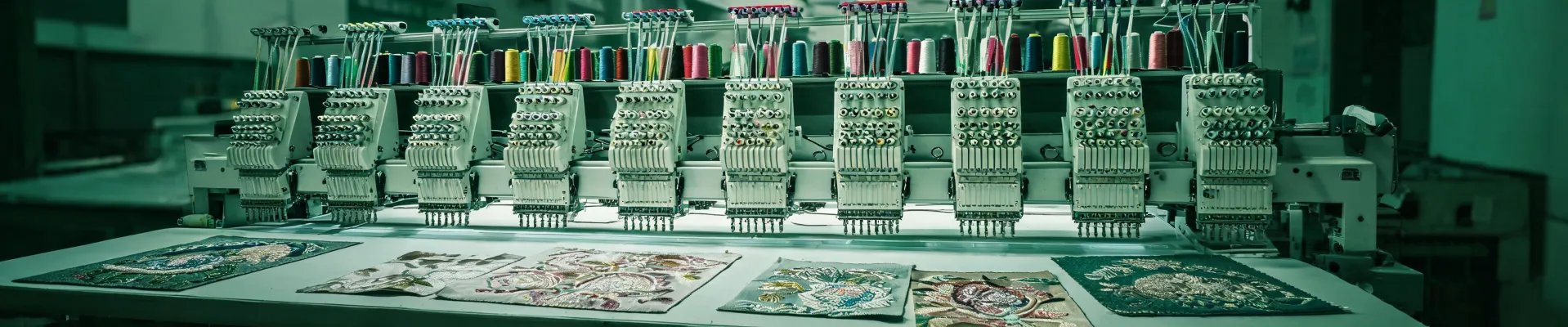
Barudan Embroidery Machines: 7 Real Answers About Prices, Hoops, and Buying (2025)
Posted on 2026-08-28 by Elise Marceau
Since Barudan is one of the brands I get asked about most — both here and in calls from other embroiderers — I put together the answers to the questions that actually come up. Not the sales-page version. The version you'd get standing next to me in the shop while a job runs.
Quick context: I run a contract embroidery business. Eight years in, roughly 250 orders a year, and a third of those land as rush jobs with little warning. I've owned two Barudans, logged hundreds of hours on a Creator, and wasted more money on cheap hoops than I'm proud to admit. Here's the FAQ, straight from the shop floor.
What does a Barudan 4-head actually cost in 2025?
Ballpark for a new Barudan 4-head: $45,000 to $70,000, depending on configuration. A 12-color machine with cap frame packages, oversized hoops, and a table will run above that range; a base 9-color unit lands on the lower end. Used 4-heads? I've seen listings between $18,000 and $35,000 in Q1 2025. Both ranges move around — verify with your dealer before you budget.
But here's what I tell every buyer: the machine price is the entry ticket, not the real cost. I've watched a shop buy a used 4-head for $22,000 and put another $6,000 into it within a year — new needle bars, tension assemblies, a cap drive repair, and two technician visits. Another shop paid $40,000 for a new one and spent almost nothing beyond routine service for two years. The difference isn't luck. It's maintenance history and how the previous operator treated the machine.
When I compare those two experiences side by side, the lesson is simple: either buy the machine with documented service, or budget for repairs. Both are fine. Pretending you can avoid both is how a bargain becomes a regret.
There's also the cost people forget: installation, training, initial hoops, and thread. That's $2,000 to $5,000 of stuff you need on day one. The real Barudan 4-head embroidery machine price shows up over the first year, not on the initial quote.
Which head configuration makes sense for a growing shop?
I used to assume more heads automatically meant more business. If 4 is good, 6 must be better, right? Three years and a lot of idle time on a 6-head later, I know better.
For a contract embroidery shop entering this space, a 4-head is the no-brainer sweet spot. You can run multiple jobs at once, keep production moving if one head needs attention, and still fill the machine consistently. A 6-head or 8-head only pays off when you have real volume — apparel manufacturing, uniform programs, consistent production contracts.
If you're just starting, a single-head or 2-head machine lets you learn without gambling the business. But if contract work is the plan, don't under-size. The most common regret I hear from shop owners isn't buying too big. It's buying too small, then upgrading eighteen months later and eating the depreciation.
A shop owner I know bought an 8-head because the financing was 'too good to pass up.' Two years later, he's running it two days a week and the marketing cost to fill it is twice the monthly payment. Don't buy what a sales rep's calculator says. Buy for the orders you have and the type of orders you can realistically win.
For our shop, 4-head was right. At least, that's been my experience with mixed orders — small batches, sample runs, the occasional 500-piece corporate rush. If your world is 5,000-piece apparel runs, my advice doesn't apply. Different game.
Is the Barudan Creator worth it if you already own a multi-head?
Own one? No. Used one? Yes — and I'll explain the difference.
The Barudan Creator is a single-head machine aimed at sample work, small batches, and quick turnarounds. Prices sit around $15,000 to $25,000 depending on age and features. The Creator's real value isn't raw output. It's the ability to take sample orders off your production machine. When a client calls at 3 p.m. needing a 10-piece proof for tomorrow morning, you don't want to pull a multi-head off a running job.
In March 2024, a client called at 3 p.m. needing 60 embroidered hats for an event that Friday. Our 4-head was in the middle of a 1,200-piece uniform job. We pulled a Creator off the sample table, ran the hats in parallel, and hit both deadlines. That's the Creator's whole case in one story.
I spent six months working on a Creator while a client's order flow slowed to a crawl. At that volume — around 15 to 20 sample sew-outs a week — it earned its keep. For most shops running fewer than 10 samples a month, it's a hard sell. You're paying a premium for convenience, not capability.
If you do personalized one-offs, local sports teams, or gift-type products, the Creator is a game-changer. If you're doing contract production, spend that money on magnetic hoops or a second 4-head. Put another way: the Creator is a specialist. Bring it in when you have specialist needs. Also, if you're looking used, expect it to hold value — good clean Creators don't sit on the market long.
The rest of the FAQ
What should you check before buying a used Barudan?
I have one big regret from our first used machine purchase: I skipped the detailed inspection because we were in a hurry. Thirty days later, we had a $400 service call for a $15 tension spring. That one hurt.
Run through this list before you wire money:
- Stitch count and actual run hours. Don't trust the counter alone — ask for service records.
- Tension assemblies. Wear shows up here first, and the fix isn't always cheap.
- Rotary hook and bobbin case wear. Listen for grinding; check the hook race for scoring.
- Color change mechanism. Any hesitation or skipping means a large repair bill waiting.
- Cap frame drive, presser feet, and needle bar movement.
Bring a small test file you know well — not the demo file. Run it on every head. Then switch to your own thread and run it again. If the seller hesitates or starts negotiating the inspection, that's a red flag. If they won't let you run a test sew-out at all, walk away. A good machine proves itself in three minutes. I've dealt with two honest dealers and one very smooth talker. The smooth talker was the one hiding problems. Don't be me.
Why do embroiderers obsess over hoops — and are magnetic hoops worth it?
Because the hoop is the most underrated piece of equipment in the shop. A bad hoop makes everything harder: registration drifts, fabric creases, and you blame the machine when the frame is the real problem.
Barudan embroidery machine hoops fit their specific frame system — you can't swap in generic hoops and expect consistent registration. Standard metal hoops run from $60 to $120 each. Magnetic hoops, where fabric sits between a base plate and a magnetic top frame, run $600 to $1,500 for a set. That sounds like a lot until you're working on delicate fabric, performance material, or high-pile items a traditional clamp will crush.
About 80 percent of our orders now run on magnetic hoops. The best way to understand why is to try one: no tightening, no pressure marks, no fighting to get the fabric flat. When I compared reject rates on standard steel hoops versus magnetic over a full quarter, the result was clear — magnetic hoops paid for themselves in scrap reduction alone.
I still kick myself for 'saving' $300 on cheap hoops when we started. They warped within six months and made every job harder. If there's one piece of hoop advice I'd give, it's this: buy the good one first. The cheap path is slower, more expensive, and twice as frustrating.
Do embroidery shops actually use a sewing machine foot with guide?
This one creates confusion, so let me clarify. A sewing machine foot with guide is a sewing accessory, not an embroidery accessory. On a dedicated machine like a Barudan, there's no place to attach it — the hoop does the guiding.
That said, if you run a combined sewing-and-embroidery machine, a guide foot is genuinely useful. It's the tool for keeping topstitching straight, aligning appliqué edges, or sewing down a trim before you hoop the whole thing. I know embroidery-focused shops that don't own one. I also know garment decorators who treat it as essential.
So: needed for embroidery? No. Nice to have in a multi-purpose shop? Absolutely. Just don't let it get added to a Barudan purchase unless you're also doing sewing work with the same machine.
What's actually changing in embroidery machine technology in 2025?
I'm not going to pretend I have insider market data. What I can share is what I saw at Texprocess 2024 and what's been showing up in our shop this year.
If you're keeping up with embroidery machine news, the bigger story is automation. Auto-trim and auto-color-change are moving from premium options to standard expectations. Laser-and-embroidery combos are getting serious attention — cutting and stitching appliqué in one pass is no longer a concept. Software integration is tighter too. Design files move from Wilcom or Hatch to the machine over wireless, which sounds small until you've walked a USB drive across a production floor during a deadline.
Delivery times look different too. The backlog mess of 2022 and 2023 has mostly cleared. Dealers are quoting 6 to 10 weeks for new builds again. Used prices are stable. And one more thing: 2025's machines are getting easier to troubleshoot remotely. That's a quiet update that matters more than any feature for anyone who runs rush orders.
One thing I didn't expect in 2025: repair parts are actually available. In 2022, we waited six weeks for a cap driver motor. Last month, our dealer had the part in stock. That's huge when a rush order is on your table.
If you're shopping this year, look for full auto-trim and easy color change, especially for short-run work. It isn't the flashy answer, but it's the one that protects your deadlines.
That's the short version of what I tell people about Barudan. Got a specific question? Drop it in the comments and I'll answer from the shop floor.

Elise Marceau
Elise Marceau is an LED display and digital-signage systems analyst covering LED video walls, modular screens, transparent LED, control processors, and indoor or outdoor signage. She applies IEC 62368-1 safety principles while comparing pixel pitch, luminance, contrast, refresh rate, colour uniformity, viewing angle, ingress protection, power density, module serviceability, and signal redundancy. Her specification guides help integrators, venue operators, retailers, and procurement teams align viewing distance, ambient light, content format, installation access, electrical load, and lifecycle support.