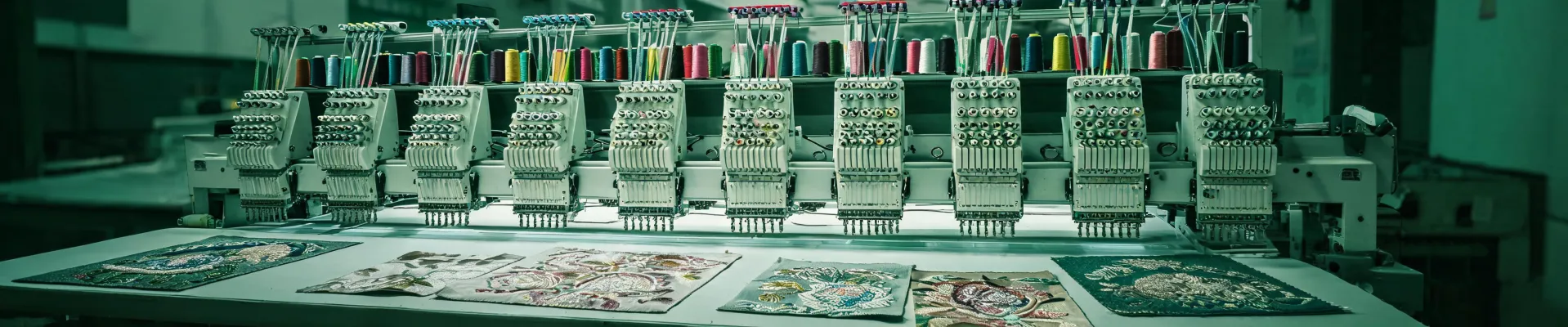
Barudan Embroidery Machines, DTF, or a Brother NQ1700E? How to Choose by Production Scenario
Posted on 2026-09-11 by Elise Marceau
I've been handling embroidery production orders for 9 years. I've personally made and documented 14 significant mistakes, totaling roughly $11,200 in wasted budget. Now I maintain our team's checklist to prevent others from repeating my errors.
If you're asking whether you need Barudan embroidery machines, a Brother Innov-IS NQ1700E, or a DTF embroidery machine, I'm going to save you some time: there's no single right answer. It depends on your order mix, your cash flow, and how you define sewing machine output.
Most buyers get into trouble because they compare specs on a spreadsheet. From the outside, it looks like more heads or a newer single-head automatically means more profit. The reality is your profit is capped by hooping, trimming, thread changes, and how much paid work you can feed the machine.
I use three scenarios. Find yourself first, then read the advice.
- Scenario A: You have repeat bulk orders and need predictable multi-head output.
- Scenario B: You do samples, names, small batches, and one-off personalization.
- Scenario C: You decorate mixed materials and need DTF transfers plus embroidery, not one machine to do everything.
Scenario A: Repeat Bulk Orders and Multi-Head Output
If you regularly run 100 to 500+ pieces with 5,000 to 15,000 stitches, you're in multi-head territory. This is where Barudan embroidery machines with 4, 6, 8, or 12 heads make sense. A single-head machine can do the work, but it becomes an operator-time problem fast.
In September 2022, I quoted a 600-piece left-chest logo job assuming one 6-head machine could do 140 pieces a day. We actually hit 92 on day one. Thread breaks, hooping, bad backing, and one operator doing everything killed the estimate. That error cost $890 in overtime plus a one-week delay. It wasn't a machine problem. It was a process problem.
People think a machine with more heads automatically increases sewing machine output. Actually, output is capped by the bottleneck. If your team can only hoop 30 garments an hour, a 12-head Barudan won't save you. The causation runs the other way: better hooping and workflow let you use more heads. Fix the front end first.
For this scenario, focus on:
- Head configuration that matches your typical order size, not your biggest dream order.
- Service and parts coverage in your region. Check current Barudan distributor coverage as of January 2025.
- Backing, needle, and thread inventory. Running out mid-order is a self-inflicted delay.
- Operator training and a pre-production checklist.
I'd argue a used Barudan machine from a reputable dealer can be a smarter buy than a new machine you can't service locally. But verify hours, maintenance records, and software compatibility before you wire money.
Scenario B: Small Runs, Samples, and One-Off Personalization
If your average job is 1 to 12 pieces, a single-head machine is the right tool. The Brother Innov-IS NQ1700E embroidery machine is a common choice for small-business personalization, samples, gifts, and small-batch apparel. It's not a replacement for a 6-head Barudan in a contract shop, but it can be exactly right for the work in front of you.
In my first year, 2017, I bought a used single-head to save money and then accepted a 300-piece order. I knew I should test the file on scrap first, but thought, what are the odds? The odds caught up when registration shifted on 47 fleece jackets. $1,200 in blanks, a customer apology, and a rush reorder later, I learned to match machine class to order class.
People assume a machine like the NQ1700E is just a hobby machine. For the right scenario, that's not an insult. The reality is a single-head machine gives you flexibility, low setup, and fast sample turnaround. What it doesn't give you is multi-head throughput. If you're comparing it to Barudan embroidery machines, measure your true hourly output including hooping, changing, trimming, and folding. In my experience, small shops overestimate sewing machine output by 30 to 40 percent.
For this scenario, focus on:
- Ease of use and file compatibility.
- Hoop sizes and cap attachments, if you need them.
- Local support or a strong dealer network.
- A simple pre-run checklist: file, hoop, stabilizer, needle, thread, test sew.
Don't buy a multi-head machine just because you got one big order. One big order doesn't pay for a machine. Repeatable demand does.
Scenario C: DTF Plus Embroidery Hybrid Work
A DTF embroidery machine doesn't really exist in the way people search it. DTF is a printer plus heat press. Embroidery is needle and thread. They're complementary, not the same process. If you need full-color on polyester, DTF can beat embroidery on cost per piece for larger designs. If you need texture, durability, and a premium feel, embroidery wins. Many shops run both.
In Q1 2024, I tried to force a three-color DTF transfer onto a job that should have been embroidered. It looked fine in the mockup. On 80 performance polos, the transfer edges lifted after washing. We reprinted 60 pieces at our cost. Net loss: $640. Lesson: don't use DTF to solve an embroidery problem just because the gear is already paid for.
For hybrid work, your real output metric isn't stitches per minute or DTF prints per hour. It's completed garments per labor hour. Track both processes separately, then track the handoff. The heat press can become your new bottleneck if you're not careful.
For this scenario, focus on:
- Which decoration method wins on each fabric and design.
- Workflow layout so DTF and embroidery don't fight for the same table space.
- Wash testing before promising durability.
- Software that can quote both methods accurately.
How to Tell Which Scenario You're In
Answer these questions honestly. The answer usually points to one scenario.
- What percentage of your revenue comes from repeat orders over 100 pieces? If it's over 40 percent, look hard at Scenario A.
- Can you keep a machine running four paid hours a day? If not, buy for flexibility, not throughput. Scenario B.
- Do customers ask for full-color logos or textured logos? If both, you're probably in Scenario C.
- Who hoops, trims, and folds? If the answer is the same person running the machine, your output is a labor question, not a machine question.
- What breaks first: cash flow or capacity? If cash flow is tight, a used single-head or used Barudan can bridge the gap. If capacity is breaking, add heads.
After 9 years, I've come to believe the best machine is highly context-dependent. It took me 3 years and about 150 orders to understand that workflow beats specs. A $30,000 Barudan embroidery machine with a bad hooping process loses to a $6,000 single-head with a tight checklist.
The 12-point checklist I created after my third mistake has saved us an estimated $8,000 in potential rework. Five minutes of verification beats five days of correction. If you're still on the fence, start with the scenario that matches the orders you already have, not the orders you hope to get.
Verify current specs, pricing, and service coverage as of January 2025 with Barudan, Brother, or your local distributor. Rates and lead times change.

Elise Marceau
Elise Marceau is an LED display and digital-signage systems analyst covering LED video walls, modular screens, transparent LED, control processors, and indoor or outdoor signage. She applies IEC 62368-1 safety principles while comparing pixel pitch, luminance, contrast, refresh rate, colour uniformity, viewing angle, ingress protection, power density, module serviceability, and signal redundancy. Her specification guides help integrators, venue operators, retailers, and procurement teams align viewing distance, ambient light, content format, installation access, electrical load, and lifecycle support.