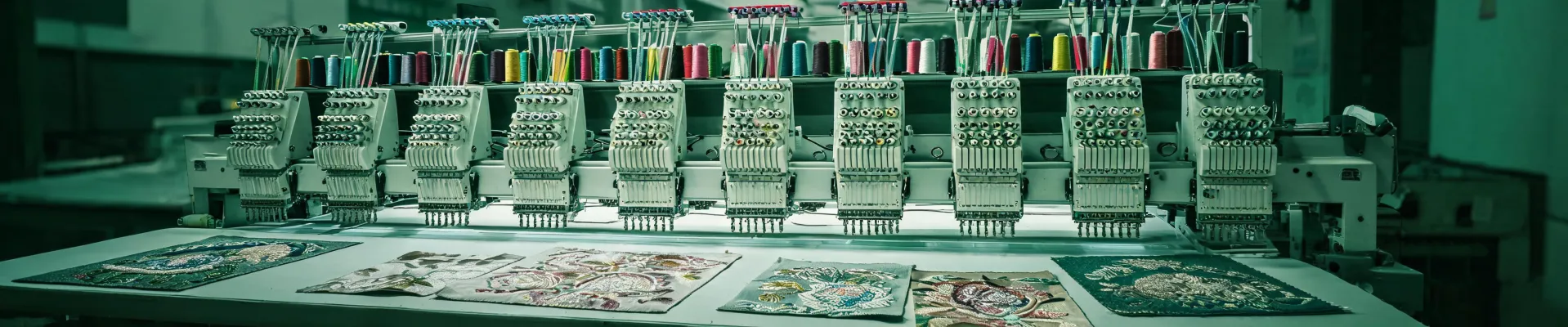
Barudan Embroidery Machines for Sale: An Admin Buyer's FAQ on Hoops, Parts, and When to Skip Industrial
Posted on 2026-09-11 by Elise Marceau
-
What should I check before buying Barudan embroidery machines for sale?
-
How do I know which hoops for Barudan embroidery machine will actually fit?
-
Where should I buy sewing accessories machine parts without getting ripped off?
-
Is a Barudan overkill if I only need a household sewing machine with table?
-
What about a Capella embroidery machine as a comparison?
-
What's the one thing people forget about buying a used Barudan?
-
How do I handle color consistency and thread approval?
I'm the office administrator for a 400-person contract embroidery company. I manage all equipment and parts ordering—roughly $180,000 annually across 9 vendors. I report to both operations and finance. When I took over purchasing in 2020, I didn't know a hoop driver from a cap frame. Since then I've bought two used Barudan machines, replaced more hoops than I can count, and learned some lessons the hard way. Below are the questions I wish I'd asked before cutting a PO.
What should I check before buying Barudan embroidery machines for sale?
First, don't trust stitch count alone. I ask for service records, board photos, and a video of every head running the same design. A 6-head that's been sitting for a year can cost more than a higher-hour machine that's been maintained. Per FTC advertising guidelines (ftc.gov), claims must be truthful and not misleading—but private sellers aren't always careful. Get the model and serial number, then call a Barudan distributor to confirm parts availability. It took me three years and about 150 orders to understand that vendor paperwork and parts support matter as much as the machine itself. This was accurate as of Q1 2025. Used prices change fast, so verify current quotes. This worked for us, but we're a mid-size B2B with predictable volume. If you're seasonal, the calculus might be different.
How do I know which hoops for Barudan embroidery machine will actually fit?
Barudan isn't one machine. A hoop that fits an 8-head may not fit a 4-head, and cap frames are their own headache. Check three things: your model's field size, the hoop driver type, and the bracket/arm clearance. I keep a spreadsheet with the serial numbers and compatible hoops for each of our machines. I once ordered a set that looked right but didn't clear the cap frame (ugh). We couldn't return it because it was a special order. Now I ask for a photo of the hoop on the exact model before buying. If you're ordering hoops for Barudan embroidery machine, buy from a distributor who lists OEM part numbers. Aftermarket hoops can work, but the tolerances aren't always the same. Measure twice, order once.
Where should I buy sewing accessories machine parts without getting ripped off?
Here's the thing: cheap parts usually cost more. I manage 8 vendors for different needs, and I've learned to separate consumables from critical parts. Needles, bobbins, and tension springs? I'll try a reputable aftermarket supplier. Boards, motors, and drivers? OEM or authorized distributor only. In 2022, I found a great price from a new vendor—$1,800 cheaper than our regular supplier. They couldn't provide a proper invoice (handwritten receipt only). Finance rejected the expense report. I ate $2,400 out of the department budget. Now I verify invoicing capability before placing any order. For a sewing accessories machine order, I also check return windows and restocking fees. Real talk: if a vendor won't put terms in writing, they aren't a vendor—they're a gamble.
Is a Barudan overkill if I only need a household sewing machine with table?
Yes, probably. I recommend Barudan for contract shops and apparel manufacturers running production. If you're monogramming gifts, doing alterations, or making 10 shirts a month, a household sewing machine with table is more sensible. Industrial machines want space, power, maintenance, and training. They don't forgive poor hooping. This solution works for 80% of commercial cases. Here's how to know if you're in the other 20%: if your monthly volume is under 500 pieces, or you can't justify a technician visit, don't buy a multi-head Barudan. Look, I'm not saying budget options are always bad. I'm saying they're matched to a different job. The right machine is the one that fits your workload, not the one with the most heads.
What about a Capella embroidery machine as a comparison?
If your search started with a Capella embroidery machine, you're likely comparing entry-level or small commercial units. Barudan is a different tier—industrial multi-head equipment with a dealer/service network. Not better or worse, just different. I can only speak to Barudan in a contract embroidery setting. If you're a home-based business with occasional orders, a Capella may fit your budget and footprint better. If you're bidding on 2,000-piece orders, you'll want industrial throughput. The mistake I see is people buying for their current volume and then growing out of the machine in six months. Three things: specs confirmed, timeline agreed, payment terms clear. In that order. Match the machine to where you'll be in two years, not just today.
What's the one thing people forget about buying a used Barudan?
Training and service. You're not just buying a machine—you're buying a relationship with a tech. After 5 years of managing these relationships, I've come to believe the best machine is the one your local technician can service. In our 2024 vendor consolidation project, I had to consolidate orders for 400 employees across 3 locations. Using a single distributor cut our ordering time from 5 hours to 90 minutes and eliminated the duplicate PO problem we used to have. That only worked because the distributor had Barudan parts and a responsive service team. Before you buy, ask who will fix it when a head goes down. If the answer is a guy on a forum, walk away. This was accurate as of Q1 2025. Verify current service coverage in your area.
How do I handle color consistency and thread approval?
For brand-critical colors, I keep a Pantone book. Industry standard color tolerance is Delta E < 2 for brand-critical colors. Delta E of 2-4 is noticeable to trained observers; above 4 is visible to most people. Reference: Pantone Color Matching System guidelines. Embroidered thread shifts depending on fabric, backing, and density, so I ask for a stitch-out sample before approving a run. We've had a client reject a logo because the blue was off by a hair (unfortunately). Now we build color approval into the timeline. This was accurate as of Q1 2025. Verify current Pantone references and thread lot numbers. If you're buying Barudan embroidery machines for sale, don't forget the thread and backing supply chain—it's part of the real cost.

Elise Marceau
Elise Marceau is an LED display and digital-signage systems analyst covering LED video walls, modular screens, transparent LED, control processors, and indoor or outdoor signage. She applies IEC 62368-1 safety principles while comparing pixel pitch, luminance, contrast, refresh rate, colour uniformity, viewing angle, ingress protection, power density, module serviceability, and signal redundancy. Her specification guides help integrators, venue operators, retailers, and procurement teams align viewing distance, ambient light, content format, installation access, electrical load, and lifecycle support.