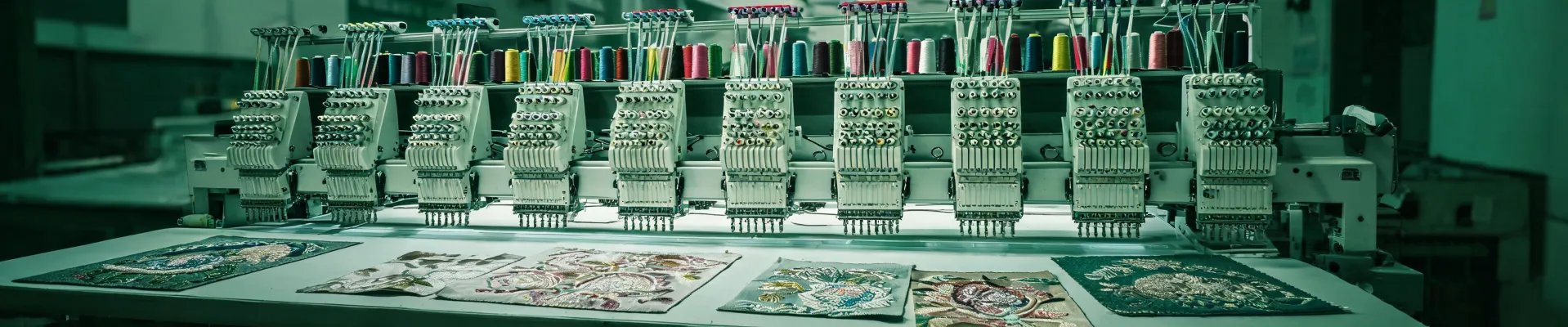
Buying a Barudan Embroidery Machine? Run This 8-Point Checklist First
Posted on 2026-08-27 by Jane Smith
-
Why a Checklist?
-
Step 1: Match the Head Count to Your Order Volume
-
Step 2: Demand the Service Records
-
Step 3: Run a Production Test, Not a Demo
-
Step 4: Verify Parts and Service Support Before You Need It
-
Step 5: Confirm Your Shop's Power and Space
-
Step 6: About That "Embroidery Thread in a Sewing Machine" Question
-
Step 7: DTF Is Not Embroidery
-
Step 8: For Makerspaces, Plan for Your Least Experienced User
-
Common Mistakes to Avoid
-
Final Note on Pricing
Every used Barudan embroidery machine for sale looks good in a photo. The seller's lighting is flattering, the plastic is glossy, and you can't see a single broken needle in a JPEG. The real question is what that machine looks like at hour 400 of a production week—on a Friday, when a client needs 900 pieces by Monday.
I'm the production coordinator at a contract embroidery shop. In eight years, I've handled more rush orders than I can count, including a 36-hour turnaround for a hotel chain that needed embroidered towels before a grand opening. We made that deadline. Barely. And that's exactly the kind of experience that changes how you evaluate equipment. A machine breakdown isn't an inconvenience. It's a missed deadline, a penalty clause, or a lost client.
If you're shopping for a Barudan—whether that's a barudan embroidery machine 6 head for a growing production shop or a single-head for a makerspace embroidery machine setup—this checklist is for you. It's eight checks, and each one has caught a real problem at least once in my shop.
Why a Checklist?
I'll be direct: prevention is cheaper than cure. That sounds like a fortune cookie, but in production, it's arithmetic. Five minutes of verification beats five days of correction.
In 2023 alone, this checklist saved us roughly $11,000 in avoided rework and repairs. I stopped tracking after that—it stopped being a surprise.
Step 1: Match the Head Count to Your Order Volume
A used 6-head Barudan is the most common configuration I see in our industry, and for good reason. It's versatile enough for small- to mid-size runs without demanding the floor space and power of a 10- or 12-head.
But "versatile" isn't the same as "right for you." Before you look at any Barudan embroidery machines for sale, ask yourself: what did my best month last year actually look like? Not your average month—your best month. If your peak production was 2,000 pieces and you're shopping for a 12-head, you'll spend a lot of money on a machine that sits idle. If you're turning away orders because your existing single-head runs 20 hours a day, a 6-head might not be enough of an upgrade.
A side note: I'm not saying a 12-head is never the right choice. Head count should follow order volume, not ambition. I've watched two local shops buy machines they couldn't fill, and both ended up doing contract embroidery for competitors just to keep the machines running.
Step 2: Demand the Service Records
This sounds obvious, but you'd be surprised how many buyers never ask.
Stitch count matters, but service history matters more. A machine with 40 million stitches and consistent maintenance logs is a better buy than a machine with 12 million stitches and no paperwork. Barudan machines are workhorses, but even workhorses need care.
Everything I'd read about buying used equipment said stitch count is the first filter. In practice, I've found the opposite. What I mean is: service history and the seller's attitude tell you more than the odometer. A machine that's been maintained will outlast a neglected machine with half the mileage.
Ask for maintenance logs, records of needle bar and rotary hook replacement, repair invoices from the last 24 months, and a description of the seller's care routine. If the seller can't produce any of this, that's not necessarily a dealbreaker—but it's a reason to adjust your offer and budget for an immediate service visit.
Step 3: Run a Production Test, Not a Demo
A demo stitch-out is designed to succeed. The seller runs a clean, simple design at moderate speed, and the machine looks fine. Great. That tells you nothing.
Bring your own files. Specifically, bring the densest, fussiest designs you produce—the ones with small lettering, dense satin columns, and tricky underlay. Run them at normal production speed for at least 15 minutes without babysitting the machine. You're looking for skip stitches, thread breaks, and tension drift.
One experience in particular shaped this rule. In March 2024, we evaluated a used 6-head for a contract order with a 48-hour turnaround. The demo stitch was flawless. Our test file broke eight needles in the first half hour and exposed a timing issue the seller "hadn't noticed." We walked away. (Should mention: that seller listed the machine again the following week—at a reduced price.)
Step 4: Verify Parts and Service Support Before You Need It
Barudan's reputation rests on reliability, but reliability is only half the equation. You also need to know who services the machine in your area and how fast they respond.
When I'm triaging a machine purchase, I check three things: distance to the nearest authorized technician, typical emergency response time, and availability of common parts like rotary hooks, needles, and thread break sensors.
I should add: if you're buying from a private seller, ask whether they have a service relationship you can inherit. We've had excellent luck with an independent technician who used to work at an authorized dealer. In my opinion, that relationship is worth as much as the machine itself.
Step 5: Confirm Your Shop's Power and Space
This is the unglamorous step that catches people off guard. A 6-head Barudan is a big machine. It needs clearance for the table, the multiple heads, and the operator to move around. It also needs air supply for the thread trimmers and—unless you've arranged otherwise—three-phase power.
Three-phase power is the big one. Many small shops and makerspaces run on single-phase only. Converting can cost thousands, and it's not always possible if your landlord won't upgrade the building's service. Verify this before you sign anything. Also measure your doorways and freight elevator. I know a shop that had to crane a machine through a second-floor window because it wouldn't fit in the elevator.
Step 6: About That "Embroidery Thread in a Sewing Machine" Question
I get this question a lot from people new to the industry: can you put embroidery thread in a sewing machine?
The short answer is yes, for decorative topstitching or free-motion work. The longer answer is that you'll fight tension issues, because embroidery thread is lighter than sewing thread and behaves differently at high speed. For a standard sewing machine, I'd suggest starting with 40-weight rayon or polyester and testing on scraps before committing. I want to say the usual pairing is a size 75/11 needle with 40-weight thread, but don't quote me on that—every machine is different.
Let me rephrase that more broadly: don't expect a sewing machine to do what a multi-head embroidery machine does. For practice projects, use whatever thread you have. For commercial production, use the right tool—and the right thread.
Step 7: DTF Is Not Embroidery
If you searched "DTF embroidery machine," you're not alone. DTF—direct to film—is a printing process that uses adhesive powder and heat transfer. It's a completely different technology from embroidery, and it's used when you want low-cost, quick-turn garment decoration without the texture or cost of stitched designs.
Some shops run both. They embroider where the brand demands a premium look and use DTF for the budget-friendly, fast-turn items. That's a legitimate hybrid setup, but it requires two machines. No embroidery machine prints DTF films, and no DTF printer embroiders. If a marketing page claims otherwise, run away.
I've seen at least a dozen buyers combine these two searches and end up with the wrong equipment. This is one of those cases where thirty seconds of research saves you a very expensive mistake.
Step 8: For Makerspaces, Plan for Your Least Experienced User
A makerspace embroidery machine has a unique problem. Unlike a production shop, where experienced operators run the equipment, a makerspace machine gets used by everyone who pays a membership fee—and most of them have never touched an embroidery machine.
If you're buying for a makerspace, a used single-head Barudan is a solid choice because it's built to take a beating. But you need three things in place:
- A training and certification process before anyone is allowed to operate the machine. This alone will cut your maintenance costs significantly.
- A repair budget. Makerspace machines get abused—not maliciously, but by a steady stream of beginners making beginner mistakes. A service contract and an annual preventive maintenance visit are worth it.
- A clear policy for who fixes what. We helped a local makerspace set up their machine room, and the biggest recurring issue wasn't stitch quality. It was needles and bobbin cases being installed incorrectly. A laminated photo instructions sheet on the wall solved most of it.
Common Mistakes to Avoid
After eight years of doing this, here are the mistakes I see most often:
Skipping the production test. The demo looks good, you skip step three, and you discover at 9pm on a Monday that the machine can't hold tension on your logo density.
Trusting a low price without understanding why it's low. Sometimes a cheap used Barudan is a genuine deal. More often, it's a machine sitting in a warehouse for three years with dry bearings. If the price is far below market, treat it as a red flag, not a bargain.
Buying before confirming power and space. I mentioned this in step five, but I'll repeat it because it's the most expensive mistake on this list. A machine you can't power or install is an expensive sculpture.
Final Note on Pricing
Used 6-head Barudan machines in good condition were ranging from roughly $20,000 to $45,000 on major equipment marketplaces as of Q1 2025, depending on age, hours, and included accessories. That's a wide range, and the market changes fast, so verify current listings before you budget. Also factor in $2,000 to $4,000 for delivery, installation, and an initial service visit.
Can you skip some of these checks and still get lucky? Probably. But in my experience, "lucky" isn't a production strategy. The process is simple: five minutes of verification now saves five days of correction later. If you run through these eight checks honestly, you'll have given yourself a serious head start.

Jane Smith
I’m Jane Smith, a senior content writer with over 15 years of experience in the packaging and printing industry. I specialize in writing about the latest trends, technologies, and best practices in packaging design, sustainability, and printing techniques. My goal is to help businesses understand complex printing processes and design solutions that enhance both product packaging and brand visibility.