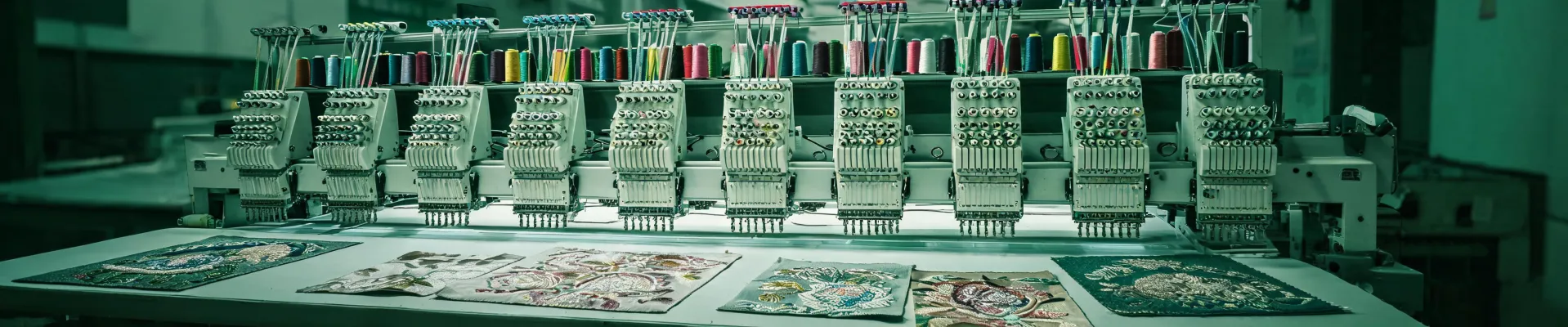
Embroidery Machine FAQ: Barudan, Makerspace Rigs, PE545, and Magnetic Hoops
Posted on 2026-09-22 by Elise Marceau
-
What actually separates Barudan machines from other industrial embroidery equipment?
-
How do I inspect a used Barudan machine before I pay for it?
-
Do I actually need an 8-head Barudan machine, or is fewer smarter?
-
What's the difference between a Brother PE545 and an industrial machine?
-
What should a makerspace embroidery machine actually be?
-
Are magnetic hoops for a Janome embroidery machine worth the money?
-
What's the one thing nobody warns you about in embroidery?
I'm the quality and brand compliance manager at a contract embroidery shop. I review 200+ unique embroidery runs a year before they ship, and I sign off on equipment specs before any machine gets ordered. These are the questions I get asked most — roughly in order of frequency — from operators, makerspace coordinators, and first-time buyers looking at used equipment. Short answers up front, longer ones where it matters.
What actually separates Barudan machines from other industrial embroidery equipment?
It isn't peak stitch speed. Most industrial multi-heads hit similar numbers on paper. What separates Barudan machines is how little drifts over time: thread tension holds across a run, needle positions stay true after thousands of needle changes, and the control systems survive eight to twelve hours a day without needing a reboot or a tech visit. Our 2019 six-head unit was still punching near-identical stitch quality in 2024 on the same fabrics. The only intervention was routine maintenance.
The other thing that doesn't get mentioned enough is head configuration range — Barudan goes from 1 head up to 12 heads on the same basic platform. That means scaling from a 4-head setup to an 8-head setup involves a lot less relearning than switching brands entirely. Reliability is the brand claim, and in commercial embroidery, that's the one that actually shows up on your P&L.
How do I inspect a used Barudan machine before I pay for it?
Power it on and let it run empty for fifteen minutes. Just listen. Bearing whine, inconsistent needle-bar sound across heads, or one head sounding noticeably different will tell you more than any spec sheet. Then run a count — the machine's own stitch counter gives you a rough idea of how hard it's been worked.
Bring a checklist (I know, the checklist thing again — but it's the cheapest insurance you'll ever buy):
- Test-stitch the same design on every head, not just one
- Run each head on its own and watch tension consistency
- Check needle plates for grooves — that's long-term wear
- Inspect drive belts and motor couplings
- Ask whether control boards have been replaced (and why)
- Request maintenance records. No records means budget $1,000–$2,000 for deferred fixes
I only believed the maintenance-records rule after ignoring it once. We bought a cheap used 4-head in 2019 with "recent service" and no paperwork. The spindle drive failed in month four. Roughly $2,400 in parts and three days of lost production. Every used-machine contract I touch now includes a spec sheet with maintenance history as a condition of sale.
Do I actually need an 8-head Barudan machine, or is fewer smarter?
Everything I'd read said more heads means more output means better business. In practice, for a shop in its first 18 months, fewer heads is often the better call. An 8-head Barudan runs about 8x the threading, 8x the hoop changes, and 8x the color-change downtime per run — unless you're filling the bed consistently, you're paying for capacity you're not using. Two 4-heads also beat one 8-head when you need to run different jobs in parallel, which small contract shops do constantly.
The honest math: 8 heads pays off when you're running the same design across 200+ pieces regularly. Below that, a 4-head plus a second 4-head later is a lower-risk path.
What's the difference between a Brother PE545 and an industrial machine?
The Brother PE545 is a single-needle home embroidery machine with a limited hoop area. It's genuinely useful for one-off gifts, small custom pieces, and proofing designs before you commit thread on a commercial run. It is not built for volume, it doesn't handle industrial stabilizers or thick fabrics gracefully, and running it eight hours a day will shorten its life fast. As of early 2025, used PE545 units typically trade in the $400–$900 range depending on condition and accessories — verify current pricing, since the used market for discontinued home machines moves a lot.
If your workload is "twenty pieces a week, all different," the PE545 makes sense. If it's "twenty pieces a day, same design," you need a commercial machine — and not just because of speed, but because the frame, tensioner, and needle bar are built for what you're asking them to do.
What should a makerspace embroidery machine actually be?
A makerspace embroidery machine has one job the home-user market doesn't: survive new users. That means simple threading, obvious tension controls, no fragile plastic parts in high-touch areas, and published maintenance instructions a volunteer can follow. In my experience, a single-head commercial machine beats a premium home machine here — not because it's fancier, but because it takes abuse and keeps calibration. Home machines tend to lose timing after enough user errors, and recalibrating them every few weeks gets old fast.
Whatever you pick, put a 10-minute sign-off checklist next to it and require it before each use. Saves a lot of grief (note to self: apply this to our own equipment too).
Are magnetic hoops for a Janome embroidery machine worth the money?
They solve two real problems: fast hooping, and no hoop burn on sensitive fabrics. That's genuinely useful for small custom work. The tradeoffs are real, though — magnetic hold can be uneven on larger designs, and the magnets can interfere with the needle area on some setups. On dense or heavy designs, I've seen more distortion with magnetic hoops than with traditional screw hoops.
I don't have hard data on failure rates across the category, but based on the jobs we've run, magnetic hoops are worth it for small, light designs and proofing. For production runs on structured garments, stick with standard hoops plus a good adhesive or topping. As of January 2025, a decent set runs $80–$200 depending on size — check current pricing before assuming it's cheap.
What's the one thing nobody warns you about in embroidery?
Fabric stability matters more than the machine. Everyone warns you about tension, needle choice, backing, thread weight. Nobody warns you that a beautifully dialed-in machine still produces garbage on an unstable substrate. They warned me, and I didn't listen — we ran 60 caps on a stretchy crown without the right backing, and the embroidery puckered on every single one. That was a $1,600 redo plus a very uncomfortable customer call.
Five minutes verifying fabric prep beats five days of fixing finished goods. Every time.

Elise Marceau
Elise Marceau is an LED display and digital-signage systems analyst covering LED video walls, modular screens, transparent LED, control processors, and indoor or outdoor signage. She applies IEC 62368-1 safety principles while comparing pixel pitch, luminance, contrast, refresh rate, colour uniformity, viewing angle, ingress protection, power density, module serviceability, and signal redundancy. Her specification guides help integrators, venue operators, retailers, and procurement teams align viewing distance, ambient light, content format, installation access, electrical load, and lifecycle support.