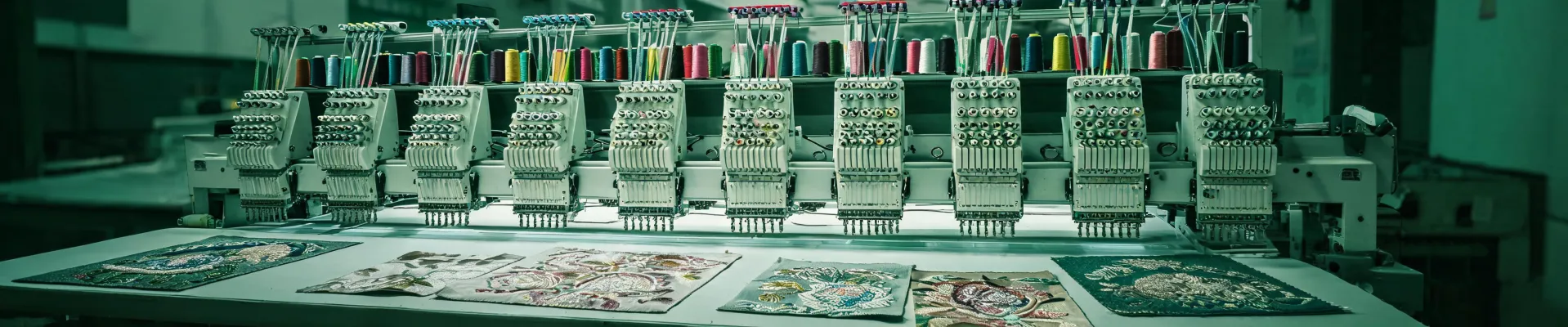
Barudan 12-Head Embroidery Machine Price: Stop Optimizing the Sticker
Posted on 2026-09-22 by Elise Marceau
-
The sticker price is not the number that decides whether you make money
-
Argument 1: Downtime and hoop mistakes cost more than the machine discount
-
Argument 2: Simple designs expose bad digitizing faster
-
Argument 3: Parts and service are the unglamorous efficiency multiplier
-
The counterargument: higher upfront cost is still higher upfront cost
-
What I would ask before signing a Barudan 12-head quote
-
My verdict: track cost per quality stitch, not sticker price
The sticker price is not the number that decides whether you make money
I work as a quality and brand compliance manager at a commercial embroidery company. I review every machine spec, hoop order, and digitized file before it reaches production—roughly 200 items a year. In 2024, I rejected about 30% of first deliveries because of spec mismatches. Not because vendors were dishonest. Mostly because we were using the same words and meaning different things.
If you are shopping for a Barudan 12-head embroidery machine and the first question is 'what is the price,' you are optimizing the wrong number. In my opinion, efficiency is the competitive advantage. Not the lowest sticker price. The lowest waste.
That does not mean price does not matter. It does. But a Barudan 12-head embroidery machine price is only one line in a three-year cost model. The other lines—downtime, rework, hoop changes, digitizing edits, parts delays—are where the real money hides.
Argument 1: Downtime and hoop mistakes cost more than the machine discount
In our Q1 2024 quality audit, we traced a rework issue back to a communication failure. I said 'standard hoop.' The supplier heard 'whatever hoop fits.' Result: 500 left-chest logos hooped off-center. We caught it after 900 pieces. The redo cost us about $6,800 in thread, backing, labor, and a late shipment credit. Not ideal. But workable. We learned.
This is why I care about Barudan embroidery hoops more than most people expect. Hoops are not glamorous. They are basically the interface between your design and your machine. If the hoop is inconsistent, the registration is inconsistent. If the registration is inconsistent, your operator spends the shift adjusting instead of producing.
Barudan's hoop range—including magnetic hoops and specialty frames—matters because it reduces the number of 'adapters on adapters' moments. Fewer workarounds means fewer chances for a simple job to become a quality problem. From my perspective, that is efficiency you can bank.
Argument 2: Simple designs expose bad digitizing faster
There is a myth in embroidery machine news that machine embroidery simple designs are forgiving. I would argue the opposite. A simple three-color logo with clean edges shows every registration error. A busy design can hide a lot. Simple designs cannot.
In 2023, we ran a blind test with our production team. Same simple left-chest logo, two digitized files. One file required 14 operator touch-ups per 100 pieces. The other ran with two stops. The better file cost $75 more to digitize. On a 5,000-piece run, the time difference was roughly nine hours of machine and operator time. At our internal rate of about $65 per hour, that is $585 saved. The math is not close.
That is why I treat the digitizing embroidery machine workflow as part of the equipment decision, not a separate purchase. A reliable machine with a bad file is still slow. A good file on a well-maintained Barudan is boring—in the best way. Boring means repeatable.
Argument 3: Parts and service are the unglamorous efficiency multiplier
Embroidery machine news loves new head counts, new speeds, and new features. In a real shop, the important question is simpler: when something goes down, how fast does it come back? A 12-head machine that sits for a week is worse than a 6-head machine that runs two shifts.
I am not 100% sure every market has the same spares depth, but in our region, Barudan's service and parts support has been pretty solid. That matters because efficiency is not just cycle speed. It is uptime. It is also the confidence to take a rush order because you know you can keep the heads running.
That is the part of the Barudan 12-head embroidery machine price conversation that rarely makes it into a quote sheet. Training. Phone support. Access to consumables. A service network that does not treat you like a stranger after the invoice clears.
The counterargument: higher upfront cost is still higher upfront cost
Let me address the obvious pushback. Yes, a Barudan 12-head machine usually costs more upfront than lower-cost alternatives. If you run one shift, have low volume, and mostly produce simple one-off items, a used single-head or 4-head machine may be the smarter buy. I would not argue with that. Efficiency is not about buying the biggest machine. It is about matching capacity to demand.
But if you are buying a 12-head to hit contract deadlines, the cheapest upfront price can become the most expensive decision. Even after choosing Barudan hoops and a higher-spec machine, I kept second-guessing myself. What if the aftermarket hoops were fine? What if the lower-priced option could hold registration? The two weeks until our first production run were stressful. Then the first run finished with fewer stops and less operator intervention than our old setup. That was the signal I needed.
What I would ask before signing a Barudan 12-head quote
When you request a Barudan 12-head embroidery machine price, do not stop at the number. Ask for the total scope:
- Which Barudan embroidery hoops are included, and which are extra?
- What is the realistic training time for your operators?
- What is the expected parts turnaround in your region?
- Does the quote include digitizing support or a preferred digitizing embroidery machine workflow?
- Can you test a few machine embroidery simple designs on the actual machine before you commit?
Per FTC advertising guidance (ftc.gov), price and performance claims should be truthful and substantiated. So if a quote promises the lowest cost or the best uptime, ask for the data behind it. I am not quoting exact 2025 prices here because configurations, regions, and availability move too fast. Take this with a grain of salt and verify current pricing with a dealer.
My verdict: track cost per quality stitch, not sticker price
So, bottom line: I believe efficiency is competitiveness. Not the lowest price. The lowest waste. For a commercial embroidery business, that means fewer hoop changes, fewer digitizing edits, fewer surprise delays, and more reliable production hours.
If you are comparing Barudan to other options, compare the full system. Machine. Hoops. Digitizing. Service. Training. Then run the three-year math. The Barudan 12-head embroidery machine price may look higher on day one. If it keeps your heads running and your rejects low, it can be the cheaper machine by the end of the first contract.
Exactly what we needed. Not the cheapest. The one that stops costing you money after the invoice.

Elise Marceau
Elise Marceau is an LED display and digital-signage systems analyst covering LED video walls, modular screens, transparent LED, control processors, and indoor or outdoor signage. She applies IEC 62368-1 safety principles while comparing pixel pitch, luminance, contrast, refresh rate, colour uniformity, viewing angle, ingress protection, power density, module serviceability, and signal redundancy. Her specification guides help integrators, venue operators, retailers, and procurement teams align viewing distance, ambient light, content format, installation access, electrical load, and lifecycle support.