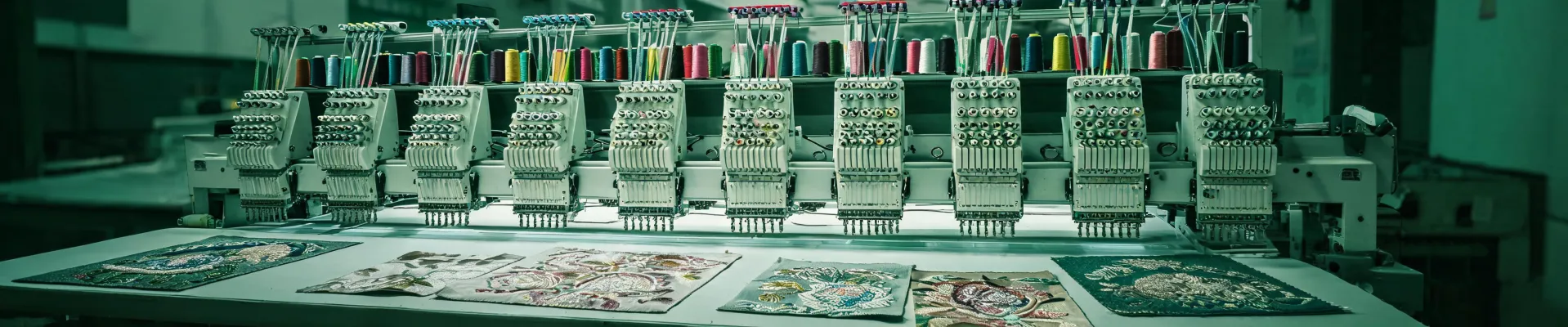
I've Handled 200+ Rush Orders. Here's Why I Choose Multi-Head Barudan Machines
Posted on 2026-09-10 by Elise Marceau
-
The evening that changed how I buy machines
-
Barudan is not a luxury. It is a support system
-
Embroidery hoops for Barudan machines are not an afterthought
-
What about the SE2000 embroidery machine?
-
Why many embroiderers also need an industrial leather sewing machine walking foot
-
The objection I keep hearing from first-time buyers
-
After 200 rush orders, my view has only gotten stronger
If you are shopping for commercial embroidery equipment the same way you would shop for a printer, stop. You might compare stitch speed, hoop sizes, and price per head. None of that tells you what matters.
What matters is this: when a client needs 120 caps by tomorrow morning and the test stitch comes out wrong, can this machine keep you alive? That is it. That is the whole conversation.
I coordinate production for a contract embroidery company. In eight years, I have handled 200+ rush orders, including same-day turnarounds for clients who had no backup plan. That experience made me an equipment snob, but not the brand-snob kind. I do not care which machine looks best in a brochure. I care whether it can still be running at 4:00 a.m. when the order is due at 7:00 a.m.
If you ask me, that is the only real question in this buying decision. And it is exactly why our production floor runs Barudan machines.
The evening that changed how I buy machines
In March 2024, a customer called at 2:00 p.m. They needed 120 embroidered caps at a conference registration desk by 6:30 the next morning. Our normal turnaround on 120 caps is five business days. The client's alternative was showing up with blank caps and sticker labels. That would have made their team look unprepared, and the event organizer had made it clear the booth space was not guaranteed.
We digitized a logo, stitched a test sample, tweaked the density, and loaded a 12-head Barudan. The machine ran through the night with almost no babysitting. We did quality checks, packed the order, and delivered it at 6:10 a.m.
The surprise was not that an industrial machine can stitch fast. The surprise was how little supervision it needed. If I had tried the same order on a single-head machine, someone would have spent the night changing hoops and thread colors to get the same result. That is the difference between a machine made for production and a machine made for projects.
Barudan is not a luxury. It is a support system
Every industrial embroidery machine will break eventually. Anyone who promises otherwise is selling something. What matters is what happens after the machine breaks.
Barudan has been around long enough that parts suppliers, independent technicians, and experienced operators know how to work on them. When we need support, we do not have to explain how a multi-head works. We order parts and keep the line moving. For a shop that accepts deadline work, that support network is the product.
It is also why the used Barudan market makes sense. I have seen 20-year-old machines still producing saleable work. A machine that holds its value because it keeps running is not an expense. It is an asset.
Embroidery hoops for Barudan machines are not an afterthought
Here is a sentence I never expected to say about rush orders: the hoop system improved our consistency more than the machine upgrade did. Seeing the same design fail because a frame sat unevenly made me realize everything is connected. If the fabric shifts by one millimeter during a run, the last hour of production is wasted.
When someone asks me about embroidery hoops for Barudan, I treat that as a technical question, not a shopping question. A hoop that does not match the machine's mounting system will cause registration problems. In a rush-order situation, that can mean missing the delivery window entirely.
Buy from a source that can confirm compatibility with your specific Barudan model. Ask about cap frames, flat hoops, and tubular options. Learn the difference before the emergency hits, not during it.
What about the SE2000 embroidery machine?
Let me slow down before anyone thinks I am bashing smaller machines. I am not. The SE2000 embroidery machine is a solid machine for learning, sampling, monograms, and small custom orders. If that pace works for the business you want, this article is not aimed at you.
But if your goal is to take orders from companies with hard deadlines, a single-head machine creates a bottleneck. There is no way to spread one design across multiple products at once. Every color change happens manually. Every new cap requires a new hoop and a new registration check. The work does get done, but the economics change when you count your labor.
Apply the same logic if you see a used listing for an FDZ embroidery machine at a price that sounds too good to ignore. Maybe it is a perfectly fine machine. I can't tell from a listing. What I can tell you is to ask tougher questions: Where do parts come from? Who repairs it? Can you get the correct hoops? If no one answers with confidence, that machine is not production equipment. It is a project.
Why many embroiderers also need an industrial leather sewing machine walking foot
Here is a piece of advice that has nothing to do with thread tension. An embroidery machine decorates material. It does not turn that material into a finished product. When a client asks for embroidered leather portfolios, the logo is only part of the job. The panels still need to be sewn together with seams that hold.
That is where an industrial leather sewing machine walking foot earns its place. The walking foot and the feed dogs move together, so leather, vinyl, and other tricky layers stay aligned. Without that, seams pucker and products look amateur no matter how clean the embroidery is.
In our shop, the Barudans and the walking-foot machines are both busy. They are not competitors. They are teammates. Trying to make one machine do both jobs is a mistake that shows up right around deadline time.
The objection I keep hearing from first-time buyers
Someone will read this and think: easy for you to say. A multi-head Barudan costs more than my entire setup right now.
Fair. Budgets are real, and I understand that. But the purchase price is not the only cost. The real cost of a machine includes your labor, the redo rate, the availability of parts, and the value of the deadlines you can keep.
If you cannot buy new, look for a used machine from a dealer who can show the service history. You might not start with twelve heads, but you can start with a system that will not leave you stranded. In my opinion, that is worth more than any feature list.
After 200 rush orders, my view has only gotten stronger
I would rather spend ten minutes helping a customer understand head configurations and hoops than clean up a mismatched equipment decision later. An informed customer is the best customer.
The most useful information I can offer is this: buy equipment based on how it behaves when everything is on the line. After years of deadlines, I choose Barudan for production. I buy the right embroidery hoops for Barudan machines before I need them. I keep a single-head machine for samples and small jobs. And if leather is part of my product line, I make sure an industrial leather sewing machine walking foot is already in the building.
That is not brand loyalty. That is risk management. When the clock is running, nothing else pays.

Elise Marceau
Elise Marceau is an LED display and digital-signage systems analyst covering LED video walls, modular screens, transparent LED, control processors, and indoor or outdoor signage. She applies IEC 62368-1 safety principles while comparing pixel pitch, luminance, contrast, refresh rate, colour uniformity, viewing angle, ingress protection, power density, module serviceability, and signal redundancy. Her specification guides help integrators, venue operators, retailers, and procurement teams align viewing distance, ambient light, content format, installation access, electrical load, and lifecycle support.