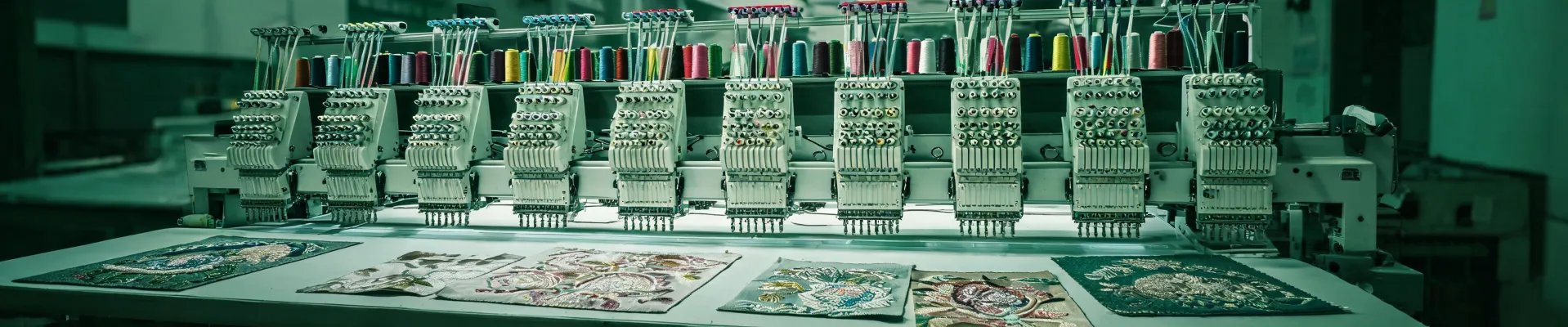
Magnetic Hoops vs. Standard Hoops for Barudan: A Real-World Comparison from the Production Floor
Posted on 2026-07-24 by Elise Marceau
Magnetic Hoops vs. Standard Hoops: Which Keeps Your Barudan Running?
If you're running a Barudan embroidery machine—whether it's a 6-head, 8-head, or a 15-needle single-head—you've probably asked yourself this: should I switch to magnetic hoops?
I've been in that exact position. In my role coordinating production at a contract embroidery shop, I've managed hundreds of jobs on Barudan machines, from small custom runs to large-scale apparel contracts. We've used standard mechanical hoops for years. But last year, we finally made the switch to magnetic hoops for about 60% of our work. Here's what I found.
This isn't a marketing piece. It's a direct, no-nonsense comparison based on real results from my shop. We'll look at three key areas: setup time, fabric handling, and overall hoop quality.
Setup Time: The Rush Order Factor
This is where the difference hits you immediately. If you've ever had a client call at 4 PM on a Friday needing 500 hats for a Saturday event (and I have), you know every minute counts.
Standard Hoops
Loading a standard mechanical hoop is a precise, two-handed operation. You have to loosen the outer ring, place the fabric, position the inner ring, and then tighten four screws in a specific sequence to avoid distortion. For a novice operator, this can take 45 seconds to a minute per hoop. For an experienced operator, maybe 20-30 seconds. On an 8-head machine, that's 2-4 minutes of setup time per garment change.
Magnetic Hoops
With magnetic hoops, you place the fabric on the base, press down the magnetic top ring, and you're done. It's a one-second operation. Honestly, I was skeptical at first. I thought the magnetism wouldn't hold tight enough. But for most fabrics, it's astonishingly effective.
The verdict: On a typical 200-piece rush order of polo shirts, switching to magnetic hoops saved us about 1.5 hours of total setup time. That's a massive difference when you're up against a deadline. (This was in Q3 2024, during a crunch for a corporate event order.)
Of course, there's a caveat: my experience is based on our shop's volume of around 300 rush orders per year. If you're doing very small batches or extremely high-end custom work, the time savings might be less dramatic for you.
Fabric Handling and Hoop Burn
One of the biggest frustrations with standard hoops is hoop burn—those permanent marks or distortions left on the fabric by the mechanical pressure of the hoop. This is a deal-breaser for delicate materials like satin, silk, or lightweight performance fabrics.
Standard Hoops
Standard hoops require significant mechanical pressure to hold the fabric taut. Over-tightening is a common mistake that causes hoop burn. Even with careful technique, you'll still get some marks on certain fabrics. We've rejected whole batches of garments because of this.
Magnetic Hoops
Magnetic hoops distribute pressure more evenly. The magnetic force holds the fabric flat without the need for aggressive clamping. On most lightweight and medium-weight fabrics, the result is virtually zero hoop burn. We've run thousands of pieces on satin and microfiber with no issues whatsoever.
That said, I've never fully understood why the mechanism works so well for some fabrics and not others. My best guess is it has to do with the fabric's weave density and how it interacts with the magnetic field. If a fabric engineer reads this and can explain, I'd love to hear it.
The verdict: Magnetic hoops win for 90% of common embroidery fabrics. The only exception is very thick materials like fleece or heavy denim, where the magnetic grip can sometimes be insufficient—we still use standard hoops for those.
Hoop Quality and Long-Term Durability
Here's where I found an unexpected twist.
I assumed magnetic hoops would be flimsy. They feel lighter and less robust than the heavy-duty mechanical hoops. But in practice, the quality has been outstanding. Our first set of magnetic hoops (purchased about 18 months ago) shows almost no wear. The magnetic holding force hasn't weakened.
Standard hoops, by comparison, need regular maintenance. The screws can strip. The inner rings can warp if dropped. Over two years, we had to replace about 15% of our standard hoop sets due to wear.
I don't have a hard data source for the long-term failure rates of magnetic hoops across the industry. But based on our internal records from 200+ hoop rotations, the magnetic ones are holding up better.
The verdict: Contrary to my initial expectation, magnetic hoops actually offer comparable or better long-term durability for most applications. (Surprise, surprise.)
When to Choose Which System
There's no single right answer. Here's my advice based on real-world scenarios.
- Choose magnetic hoops if: You do high-volume production, hate hoop burn, and need fast changeovers. They're perfect for a 6-head Barudan doing large orders of polo shirts, hats, or jackets.
- Stay with standard hoops if: You primarily work with very thick fabrics (fleece, heavy canvas) or need absolute control for ultra-precise positioning on complex designs.
- Hybrid approach (what we do): Keep a set of both. Use magnetic hoops as your go-to for 90% of jobs. Keep standard hoops for the tough cases.
In my shop, we now use magnetic hoops for 90% of jobs. The time savings alone made the switch worthwhile (note to self: we really should document the ROI formally). If you're running a Barudan 15-needle machine or any multi-head system, this is one upgrade that pays for itself in a few months.

Elise Marceau
Elise Marceau is an LED display and digital-signage systems analyst covering LED video walls, modular screens, transparent LED, control processors, and indoor or outdoor signage. She applies IEC 62368-1 safety principles while comparing pixel pitch, luminance, contrast, refresh rate, colour uniformity, viewing angle, ingress protection, power density, module serviceability, and signal redundancy. Her specification guides help integrators, venue operators, retailers, and procurement teams align viewing distance, ambient light, content format, installation access, electrical load, and lifecycle support.