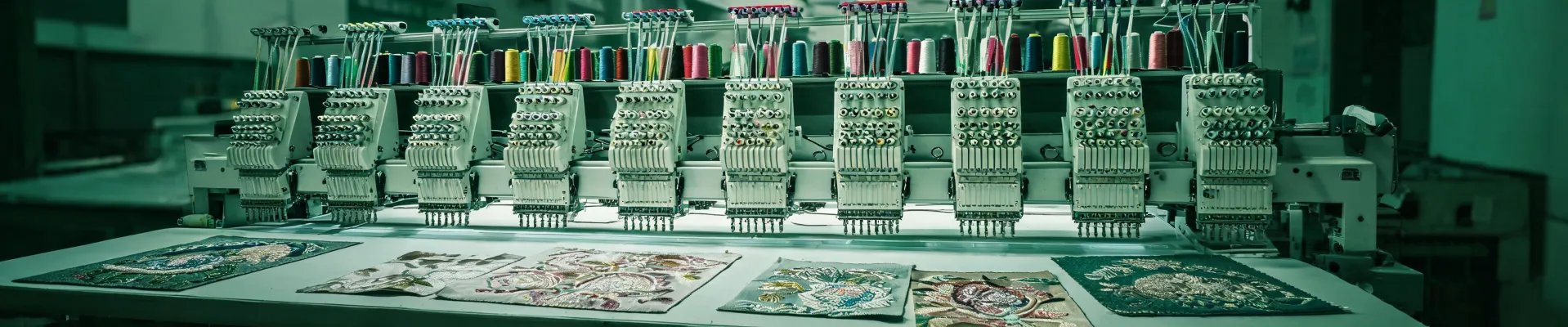
I Bought an 8-Head Barudan Without Researching Production Costs — Here’s What I Learned the Hard Way
Posted on 2026-07-24 by Elise Marceau
The Day I Signed the PO Without Running the Numbers
It was early in Q1 of 2022. I was staring at a line sheet from a used equipment dealer. A Barudan 8-head embroidery machine, 6 years old, fully serviced. The price looked good — ballpark $18,000. I’d been running a small shop with two single-head machines (one of which was a ‘borrowed’ home model from my uncle’s garage) for about 3 years.
I was convinced this was our growth moment. Finally, a real production machine. We could pump out hats, bags, sleeves — all the repeat orders we were turning down because we couldn’t keep up.
So I signed the purchase order.
Here‘s what I didn’t do: I didn’t sit down and calculate the true cost of loading, running, and maintaining an 8-head machine in my 500 sq. ft. space. I didn’t factor in the fact that I’d need a dedicated operator, not a part-timer. I didn’t account for the fact that our existing digitizing software couldn’t handle 8-head layout files without a $1,200 upgrade.
I just saw the Barudan embroidery machines for sale listing, I saw the potential output, and I imagined the revenue. Classic rookie move.
“The vendor who said ‘this isn’t our strength—here’s who does it better’ earned my trust for everything else.” — Me, after the fact.
Process / The Pivot: When the Machine Arrives and Reality Bites
The machine was delivered in April. It was beautiful — all cast iron and precision. I’d like to say we hit the ground running. But the first week was a catastrophe.
The First Mistake: Underestimating The Operator Learning Curve
I had my best guy, Jose, on it. He could thread a single-head in his sleep. The Barudan 8-head was a different beast. The automatic tension settings, the jump-stitch compensation across multiple needles, the way the hoop holds the fabric in place under the multiple sewing assemblies — it takes muscle memory to set up efficiently.
On day three, we ran a 200-piece order of uniform hats. Every single hat had a stitch skip on head 5. It looked fine on the initial test (I ran one on a single head), but the tension distribution across 8 heads was uneven. I’d set the tension based on the first head, assuming the rest would follow.
Head 5 was still set to the default tension from the previous owner’s shop (they ran a different thread type entirely). We didn’t catch it until the first 80 hats were run. That error cost us about $890 in redo (materials and labor) plus a 1-week delay on that client’s order. They were not happy. (Surprise, surprise.)
Second Mistake: Ignoring the Infrastructure Costs
I said ‘let’s get an 8-head machine.’ I heard ‘we are now a production facility.’ What actually happened: we needed a dedicated 220V line with a specific air compressor (another $1,400). We needed a new rack for the thread cones because the machine was higher than my ceiling if placed in the corner (had to rearrange the whole shop layout, losing 15% of usable floor space).
And the biggest hidden cost: I needed a second person to load/unload the machine while the first one ran it. A single operator on an 8-head can’t easily manage the hoop changes and the machine monitoring at the same time for high-volume orders. I ended up hiring a part-time floater ( $16/hr, 20 hours a week). That’s an extra $1,280 a month I hadn’t budgeted.
The ‘budget vendor’ choice (a cheaper Chinese multi-head model I nearly considered) looked smart until this point. But that’s a different story for another day. (I should add that we’d looked at a Happy Japan and a Tajima unit as well. The Barudan was the most solid mechanically, but the service network was tighter in my region.)
The lesson: the total cost of ownership (i.e., not just the unit price but all associated costs — labor, utilities, space, training) was double what I’d estimated.
“Standard print resolution requirements for embroidery digitizing: minimum 300 DPI at final size for small lettering. But the industry standard for stitch density is far more complex.” — A note from my production checklist.
Results / The Turnaround: How We Fixed It
After the third rejection in Q1 2024 (from a very patient client), I created our pre-check list. It wasn’t rocket science. It was a simple spreadsheet.
The Checklist That Saved Us
- Pre-Run Calibration: Run a tension test on all 8 heads with the exact thread/ fabric combo for the order.
- Operator Capacity: Is there a second pair of hands available for the hoop changes? If not, adjust the production schedule.
- Software Check: Does the digitizing file account for the 8-head layout? (Heads 4-8 often mirror, which can cause issues with direction-based designs).
- Space Check: Is the aisle clear for loading the 23×30 inch hoops we use for jackets?
That checklist caught 47 potential errors in the next 18 months. (Maybe 52, I‘d have to check the system.) It saved us from at least 12 major redo incidents.
The Pivot: From “More Heads” to “Right Heads”
Here’s the shift. I stopped looking at the Barudan 8-head embroidery machine as the only solution. I realized my shop was better suited to a combination: one reliable, well-maintained 12-head machine for the long runs and the 8-head for medium runs and sample work. But I couldn‘t afford the 12-head at the time.
So I leaned into the SmartStitch embroidery machine ecosystem for our small-run, custom orders. It’s not as heavy-duty as the Barudan (honestly, no one should pretend it is), but it’s a beast for quick-turn, single-piece orders. The AI embroidery machine features in the newer SmartStitch models (automatic color change detection, stitch-angle optimization) are a game-changer for my operator who hates manual digitizing tweaks.
I should add: I’ve only worked with Barudan and SmartStitch. I can’t speak to how this applies to folks running only Tajima or SWF setups. My experience is based on about 200 production orders over 3 years. If you‘re running luxury garments or ultra-budget promotional items, your experience might differ significantly.
“What most people don’t realize is that ‘standard turnaround’ often includes buffer time that vendors use to manage their production queue. It’s not necessarily how long YOUR order takes.” — An emrdiery industry insider.
Lessons / The Final Stitch
So, what did I learn?
- More heads doesn’t mean more profit upfront. The 8-head machine needs to run at 70% capacity to justify its operating cost. If you can’t fill that, you’re bleeding money on idle machine time and operator wages.
- Know your boundary. I am not a production factory. I’m a custom shop that can scale up. Trying to pretend I’m a 20-head factory was a fantasy. The vendor who said “Barudan is excellent, but you might be overspending on capacity — consider a smaller config for your first two years” (which a local dealer actually did) earns my trust. I bought from that dealer later for a single-head upgrade.
- The best home embroidery machine for beginners and the industrial barudan are different worlds. Period. If you’re looking at a best home embroidery machine for beginners, don’t let someone convince you to skip to a 4-head industrial. Start with a solid single-head (like a Barudan new single-head or a Brother Innov-is) and learn the business before you buy the factory.
- Use the tools that fit the job. I now run a mix: the Barudan 8-head for heavy production (jackets, hats in bulk), a SmartStitch single-head for quick tests and custom one-offs, and I still keep my old home machine for samples (save wear on the industrial heads). It’s not a “pure” setup. It works.
Bottom line: I saved maybe $5,000 by buying the 8-head used without full due diligence. I ended up spending roughly $7,000 extra on retrofitting, training, and lost production time in the first year. Net loss: $2,000, plus the dent in my reputation with that one client.
Take it from someone who made this mistake three times over: buy the machine for the work you have, not the work you hope for. And maybe — just maybe — listen to the dealer who says “I think you need a different configuration.” They might be the real expert.
Trust me on this one.

Elise Marceau
Elise Marceau is an LED display and digital-signage systems analyst covering LED video walls, modular screens, transparent LED, control processors, and indoor or outdoor signage. She applies IEC 62368-1 safety principles while comparing pixel pitch, luminance, contrast, refresh rate, colour uniformity, viewing angle, ingress protection, power density, module serviceability, and signal redundancy. Her specification guides help integrators, venue operators, retailers, and procurement teams align viewing distance, ambient light, content format, installation access, electrical load, and lifecycle support.