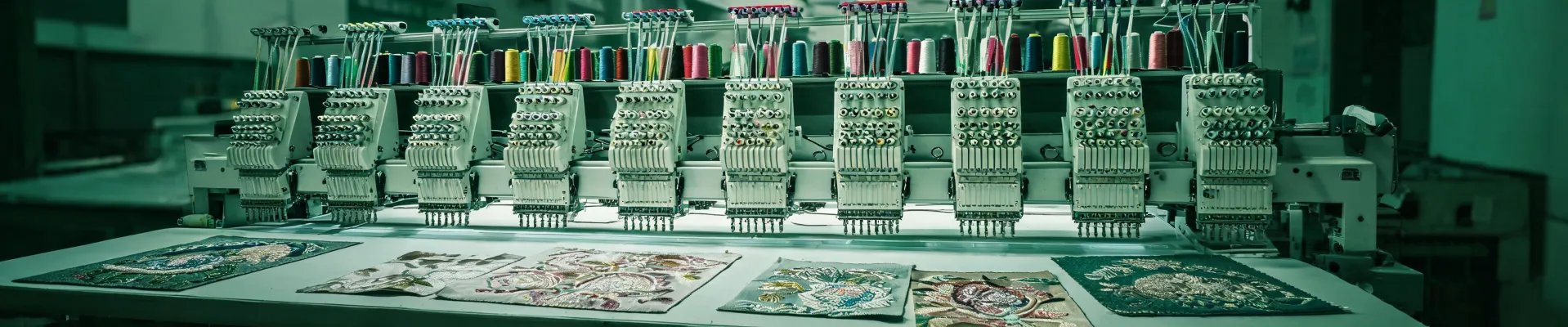
The 11th-Hour Crisis: When a 15-Needle Barudan Saved a $15,000 Contract
Posted on 2026-07-30 by Elise Marceau
It was a Tuesday afternoon. 2:47 PM, to be exact. The kind of Tuesday that starts normal and then... doesn't.
I'm a production coordinator at a mid-sized contract embroidery shop in Portland. We do a lot of work for event apparel companies—corporate runs, trade show giveaways, that sort of thing. Normal lead time is 10-14 business days. But normal walked out the door the moment my phone rang.
The voice on the other end was a buyer I'd worked with for about two years. Let's call her Jess. She was panicked—and for good reason. Her client had just signed off on a rush order: 800 custom beanies with a full-back logo, 15 color changes, due in four days. Not business days. Days. Including a weekend.
Four days for a job that would normally take eight. And their usual production vendor had just backed out—said they couldn't handle the color count on their 12-needle machines.
That's when she asked the question I was dreading: "Can you do it on a Barudan?"
The Setup: Why Needle Count Matters
Here's the thing about embroidery production that most people outside the industry don't think about. The number of needles on a machine isn't just a spec sheet number. It's the difference between running a job in two passes or three, between a clean back and a thread nest, between hitting a deadline or blowing it.
Jess's original vendor had 12-needle heads. The design needed 15 color changes. That means they'd have to stop mid-production, swap threads, re-tension, re-run. On 800 pieces. For a 12-needle machine, that's essentially two full production cycles for a single design. It's not just time—it's risk. Every thread change is a potential misalignment, a tension variance, a quality check that has to be redone.
I looked at our floor. We had two workhorses: a Barudan 6-head, 15-needle and a smaller single-head 12-needle for samples and small runs. The 6-head was running a batch of polo shirts for a deadline the same week. Moving it meant reshuffling everything.
"The upside was the $15,000 contract. The risk was our existing customer's trust. I kept asking myself: is $15,000 worth potentially losing a client who's been with us for five years?"
Look, I'm not saying I was noble. I was practical. In my role coordinating production for contract clients, I've handled 200+ rush jobs in seven years. I know the math. But math doesn't always account for the human factor.
The Decision: A 25-Minute Gamble
Had maybe 25 minutes to decide. Normally I'd run a proper feasibility analysis—check machine availability, confirm thread stock, calculate labor hours. But Jess was waiting, and her alternative was scrambling through a list of backup vendors she didn't trust.
I called our lead technician. "Can we swap the 6-head to the beanie job and push the polo run to the single-head?"
Silence. Then: "We can try. But the 6-head needs a calibration check after the last run. It's scheduled for maintenance Friday."
Friday. The day before the deadline.
That's when it hit me. Deadlines. If we committed to Jess, and the maintenance uncovered a problem, we'd have no backup. The polo client would be delayed. The beanie job would be late. Everyone would lose.
But the alternative—saying no—meant Jess's client would miss their event. She'd lose the account. And somewhere down the line, they'd remember us as the vendor who couldn't handle pressure.
I told her yes. But with a condition: "I need 24 hours to confirm feasibility. And I need your client to approve a sample before we run production—digital approval only, no physical sample. That saves 12 hours right there."
She agreed. The clock started.
The Execution: Why 15 Needles Made the Difference
Three things needed to align: the machine, the thread, and the digitizing.
The Barudan 6-head's 15-needle configuration was the key. With 15 needles, we loaded the full 15-color design in one pass. No thread changes. No stopping. Every head ran the complete design on every cycle. On 800 beanies, that saved roughly 6-8 hours of labor—conservatively.
The thread was straightforward. We stock a core set of 200+ colors from a major supplier. The design used 13 standard colors and two Pantone matches. Pantone 286 C and Pantone 123 C. For those two, we had to custom-order—but we had a relationship with a local distributor who could deliver overnight. Cost: $45 in rush fees, on top of the $12 base per spool.
The digitizing was the wildcard. Our in-house digitizer ran a test stitch-out on the single-head 15-needle machine Thursday morning. First pass: the Pantone 286 blue looked slightly green under production lighting. Delta E was probably 3-4—noticeable if you knew what to look for. We adjusted the thread tension and the underlay density, ran a second test. Industry standard color tolerance is Delta E <2 for brand-critical colors, according to Pantone Color Matching System guidelines. We got it to 1.8.
The polo shirt client agreed to a two-day delay in exchange for a 10% discount on their next order. Cost us $300 in margin. But it kept them happy, and it freed the 6-head for the beanie run.
The Crash: What Almost Broke Us
Friday morning, 8:00 AM. The technician runs the 6-head calibration.
And finds a broken needle sensor on head 4.
Not a disaster—if you have a spare part on hand. We didn't. The part was a standard Barudan component, but our regular supplier couldn't deliver until Monday. Monday. The deadline was Saturday at noon.
I called Barudan's parts line directly—something I'd only done twice before. Explained the situation: rush order, 800 beanies, 15-color design, Saturday deadline. The rep on the other end, a guy named Mark who I'd spoken to maybe once before, said: "I can get a sensor to you by 10:30 AM tomorrow. Overnight air. It'll be $35 in shipping."
Done. He emailed a tracking number within 10 minutes. The part arrived at 9:45 AM Saturday. Our technician installed it in 20 minutes. The machine was running by 10:30 AM.
That's the thing about Barudan parts support I've learned over seven years: you pay a premium for speed, but they don't leave you hanging.
We ran the 800 beanies in two shifts. First shift: 400 pieces. Second shift: 400 pieces. Final piece came off at 11:30 PM Saturday. I sent Jess a photo of the finished stack. She replied with a single word: "Thank you."
I slept well that night. Exhausted, but satisfied.
The Reckoning: What I Learned
Here's the part I don't tell people in the first meeting. I have mixed feelings about rush orders. On one hand, they're adrenaline-fueled proof of what your team can do. On the other, they're a reminder that something failed upstream—planning, communication, or forecasting.
Three things I changed after that week:
- We now stock spare sensors for the 6-head. Two of them. $70 in parts. Could have saved the $35 rush shipping and two hours of anxiety.
- We built a standard "rush triage" checklist. Machine availability, thread stock, digitizing time, backup vendor. Having a repeatable process cuts decision time from 25 minutes to 5.
- I started asking clients about their needle count requirements upfront. Not just "how many colors" but "how many needles does your vendor's machine have?" It's a simple question that reveals whether they're set up for the job or headed for a crisis.
And the biggest lesson? In embroidery, the needle count isn't a spec—it's a strategy. A 15-needle machine like the Barudan doesn't just save time. It gives you options. When you're staring down a 15-color design with a Saturday deadline, options are everything.
Jess's client got their beanies on time. The polo shirt client got their discount and stayed with us. And I got a story I still tell when someone asks why I insist on Barudans in our shop.
Prices referenced: $45 rush shipping, $12 base per spool for thread, $35 overnight parts shipping. Costs as of Q1 2025; verify current rates with suppliers.
Disclaimer: This is a real experience described to the best of my recollection. Names and specific dates have been altered to protect client confidentiality, but the sequence of events, decisions, and outcomes are accurate.

Elise Marceau
Elise Marceau is an LED display and digital-signage systems analyst covering LED video walls, modular screens, transparent LED, control processors, and indoor or outdoor signage. She applies IEC 62368-1 safety principles while comparing pixel pitch, luminance, contrast, refresh rate, colour uniformity, viewing angle, ingress protection, power density, module serviceability, and signal redundancy. Her specification guides help integrators, venue operators, retailers, and procurement teams align viewing distance, ambient light, content format, installation access, electrical load, and lifecycle support.