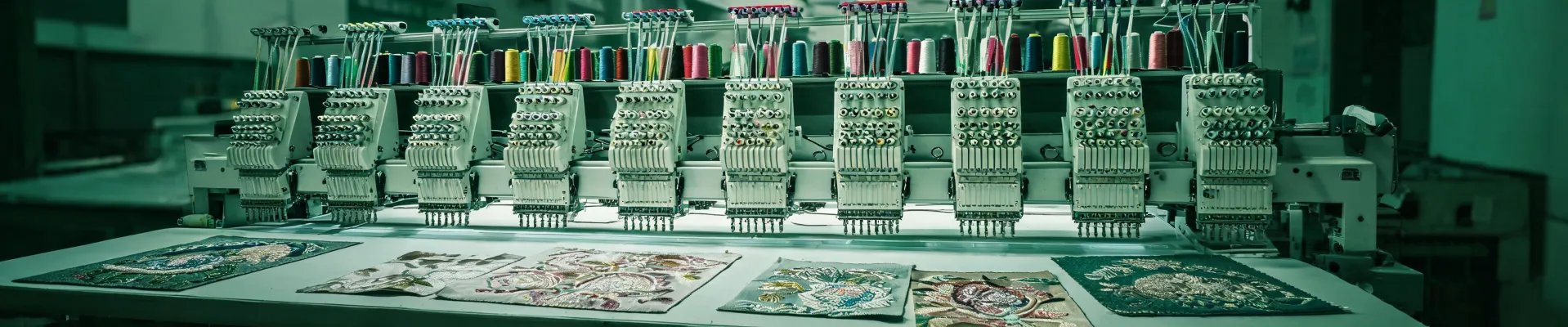
The $22,000 Hoop Lesson: What a Quality Audit Taught Me About Barudan Single-Head Machines
Posted on 2026-08-04 by Elise Marceau
On the first Tuesday of March (this was back in 2024), I rejected an order of 600 left-chest polos. The logo was rotated four degrees on about one out of every three shirts. Not enough to catch on a quick glance. Enough that the customer caught it and sent photos back within the hour.
I'm the quality and brand compliance manager at a contract embroidery shop. I review every finished lot before it reaches customers—roughly 200 lots a year. I've rejected about 6% of first deliveries in 2024, mostly for tension issues and misaligned hooping. That polo order was one of them. My first instinct was to blame the machine.
That quality issue cost us close to $22,000 once I counted re-stitching labor, thread, and the late-shipment penalty. That number still makes me wince. But the real cost was what it forced me to learn.
The order I rejected in March
I walked over to the single-head Barudan that had sewn the original approval samples. It looked fine. The operator was sure the timing was off. The mechanic couldn't find anything. The machine sewed a test design at full speed, and the test piece looked clean.
This is where I used to get stuck. When the machine passes and the work still fails, the easy answer is to blame the operator. I've done that. I've been wrong. The real issue showed up when I pulled the lot records and found the operator had swapped the magnetic hoop for a spring-tension hoop that was too small for the fabric. The rotation wasn't random. It was progressive. The fabric shifted a little on each pass, so by the last color stop, the whole design had rotated a few degrees.
I re-hooped the same machine with a properly sized magnetic hoop and fresh backing (a midweight cutaway, if you're keeping score). The rotation disappeared. Exactly what we needed. The twist was uncomfortable: the machine was never the problem. The hoop was.
It took me four years and a $22,000 rejected order to understand that the machine is the easy part. The hoops are the hard part. After that, I started treating Barudan embroidery machine hoops as part of the quality system, not as accessories.
It wasn't a tension problem. It was a design problem.
In our Q1 2024 quality audit, hooping-related defects outnumbered machine-related defects by a wide margin. That surprised everyone except the lead embroiderer, who had been saying the same thing for years. I ran a blind test with her: same design, same machine, same thread, two different hoop systems. She picked the sample hooped in the magnetic frame as cleaner every single time. The cost difference was around $80 per hoop. On a machine that costs more than $20,000, that's not a line item worth skipping.
In 2022, I implemented our verification protocol. Now every contract includes the hoop type, backing weight, and a placement tolerance check. Per FTC guidelines (ftc.gov), advertising claims have to be truthful and substantiated. We used to say precision alignment without defining the hoop method that made that possible. That was a marketing phrase, not a quality standard.
Honestly, I'm not sure why some shops get away with cheap hoops for years. My best guess is they're doing simple flat work on stable fabrics, where a slightly loose hoop doesn't show up. The moment you add caps or stretchy knits, the margin for error collapses.
The most expensive embroidery machine in the world will not fix a hoop that doesn't hold tension.
Not ideal, but workable. That's how I used to talk about borderline hoops. I don't say that anymore. A hoop that slips isn't workable. It's a production stopper.
The Barudan single head embroidery machine price question
Once I started talking about this, home-business operators started asking me about the Barudan single head embroidery machine price. It's the first question almost everyone asks. I don't think it's the right first question.
Here's the thing: I don't work for Barudan. I work downstream of it. I have no stake in which brand you buy, but I do have a strong opinion about pricing transparency.
In 2023, we quoted a new single-head Barudan with a tubular frame, installation, and a training day at about $21,500. That was a specific configuration, not a published list price. I don't think there's one public Barudan price list, because too much depends on hoops, frame options, and service agreements. I've also seen used machines listed for less, but I can't speak to the current market.
I've learned to ask what's NOT included before I ask what's the price. The vendor who lists every fee upfront—even if the total looks higher—usually costs less in the end. A cheap machine with no installed hoops and no training is not cheap. It's an incomplete project.
When someone says they're thinking about an embroidery machine PE900, I understand why. It's a popular home machine and it does what it's designed to do. But if you're planning to sell embroidered goods, the question isn't whether it can stitch a design. It's whether it can survive the number of repeats you need.
Is a commercial embroidery machine for home business overkill? Maybe. But if you're selling embroidered products, you're running a commercial operation, even when it's in a spare bedroom. That's why a commercial embroidery machine for home business makes sense once you have steady orders.
Real sewing machine output is a system, not a spec
People love asking about sewing machine output. The spec sheet gives you a maximum stitches-per-minute number, but that number lies to you. What actually matters is finished, acceptable pieces per hour. That includes hooping, unhooping, thread changes, and the occasional do-over when a design looked fine on screen but the fabric shifted.
A single-head machine can sew fast. That doesn't mean it produces fast. The hoops, backing, and operator rhythm decide the real output. I've seen shops with a twelve-head machine produce less than a well-run single-head because they spent half the day fighting tension and re-hooping.
Shipping also eats into output. When we send test swatches to a customer, I check USPS rates first. According to USPS (usps.com), as of January 2025, a First-Class large envelope (1 oz) is $1.50. Ten rounds of swatches adds up to $15 in postage. That's not a huge line, but it's the kind of cost that quietly disappears from your margin when you're only thinking about speed.
Since I started tracking rejections in 2022, two things have moved the needle more than any new machine: better hoops and a written spec for every job. That sounds kinda backwards, because everyone wants to talk about heads and speed. But it's the truth.
A lesson learned the hard way: the smooth-running Barudan was always fine. The parts I ignored were the ones touching the fabric. When I finally paid attention to hoops, pricing transparency, and real output, the quality came with me instead of fighting me.
I'm still not done with this topic. If you have a way to measure hoop tension that doesn't rely on feel (besides stitching out a test piece), I'd genuinely love to hear it.

Elise Marceau
Elise Marceau is an LED display and digital-signage systems analyst covering LED video walls, modular screens, transparent LED, control processors, and indoor or outdoor signage. She applies IEC 62368-1 safety principles while comparing pixel pitch, luminance, contrast, refresh rate, colour uniformity, viewing angle, ingress protection, power density, module serviceability, and signal redundancy. Her specification guides help integrators, venue operators, retailers, and procurement teams align viewing distance, ambient light, content format, installation access, electrical load, and lifecycle support.