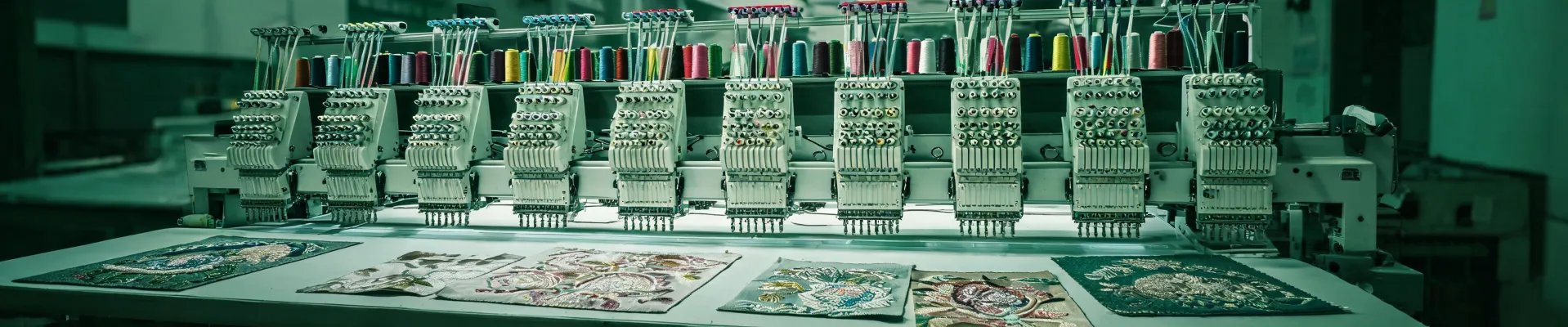
Barudan 4 Head Embroidery Machine: What I Wish I Knew Before Buying
Posted on 2026-08-04 by Elise Marceau
If you're serious about running a contract embroidery business, a Barudan 4 Head Embroidery Machine is often the right move—but only if you understand the real cost before you sign. I learned this after a purchase mistake in 2022 that cost me about $4,800 in wasted fees, downtime, and reordering. This article is the checklist I now use every time someone asks me about buying a multi-head machine.
Quick background: I've been in embroidery for 11 years. I've personally made—and documented—9 significant equipment mistakes totaling roughly $15,800. I'm not a dealer. I don't sell machines. I just want you to avoid my errors.
Why I almost bought the wrong machine
In early 2022, orders were piling up. My single-head was maxed out. I did what everyone does: I searched 'barudan embroidery machines' and found a used 4-head. Then I started comparing prices. The conventional wisdom said, 'Buy new, get a warranty, avoid someone else's problems.' Everything I'd read said that. In practice, I found the opposite for my situation.
I almost went with a new Dahao-controlled machine instead of a used Barudan because the quote was 40% lower. Let me be clear: I'm not here to bash budget machines or Chinese manufacturing. Some shops run Dahao-based systems profitably. But when I looked at the total cost—local tech support, spare parts availability, operator training, resale value—the Barudan won. It wasn't close.
If you search for an 'embroidery Dahao machine,' you'll see what I mean. The category is real: affordable multi-head machines with Dahao control systems. The control system is common, which helps with parts. But my local technician couldn't service it, and the closest authorized tech was four hours away. That risk was bigger than any warranty.
Around the same time, I was also tempted by the Brother SE2000 embroidery machine and the Babylock Enterprise 10 needle embroidery machine. They're great machines. But they are single-head tools. The SE2000 is a sewing/embroidery combo designed for home use. The Enterprise can run 10 colors automatically, which is excellent for samples—but it still hoops one garment at a time. My orders needed four at once.
I ended up buying a used Barudan 4-head from a retiring shop. It wasn't new, but it had service records and around 1.8 million stitches. That sounds like a lot, but many commercial Barudans run 10 million+ with proper maintenance. The used machine felt like a safer bet than the new budget option with no local support. I want to say the price was around $31,500, but don't quote me on that—I'd have to dig up old emails. The point is that the true cost difference was smaller than the sticker gap.
One more thing convinced me: I called two authorized Barudan service centers and asked how many machines they serviced each month. Both said Barudan was a big part of their workload. That is not a bad thing. It means parts exist, technicians know the machines, and error codes are documented. With the Dahao machine, I couldn't find one person within a two-hour drive who had ever opened the control box. For a production machine, that is a dealbreaker.
What the price quote doesn't tell you
Here's the part that cost me $4,800: I compared purchase prices and ignored everything else. What I mean is that the 'cheapest' option isn't just about the sticker price—it's about the total cost including your time spent managing issues, the risk of delays, and the potential need for redos. I didn't ask about the crate, rigging, air compressor, voltage conversion, or hoop compatibility.
I've learned to ask 'what's NOT included?' before 'what's the price?' The vendor who lists all fees upfront—even if the total looks higher—usually costs less in the end.
The machine itself was never the real problem. My process was.
The checklist I now use on every equipment quote:
- Is the price delivered or ex-works? A six-thousand-dollar freight bill changes the math.
- Who installs and levels the machine? What does that cost?
- Are hoops included? Barudan hoop packages are not universal across models.
- Does my shop have 3-phase power? If not, what's the phase converter cost?
- Is training included, and how many operators does it cover?
- What spare parts should I stock? Needles, bobbin cases, thread break sensors?
Another hidden cost is software. A multi-head machine needs production-ready digitizing software, not the free app that came with your home machine. If you have been running a single-head with a basic package, budget for a proper digitizing program and staff training. Some dealers bundle software with the machine; not all do. Ask.
That last one—thread break sensors—is the part I would have called boring before the mistake. A new budget machine can meet or beat a used Barudan on paper speed. But when a sensor fails on a Friday afternoon, a local spare parts shelf can mean the difference between Monday production and a week of downtime. I now stock around $800 in critical spares. It feels like waste until you need them.
The mistake that cost me $4,800
In September 2022, I had two machines on the table: the used Barudan 4-head and a new Dahao-based 6-head. I chose the cheaper 6-head based on price per head. I didn't check the voltage requirement, the air consumption, or the included hoop set. The machine arrived 11 days late—or rather, closer to 14 when you count the crate delay. It needed a phase converter I hadn't budgeted for. The hoops didn't match my existing frames. My 'free training' covered the control panel but not multi-head setup. Total waste: $4,800, plus a 2-week delay on a 300-piece order.
The most frustrating part was that the Barudan had been available the whole time. You'd think a written spec would prevent this, but I never wrote a spec at all. I was comparing prices, not capabilities.
So glad I didn't sign for the Dahao machine without testing it with my own files. I almost went through with it to save $9,000. Dodged a bullet—not because the machine couldn't work, but because it couldn't work for me.
When a Barudan 4-head is NOT the right answer
If your volume is under 50 production pieces a month, a 4-head machine is overkill. A Babylock Enterprise 10 needle embroidery machine can be a better fit for a small shop doing custom samples, monogramming, and low-volume work. The Brother SE2000 embroidery machine is a genuine option for a crafter moving into selling, but it's not designed for 8-hour production shifts.
Also, if you only do caps, head count matters less than the cap frame system. A 2-head Barudan with the right cap frames can outperform a 4-head with poor frames. The best machine is matched to your order mix, not to the number of heads. I chose a 4-head instead of a 6-head because my average order size is 50-200 pieces. A 4-head lets one operator run four placements per cycle. A 6-head adds more output, but also more hoops to align and more needles to maintain. The extra heads only pay if the orders are there. Don't buy the biggest machine you can afford; buy the one that matches your production.
The checklist that would have saved me
My post-mortem came down to four things: specs confirmed, timeline agreed, payment terms clear, training scheduled. In that order. It took one expensive mistake to learn that order should never change.
As of Q1 2025, used Barudan 4-head prices from dealer listings and resale marketplaces roughly range from $28,000 to $55,000 depending on year, hours, and included hoops. New multi-heads with Dahao controls can start lower, but compare after adding delivery, setup, training, and a spare parts kit. Verify current rates—this market moves.
This isn't a one-size-fits-all recommendation. A used Barudan made sense because I had a local tech and access to parts. If you don't have that, a new machine from a dealer with a strong service contract might be the better risk. The point is to make that decision with your eyes open.
Everything here was accurate as of Q1 2025. The embroidery machine market changes fast—models are discontinued, software updates happen, and dealer inventory shifts. Verify current specs, prices, and support options before you commit. And before you ask 'what's the price?' ask 'what's NOT included?' That single question would have saved me thousands.

Elise Marceau
Elise Marceau is an LED display and digital-signage systems analyst covering LED video walls, modular screens, transparent LED, control processors, and indoor or outdoor signage. She applies IEC 62368-1 safety principles while comparing pixel pitch, luminance, contrast, refresh rate, colour uniformity, viewing angle, ingress protection, power density, module serviceability, and signal redundancy. Her specification guides help integrators, venue operators, retailers, and procurement teams align viewing distance, ambient light, content format, installation access, electrical load, and lifecycle support.