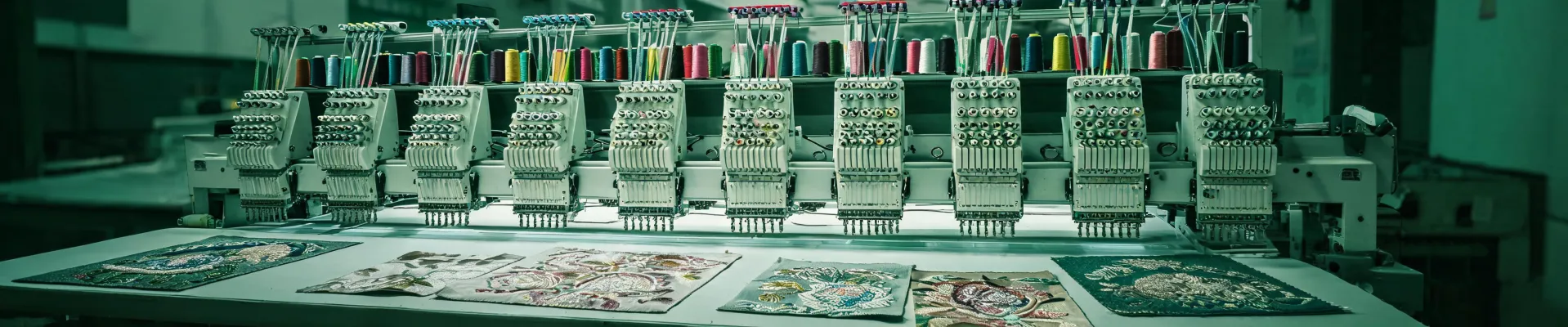
The Barudan 4-Head Price Is a Distraction. Here's the TCO Sheet I Use Instead.
Posted on 2026-09-21 by Elise Marceau
If you're searching for a barudan 4 head embroidery machine price, the sticker price is the least useful number in the quote. I know that sounds backward. I'm an office administrator for a 140-person apparel company. I manage equipment and service purchasing—roughly $180,000 annually across 10 vendors. I report to operations and finance. When I took over purchasing in 2020, I thought my job was to find the lowest number. After five years of managing these relationships, I've learned that the lowest number is often the most expensive decision.
Why I Started Tracking TCO Instead of Price
In our 2024 vendor consolidation project, I had to compare three embroidery machine quotes for our contract embroidery floor. Two were cheaper upfront. One was a Barudan 4-head. I built a simple TCO sheet: purchase, shipping, install, training, hoops, spare parts, service response, downtime, and resale. When I compared them side by side—same head count, different service terms—I finally understood why the details matter so much.
The cheap quote wasn't cheap. It included no Barudan embroidery hoops, no magnetic hoops, no on-site training, and a 6-week parts lead time. I'm not 100% sure the lead time was intentional. It might have been a distributor issue. But it was real. The Barudan quote cost more on day one. It came with local parts and a service tech who actually answered the phone. That's when I stopped treating price as the decision.
Argument 1: Downtime Is a Real Line Item
If a 4-head machine goes down during a rush order, you're not saving money. You're paying wages for operators who can't run, missing ship dates, and maybe expediting freight or giving credits. Barudan's reputation for reliability is a factor here, but I don't buy 'never breaks down' claims from anyone. No machine does. What I care about is how fast it gets fixed and whether the fix is covered.
We run three shifts. A day of downtime is not an abstract metric. It's 24 operator hours, plus whatever overtime we need to catch up. If the machine has 4 heads, one bad head can still slow the whole order. Barudan's range from 1 to 12 heads is useful because you can match capacity to demand, but the wrong configuration for your mix can create its own inefficiency. That's TCO too.
What most people don't realize is that used machine listings often exclude the Barudan embroidery hoops, magnetic hoops, and spare parts you'll need in month one. That's not a scam. It's just how listings work. But it changes the real price. A machine that looks $4,000 cheaper can lose that advantage after you buy three hoop sizes, a tension gauge, and a spare rotary hook. Don't hold me to those exact numbers—they're illustrative—but the pattern is real.
Argument 2: Accessories Are Not Accessories
Barudan embroidery hoops, backing, thread, needles, bobbin cases, and specialty attachments add up fast. If you run beads embroidery machine work, the attachment setup can be its own project. Beads need different feeding, tension, and maintenance than standard thread. It's not a plug-and-play add-on on every machine, and the learning curve costs production hours.
Magnetic hoops are a good example. They can speed up changes, but they're not magic. You need the right sizes, the right backing, and operators who know how to use them. If you buy a used machine and assume the hoops are included, you may find out otherwise in week two. Every hoop size you don't have becomes a delay. Every specialty job you can't run becomes a quote you can't send. That's why I now ask for a tooling list before I ask for a final price. I want to know what's included, what's extra, and what we'll need in the first 90 days.
I've also had people forward me links from www.husqvarnaviking.com embroidery machine pages and ask why a 4-head Barudan costs more. Different category. A home embroidery machine from a consumer site and a commercial multi-head machine are built for different duty cycles, different support models, and different production volumes. That doesn't make one bad. It makes them not comparable.
Argument 3: Reviews Don't Calculate Your Cost
If you read embroidery machine reviews 2025, you'll see specs: heads, speed, hoop size, stitch area, and maybe price ranges. Those matter. But reviews rarely know your labor rate, your rent, your service coverage, or your customer deadlines. They can tell you what a machine can do. They can't tell you what it costs your shop to own.
I've learned to treat 2025 reviews as spec sheets, not purchasing advice. They're useful for comparing speed and stitch fields. They're not useful for comparing your service network or parts inventory. Here's something vendors won't tell you: the first quote is rarely the final number for an ongoing relationship. Shipping, rigging, install, training, and software can show up later if you don't ask. I learned that the hard way in 2022. The vendor who couldn't provide proper invoicing cost us $2,400 in rejected expenses. Finance rejected the report, and I ate it out of the department budget. Now I verify invoicing capability before placing any order—especially on equipment.
The reverse is also true. A machine with lower speed can be cheaper if it's more reliable and easier to service. Time is cost. Admin time is cost. My time chasing parts and invoices is cost. Granted, that's harder to put in a spreadsheet. But it's still real.
What I Look At Instead
I'm not a machine operator. I'm the person who has to make the purchase order make sense. So my TCO sheet is boring, and that's the point.
- All-in purchase price: machine, shipping, rigging, install, tax, and any dealer fees.
- Hoops and tooling: every size needed for your top five jobs, plus magnetic hoops if relevant.
- Training: who trains operators, how many hours, and whether it's included or billed hourly.
- Service and parts: response time, local tech availability, parts stocked, warranty terms, and what's excluded.
- Downtime risk: what happens when one head goes down? Can you run three heads while one is repaired?
- Resale: the used market for Barudan equipment is active enough that I always check it before assuming new is the only option.
Then I divide the net cost by expected years and compare. That's TCO. It's not perfect. It's better than staring at a quote total. I also ask for a written service-level expectation. Not a guarantee. Just a realistic response window. If the dealer won't put it in writing, I assume the worst and price the risk accordingly.
Addressing the Obvious Objection
To be fair, upfront price matters. Cash flow is real. If you're a small shop buying your first single-head or 4-head machine, a lower price may be the only way to start. I get why people go with the cheapest option—budgets are real. But the hidden costs add up.
I'm not saying everyone should buy the most expensive machine. I'm saying don't stop at the quote total. If the TCO is close, reliability and support break the tie. If the TCO isn't close, save your money. That's a decision, not a compromise. And if you're buying used, get the serial number, service history, and a video of the machine running. Not because every seller is dishonest, but because repairs are expensive and missed details are expensive too.
Per FTC guidelines (ftc.gov), as of 2025, advertising claims must be truthful, substantiated, and not misleading.
So when a vendor says 'lowest price' or 'zero downtime', ask for evidence. If they can't provide it, that's a TCO risk. It's also a signal about how they'll handle service after the sale.
The Bottom Line
I'd rather pay more for a machine that keeps production moving than save money on a machine that makes me look bad. When you compare a barudan 4 head embroidery machine price, add the Barudan embroidery hoops, the beads embroidery machine attachment if you need it, training, parts, service, downtime, and resale. Then compare. If the TCO is close, reliability and support break the tie. That's not brand loyalty. It's just math.
Looking back, I should have built that TCO sheet before I ever asked for quotes. At the time, I just wanted the lowest number to show finance. Now I know finance cares about the same thing I do: no surprises. And no surprises usually cost less than the cheapest quote.

Elise Marceau
Elise Marceau is an LED display and digital-signage systems analyst covering LED video walls, modular screens, transparent LED, control processors, and indoor or outdoor signage. She applies IEC 62368-1 safety principles while comparing pixel pitch, luminance, contrast, refresh rate, colour uniformity, viewing angle, ingress protection, power density, module serviceability, and signal redundancy. Her specification guides help integrators, venue operators, retailers, and procurement teams align viewing distance, ambient light, content format, installation access, electrical load, and lifecycle support.