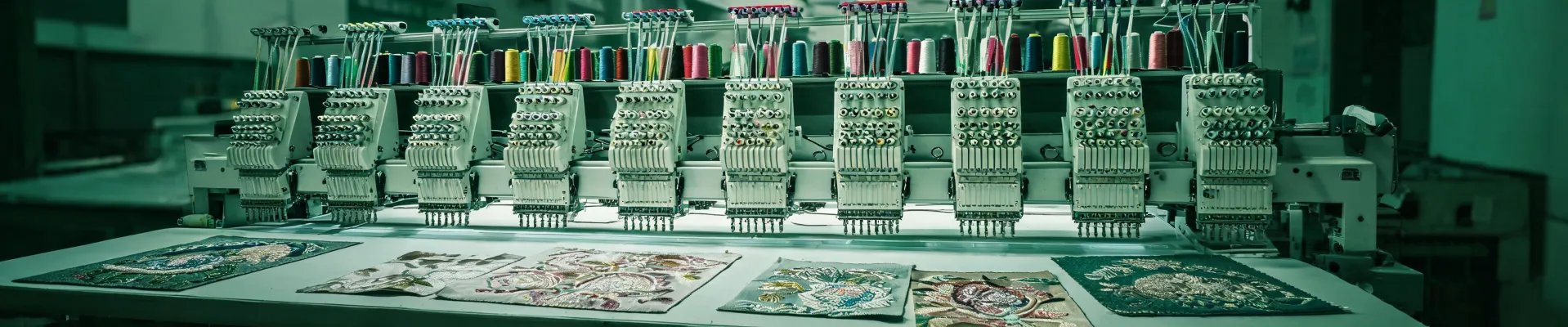
Why a Used Barudan Embroidery Machine for Sale Is About Uptime, Not Price
Posted on 2026-08-12 by Elise Marceau
I coordinate production for an embroidery shop that lives and dies by rush orders. In the last eight years, I've handled maybe 200 of them—or rather, 220 if you count the ones that required late-night phone calls. The pattern is always the same: a client needs 180 embroidered hats in 72 hours, and something breaks.
So when someone asks me about buying a used Barudan embroidery machine, they usually want a price number. Is $18,000 fair? Is a 12-head older unit better than a 6-head newer one? I used to think the machine itself was the investment. Then a Tuesday in March 2024 changed how I think about backup planning.
A client called at 9:37 in the morning. Their event was that Saturday; it was Thursday. They needed 180 caps. Their 4-head machine had thrown a thread sensor error at 5 a.m., and the local tech said 'Tuesday.' Not acceptable. Two months earlier, they had bought a used Barudan on a pallet and never set it up. We spent the afternoon uncrating it, checked the cap frame, adjusted tension, and stitched a test. That machine saved the order. And honestly, I'm still relieved we had pushed them into buying it two months earlier. They almost went with a lower-cost unit to save about $3,000. That decision would have cost them the client.
What Most Buyers Get Wrong
When someone types 'used Barudan embroidery machine for sale' into Google, they think they're comparing machines. What they're really looking for is a guarantee. That's okay. But the guarantee doesn't come from the brand name alone. It comes from support, service history, and mechanical condition.
I've seen shops get great production out of an FDZ embroidery machine. I've also seen shops buy a lower-cost machine with no local distributor and watch it sit dead for two weeks waiting on a part. The difference isn't always brand. It's support. In my experience managing 220-plus rush orders, the lowest quote has cost us more in about 60% of cases. The cheap machine wasn't cheap. It was just cheap on day one.
That's the point most buyers miss: an embroidery machine is not a purchase. It's a production system. The machine is just one part. The other parts are parts availability, technician access, operator skill, and hoops.
The 'Senior Sewing Machine' Myth
You know how every family has a 'senior sewing machine' — the old Singer that never dies? Used Barudans have that reputation in contract embroidery. It is mostly earned. A well-maintained multi-head Barudan from the early 2000s can still out-stitch a lot of newer machines.
But 'can' doesn't mean 'will.' Every machine eventually needs a new belt, a sensor, or a thread path adjustment. The problem is not the machine getting old. The problem is assuming old equals unbreakable. A used Barudan with no service record is not the same as a used Barudan with a dealer or former owner who kept logs. One is a senior sewing machine. The other is a box of surprises.
Hat Embroidery Is a Different Beast
If hats are part of your lineup, the search changes. You don't just need any used machine. You need a setup that handles curved surfaces. A Barudan hat embroidery machine setup usually includes a cylinder arm and cap frames. Those cap frames are the hidden variable.
I've watched shop owners blame the machine for bad hat embroidery when the real problem was a worn cap hoop. The clamp slips, the backing plate bends, the seam lands off-center. The machine stitches perfectly on flat goods and then looks like it's possessed on caps. That's not the motor. That's the hoop.
When you buy any used embroidery machine, budget $150 to $300 for new or refreshed cap hoops. If the seller includes a full set of Barudan hat hoops, even better. Test them before you need them. A cap frame that fails during a 36-hour rush order is not a repair. It's a crisis.
What a Breakdown Really Costs
Let's put numbers on it. A contract shop billing $85 to $150 per hour for production loses $680 to $1,200 in a single 8-hour day when one machine is down. If a part takes four days to arrive, that's $2,720 to $4,800 of lost production. The machine was 'cheap' until it wasn't.
Add emergency outsourcing. I've paid $900 in rush fees to save a 120-hat order after a machine failure. Add express shipping. According to USPS (usps.com), as of January 2025, a First-Class stamp is $0.73, but that doesn't ship a hat box. Express rates on a 12x12x6 box were around $30 to $60 last time I checked. Roll it all together and one breakdown can cost $4,000 to $6,000 over the price of the original deal.
There's also a trust side. The FTC says advertising claims must be truthful and substantiated (ftc.gov). When you tell a customer 'we can deliver 180 caps by Thursday,' that is effectively a claim about your capacity. Your machine is the substantiation. If you don't have a backup plan, that claim is a risk—not just a sales promise.
The Short Version
If you're searching for a used Barudan embroidery machine for sale, follow this pattern instead of just comparing prices:
- Buy from a seller who can show service records, not just a video of it stitching.
- Budget for hoops, a service visit, and common spare parts before you budget for the machine itself.
- Test cap hoops immediately if you plan to do hats. Worn hoops ruin more rush orders than broken motors.
- Set the machine up as a spare before a customer depends on it. A machine on a pallet is not a machine.
- Keep a compact single-head machine like the Brother NS1150E computerized embroidery machine for samples, proofs, and small fixes. It is not a production replacement.
- Remember the senior sewing machine rule: reliability requires maintenance, not just reputation.
It's not the cheapest way to buy a machine. But after managing more than 200 rush orders, I'm a lot more scared of a dead machine than of paying a fair price for one that's ready. Value over price isn't a slogan. It's how I keep clients happy.

Elise Marceau
Elise Marceau is an LED display and digital-signage systems analyst covering LED video walls, modular screens, transparent LED, control processors, and indoor or outdoor signage. She applies IEC 62368-1 safety principles while comparing pixel pitch, luminance, contrast, refresh rate, colour uniformity, viewing angle, ingress protection, power density, module serviceability, and signal redundancy. Her specification guides help integrators, venue operators, retailers, and procurement teams align viewing distance, ambient light, content format, installation access, electrical load, and lifecycle support.