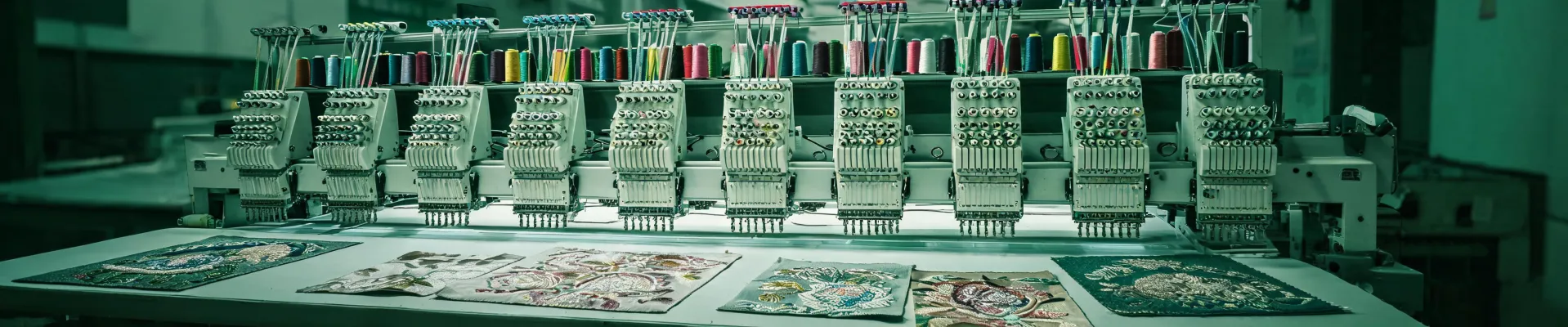
Why I'd Buy a Used Barudan Embroidery Machine—Even When the Math Looks Wrong Up Front
Posted on 2026-09-24 by Elise Marceau
-
The Barudan Logo Isn't the Reason to Buy—It's the System Behind It
-
Argument 1: Clients See Stitch Quality, Not Machine Specs
-
Argument 2: TCO Beats Sticker Price—Every Time
-
Argument 3: Innovation That Actually Matters
-
What About the PE570 Embroidery Machine and Local Sewing Stores?
-
The Counterargument: Used Machines Are Risky
-
Restating the Point: Buy the Output, Not the Badge
The Barudan Logo Isn't the Reason to Buy—It's the System Behind It
For a commercial embroidery shop, a used Barudan embroidery machine is usually a better buy than a cheaper machine with newer specs—if you calculate total cost of ownership and verify service history.
I'm a procurement manager at a 35-person contract embroidery company. I've managed our equipment budget ($250,000 annually) for 7 years, negotiated with 12+ vendors, and documented every order in our cost tracking system. I don't care about brand romance. I care about what hits the invoice and what hits the client's hands.
That's why I'd still put a used Barudan on our floor before I'd chase a lower sticker price. Quality output is your brand. And your brand is not a place to save $3,000.
Argument 1: Clients See Stitch Quality, Not Machine Specs
When a client opens a box of embroidered jackets, they're not checking head count or motor specs. They're checking whether the logo looks sharp, whether the edges are clean, and whether the thread tension is consistent across 200 pieces.
That's where a Barudan earns its keep. The barudan logo on the head isn't just decoration. It signals a machine built for repeatable tension, consistent density, and minimal thread breaks. Those three things show up in client feedback.
In 2023, we audited a recurring complaint: misaligned left-chest logos on polos. Not huge—maybe 2% of orders. But that 2% was costing us $1,400 in redo shipping and labor. We moved the job to a better-maintained machine and cut the complaint rate to under 0.5%. The client didn't say 'nice machine.' They said 'these look better.' That's the point.
Argument 2: TCO Beats Sticker Price—Every Time
I've compared quotes for used Barudan embroidery machines for sale across dealer listings, auction sites, and private sellers. The sticker price is the least important number.
Here's what I track:
- Freight and rigging
- Missing hoops and accessories
- Control board condition
- Technician availability
- Parts lead time
- Training hours
In Q2 2024, we looked at three used 6-head machines. One Barudan was $4,000 more than a non-Barudan option. The cheaper one needed $900 in freight, $1,200 in hoops, $600 for a tech visit, and then a $1,800 board replacement in month two. The Barudan came with service records and a local tech who knew the model. That $4,000 gap disappeared in 12 months.
That's not brand loyalty. That's math.
Argument 3: Innovation That Actually Matters
Embroidery machine innovation gets sold as speed, heads, and touchscreens. Those are fine. But for a commercial shop, innovation is uptime. It's quick hoop changes. It's software that talks to your existing workflow. It's a machine that doesn't surprise you on a Friday afternoon with a deadline on Monday.
Everything I'd read about new embroidery machines said more features equal better production. In practice, for our specific use case, reliability and hoop compatibility beat feature count every time. A 12-head machine that runs at 85% uptime will outproduce a faster 12-head machine that runs at 60% uptime.
That's why a used Barudan with a known service history often beats a new machine with an unknown local support network. The barudan logo tells you parts and service exist. That's the innovation that keeps the lights on.
What About the PE570 Embroidery Machine and Local Sewing Stores?
If you're comparing a PE570 embroidery machine to a Barudan, you're comparing a home machine to a production tool. The PE570 is fine for hobby projects, small runs, and learning. It's not built for 6-head, 8-head, or 12-head commercial output. Different category. Different TCO.
And if you're searching for Carson City sewing machine stores, call ahead. Most retail sewing shops focus on home machines, fabric, and classes. They rarely stock industrial embroidery parts, hoops, or techs. For a Barudan, you'll usually get better results from a commercial embroidery dealer or a factory-trained technician.
The Counterargument: Used Machines Are Risky
Fair. Used machines are risky. I've been burned.
I knew I should verify the maintenance logs on a used machine before wiring the deposit. But we'd worked with the seller before, and I thought, 'What are the odds?' The odds caught up when a control board failed in week three. $1,800 plus downtime. That was the one time it mattered.
So now we follow a checklist before any used Barudan purchase:
- Run a test stitch on the exact fabric and design type you'll use.
- Verify hours and service records—not just the seller's word.
- Confirm hoop compatibility and what's included.
- Get a local technician's name and availability in writing.
- Price the first 12 months of likely consumables and parts.
Do that, and the risk drops to a manageable number.
Restating the Point: Buy the Output, Not the Badge
I'm not saying every shop needs a Barudan. I'm saying that if your clients judge you by the embroidery they receive, then the machine producing that embroidery is a brand asset. The barudan logo matters less than the service network, parts availability, and stitch consistency behind it.
When you search for Barudan embroidery machines for sale, don't start with the lowest price. Start with TCO. Start with the client's first impression. Start with uptime.
Speed, quality, price. Pick two. For a commercial embroidery business, quality is the one you can't drop.
Pricing and machine availability vary by dealer, model, head count, year, and condition. Verify current listings, service records, and freight costs before purchase. Based on dealer listings reviewed Q1 2025; prices and availability change.

Elise Marceau
Elise Marceau is an LED display and digital-signage systems analyst covering LED video walls, modular screens, transparent LED, control processors, and indoor or outdoor signage. She applies IEC 62368-1 safety principles while comparing pixel pitch, luminance, contrast, refresh rate, colour uniformity, viewing angle, ingress protection, power density, module serviceability, and signal redundancy. Her specification guides help integrators, venue operators, retailers, and procurement teams align viewing distance, ambient light, content format, installation access, electrical load, and lifecycle support.