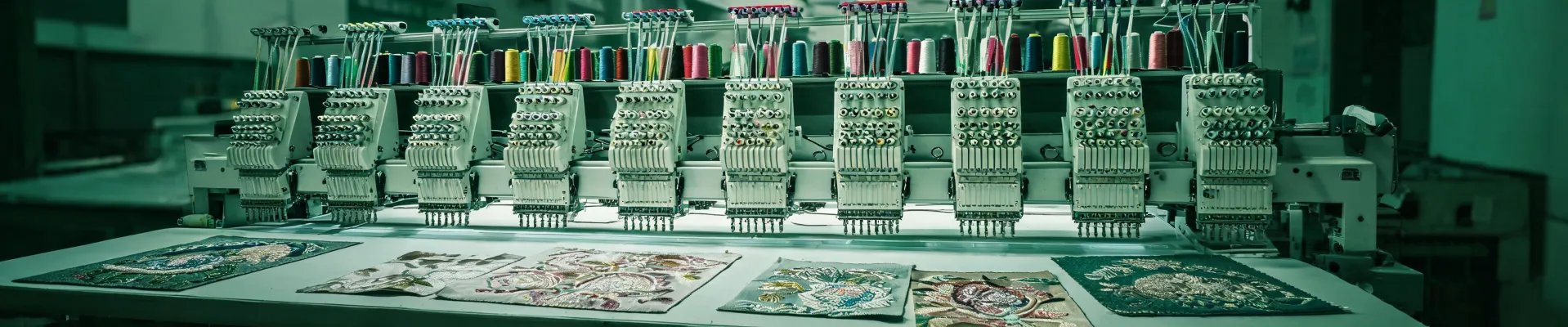
Barudan vs. Other Brands: A Procurement Manager's Honest Take on Embroidery Machine Cost
Posted on 2026-07-27 by Elise Marceau
-
What you'll find here
-
1. Why would I pay more for a Barudan when cheaper machines exist?
-
2. How do Happy Japan and Barudan compare on total cost of ownership (TCO)?
-
3. Is a used Barudan machine a smart buy?
-
4. What's the real cost of embroidery hoops—are magnetic hoops worth it?
-
5. How do I calculate TCO for a new embroidery machine?
-
6. Should I consider single-head or multi-head for my business?
-
7. What about JDbao and other budget industrial sewing machines? Should I even look at them?
What you'll find here
I've been managing procurement for a mid-size contract embroidery company for 6 years. Our annual spend on machines and parts runs ~$120K. I've negotiated with a dozen vendors, chased hidden fees, and built my own TCO spreadsheet. This FAQ covers the questions I wish someone had answered before I made my first purchase.
1. Why would I pay more for a Barudan when cheaper machines exist?
Fair question. I almost bought a budget machine in 2022. The price tag was 60% less than a comparable Barudan. But when I ran the numbers over 5 years—including downtime, service calls, parts availability, and resale value—the Barudan was actually cheaper.
Here's a real example from our books: We own two 6-head machines, one Barudan and one budget brand (purchased before I came on). Over 4 years, the budget machine needed 8 service visits (average $350 each) plus had 14 days of downtime, costing us an estimated $8,000 in lost production. The Barudan? 2 visits, 3 days downtime. That's a $5,000+ difference right there.
Look, I'm not saying budget machines can't work—they can for low-volume shops running simple designs. But if you're running production, the reliability premium pays for itself.
2. How do Happy Japan and Barudan compare on total cost of ownership (TCO)?
I've managed quotes for both over the years. Happy Japan machines are solid—comparable build quality, similar price points. The real differences come down to service network and head configuration options.
In my experience, Barudan has a wider dealer network in the US (we're in the Midwest, got same-day parts support from a local distributor). That's hard to quantify but matters when a machine is down mid-production. Happy Japan's network is good but less dense.
Cost-wise, for a 6-head machine, after 3 years of factoring in parts and tech visits, our TCO spreadsheet showed Barudan within 5% of Happy Japan—and that's before resale. The used market loves Barudan. I've seen 5-year-old machines sell for 60% of original cost. That's a big deal when you upgrade.
I don't have hard data on industry-wide resale rates, but based on tracking machine values at auctions and online listings, that's been our experience.
3. Is a used Barudan machine a smart buy?
Yes, but with caveats. We bought a used 8-head Barudan in 2024. Saved about $18K vs new. Here's what I'd check:
- Service history – ask for the log of needle changes, tension adjustments, hoops replaced.
- Head hours – machines with under 10,000 hours are generally solid.
- Dealer refurbishment – a certified dealer will replace bearings, belts, and run diagnostics. Worth paying extra for.
Watch out for hidden costs. That "great deal" on a 2018 model might need a $2,000 controller board replacement within 6 months. We almost bought one until I called a service tech who said those boards were failing frequently. Dodged a bullet.
4. What's the real cost of embroidery hoops—are magnetic hoops worth it?
Hoops are a recurring expense people underestimate. Standard Barudan hoops run about $30-$80 each. Magnetic hoops (like the ones sold by third-party suppliers) cost $120-$200 but can speed up hooping time by 50%.
Our team does about 2,000 pieces a month. Swapping to magnetic hoops saved us roughly 2 hours per shift—that's 40 hours a month. At our labor rate, that's $1,200 monthly savings. The magnetic hoop pays for itself in 2-3 months.
One thing though: not all magnetic hoops work perfectly on every Barudan model. We tried a generic brand on our 12-head and had registration issues. Ended up buying Barudan's own magnetic hoop system—more expensive, but it worked out of the box. So yes, do your research.
5. How do I calculate TCO for a new embroidery machine?
Here's the formula I use. It's not perfect, but it's saved us from bad deals:
TCO (5-year) = Purchase Price + (Annual Maintenance × 5) + (Expected Downtime Days × Daily Revenue Loss) – Resale Value
For a Barudan 6-head at $45K:
- Maintenance: ~$1,500/year → $7,500 over 5
- Downtime: estimate 5 days → $3,500 lost revenue
- Resale after 5 years: ~$25K
- TCO: $45K + $7.5K + $3.5K – $25K = $31K
For a budget machine at $18K:
- Maintenance: ~$3,000/year → $15K
- Downtime: 20 days → $14K lost
- Resale: $5K
- TCO: $18K + $15K + $14K – $5K = $42K
That's an $11K difference against the cheap option. Numbers vary by your operation, but the pattern is consistent.
6. Should I consider single-head or multi-head for my business?
Depends on your volume. For contract embroidery, we started with a single-head Barudan—great for sample runs and small orders. But at our first 5,000-piece order, we knew we needed multi-head. We bought a 6-head, then an 8-head.
The math: A single head does about 1,200 stitches per minute. A 6-head does 6× that (theoretically). In practice, you lose some efficiency on setup, but production per hour is roughly 4-5× higher. If your average order is under 500 pieces, single-head might be fine. If you're doing 1,000+ piece runs regularly, consider 6-head or 8-head.
One more thing: resale is easier on multi-head machines. Single-heads are harder to sell used. Just something to factor in.
7. What about JDbao and other budget industrial sewing machines? Should I even look at them?
I've looked—actually, I compared quotes from a JDbao distributor in 2023. Their 6-head was priced at $12,500, which is tempting. But here's what I found after calling three current owners (found them on forums):
- Parts availability: long wait times, often 4-6 weeks for shipping from overseas
- Documentation: mostly in Chinese, translations were unhelpful
- Service technicians: none local in our area
- Reliability: one user reported 3 major breakdowns in 18 months
I can't recommend them for production environments. For a hobby shop or startup with very low volume? Maybe. But for contract work, the risk of missing a deadline due to a parts delay is too high. I'd rather take a Barudan or Happy Japan used machine for the same budget.
I'm not a service engineer, so I can't speak to the internals. From a procurement perspective, the total risk outweighs the upfront savings.
These answers come from my own tracking spreadsheets and conversations with dealers and techs. Always consult with your local service team before making a purchase decision.

Elise Marceau
Elise Marceau is an LED display and digital-signage systems analyst covering LED video walls, modular screens, transparent LED, control processors, and indoor or outdoor signage. She applies IEC 62368-1 safety principles while comparing pixel pitch, luminance, contrast, refresh rate, colour uniformity, viewing angle, ingress protection, power density, module serviceability, and signal redundancy. Her specification guides help integrators, venue operators, retailers, and procurement teams align viewing distance, ambient light, content format, installation access, electrical load, and lifecycle support.