I Bought a Used Barudan 6-Head: Here’s What Nobody Tells You About the Hidden Costs
Posted on 2026-07-27 by Elise Marceau
-
If you're looking at a used Barudan 6-head, stop. The real cost isn't the purchase price—it's the downtime.
-
The Shortcut That Cost Me $2,600
-
Why Time Certainty Matters More Than a Discount
-
Your Used Barudan Checklist (From Someone Who Paid the Tuition)
-
The SmartStitch Comparison Trap
-
When It's Okay to Take a Chance
If you're looking at a used Barudan 6-head, stop. The real cost isn't the purchase price—it's the downtime.
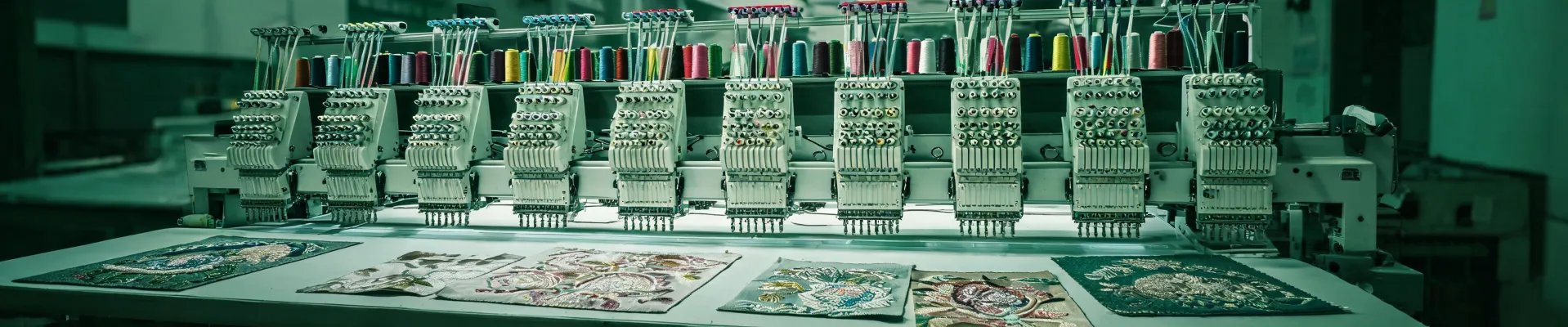
I'm a contract embroiderer who handles production orders for a dozen apparel brands. In my first two years, I made every mistake you can make when buying used industrial embroidery machines. Three deals. Two lemons. One that actually worked after $1,800 in repairs. Total loss: about $4,200, plus weeks of delayed shipments and angry clients. Now I maintain our shop's equipment checklist to stop others from repeating my errors.
Let me save you the pain. Here's what I wish someone had told me before I bought my first used Barudan.
The Shortcut That Cost Me $2,600
It's tempting to think that a used Barudan 6-head from a private seller is a steal. The price tag said $8,500—almost $10,000 below a dealer's refurbished unit. The machine looked clean in photos. The seller had great reviews on a trade forum. I skipped the in-person inspection because I was too busy. Big mistake.
When the freight truck dropped it off, the machine made a grinding noise on the first run. Turned out the main shaft bearing was shot. Replacement cost? $1,200 in parts plus $900 in labor from a service tech. Then the thread tension module started acting up—another $500. Plus two weeks of lost production while we waited for parts. That $8,500 machine ended up costing $11,100 and countless headaches.
Here's the thing: the cheapest used Barudan is rarely the cheapest option. The real price includes repairs, downtime, and the stress of chasing parts. A dealer's refurbished machine at $12,000 with a 90-day warranty would've been a better deal. I tell every new embroiderer I mentor: paying for reliability is not a luxury—it's risk management.
Why Time Certainty Matters More Than a Discount
In Q1 2024, we had a $15,000 order from a major retailer. Our 6-head Barudan (the one that survived) was running flat out. Then the second machine—the cheap one—failed again. We paid $400 for an emergency repair to get back online within 48 hours. The alternative was missing the deadline and losing a long-term contract. The $400 felt expensive. Missing the $15,000 order would've been catastrophic.
That's when I fully embraced the idea that certainty is worth a premium. When you're up against a deadline, a guarantee that your machine will run—even if it costs more upfront—is worth every penny. Online printers like 48 Hour Print work well for standard products with standard turnaround; similarly, for industrial embroidery, the value isn't just speed—it's knowing your equipment won't let you down.
Your Used Barudan Checklist (From Someone Who Paid the Tuition)
Here's what I now do before buying any used Barudan—whether it's a 4-head, 6-head, or 8-head:
- Get a service history. Ask for maintenance logs. If the seller can't provide them, walk away. I once saw a machine with "only 2,000 hours" but the needle guards were worn down—a sign the meter had been reset.
- Run a test stitch-out. Bring your own thread and a USB design. Run at full production speed (750–850 RPM). Listen for unusual noises. Check stitch quality on multiple heads. The best machine I found actually had a small tension issue that came up only after 20 minutes of running.
- Inspect the machine in person. Look for oil leaks, broken spring tensioners, worn drive belts, and rust inside the head covers. A dealer I trust later told me that 30% of the used Barudans they see from private sellers need major repairs within 6 months.
- Factor in 15% extra for repairs. Even if the machine looks clean, budget for new needles, oil, a service call, and a half-day of tuning. If you end up not needing it, that's a win.
Three things: test. verify. budget for the unexpected. In that order.
The SmartStitch Comparison Trap
I see a lot of people comparing used Barudans with lower-cost modern machines like the SmartStitch embroidery machine. Look, I'm not going to trash SmartStitch—they serve a market. But if you're producing 10,000+ pieces per month for clients with tight deadlines, your machine's uptime determines your profit. A Barudan that has been properly maintained will outlast three budget machines. I've seen it happen.
The advice to "just buy new" ignores the fact that a well-maintained used Barudan can be a fantastic value—if you do your homework. The trick is not to fall for the oversimplification that all used machines are the same.
When It's Okay to Take a Chance
I'm not saying never buy from a private seller. But I've learned the hard way that you should only skip the expensive pre-purchase inspection when:
- The machine is less than 5 years old and has complete service records from an authorized Barudan dealer
- You can negotiate a return clause (e.g., "covers removal and shipping if it fails within 30 days")
- You have a backup machine to cover downtime if things go wrong
Otherwise, pay the extra $1,000–2,000 for a dealer's refurbished unit with a warranty. That $2,000 buys you certainty—and after my $4,200 mistake, I finally understand that uncertainty costs more than money; it costs your reputation.
Prices as of March 2025; verify current rates for parts and labor.

Elise Marceau
Elise Marceau is an LED display and digital-signage systems analyst covering LED video walls, modular screens, transparent LED, control processors, and indoor or outdoor signage. She applies IEC 62368-1 safety principles while comparing pixel pitch, luminance, contrast, refresh rate, colour uniformity, viewing angle, ingress protection, power density, module serviceability, and signal redundancy. Her specification guides help integrators, venue operators, retailers, and procurement teams align viewing distance, ambient light, content format, installation access, electrical load, and lifecycle support.