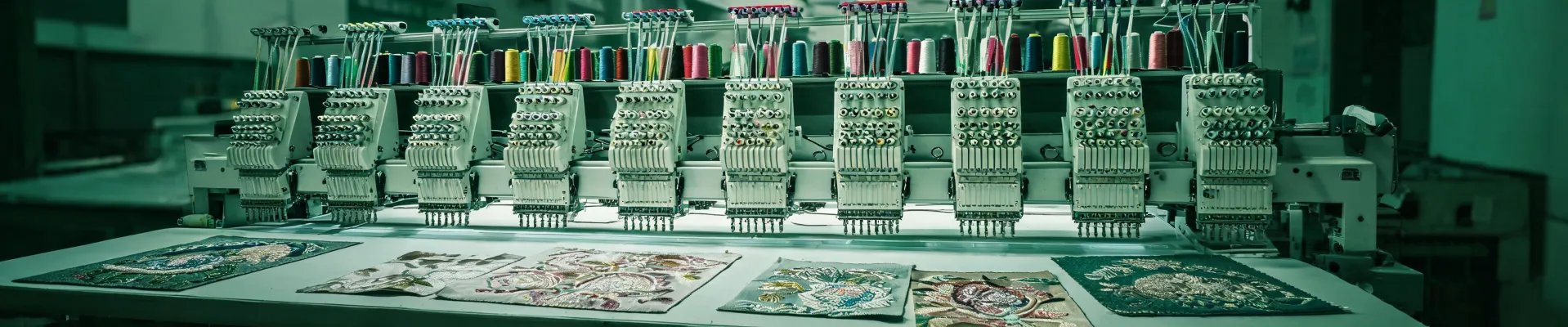
Why I Pay More for Used Barudan Machines (And Why You Should Too)
Posted on 2026-07-28 by Elise Marceau
-
Here's what I've learned after 6 years of managing embroidery production budgets: cheap machines are the most expensive mistake you'll make.
-
The Real Cost of "Cheap"
-
Why Barudan's Reliability Is Worth a Premium
-
Second-Hand Doesn't Mean Second-Rate
-
Service Support = Time Certainty
-
Counterpoint: What About Budget Constraints?
-
My Bottom Line
Here's what I've learned after 6 years of managing embroidery production budgets: cheap machines are the most expensive mistake you'll make.
I'm a procurement manager for a mid-sized contract embroidery company. I've been tracking every dollar we spend on equipment, parts, and downtime for half a decade. When I audit our P&L, the single biggest line item isn't machine purchase price—it's lost production time. And that's why I'll always pay more for a used Barudan embroidery machine over a brand new entry-level unit from any other brand.
If you're shopping for embroidery equipment and seeing terms like "Brother SE700 sewing & embroidery machine reviews" or wondering if a B500 or Servis sewing machine could save you money, listen up. I'm not here to trash those brands. But I am here to show you why, for commercial use, the time-certainty premium on a used Barudan is worth every extra dollar.
The Real Cost of "Cheap"
Last year I compared three purchase options for a new-to-us production line:
- Brand new B500 (single head, all-in-one): $1,800
- Brother SE700 (home combo unit): $1,200
- Used Barudan 4-head machine (2019 model): $8,500
On paper, the Barudan looked insane. $8,500 for a used machine? You could buy five B500s. But I'd been burned before. In 2023, we bought a "budget-friendly" 6-head from a lesser-known brand. It ran for about 3 months before the main board fried. Repair took 2 weeks—we lost a $14,000 rush order for a hotel chain. The machine cost us $4,200. The lost revenue was three times that. And the repair? Another $1,100.
That experience flipped my thinking. Now I apply a TCO (total cost of ownership) lens to every equipment decision. And Barudan always wins—not because it's the cheapest upfront, but because it's the most predictable.
Why Barudan's Reliability Is Worth a Premium
People think expensive machines deliver better quality. Actually, machines that deliver consistent quality can charge more—the causation runs the other way. Barudan has been building industrial embroidery machines since the 1960s. Their multi-head units are designed for 24/7 production. The used market is massive, which tells you something: these machines hold value because they keep running.
In our shop, we've got 7 Barudan machines—wait, 8? No, 7. I'm mixing it up with the one we sold last year. Anyway, of those 7, the oldest is a 2012 model. It's still running daily. Average unplanned downtime per machine? About 4 hours a year. Compare that to the B500 variant we trialed for a month: we had 22 hours of downtime in 4 weeks. That's not a fair comparison—the B500 isn't made for commercial duty—but that's exactly my point. If your business depends on hitting deadlines, you can't risk a machine that wasn't designed for 8-hour shifts.
Second-Hand Doesn't Mean Second-Rate
Here's where the "used Barudan" angle gets interesting. Because Barudan builds machines to last 15–20 years, buying a used one at 40% of the new price gets you 80% of the lifespan. And because parts and service are widely available, even a 10-year-old machine can be trusted for rush orders.
I track every invoice in our procurement system. Over the past 6 years, we've bought 4 used Barudans. Total spent: $34,000. Resale value today: about $22,000. That's 35% depreciation over 6 years—or roughly 6% per year. Meanwhile, that B500 lost 60% of its value in the first year alone. Servis sewing machines? Resale is almost nonexistent. So the Barudan actually costs me less per year of use. That's the math most people skip.
Oh, and those Brother SE700 reviews you see online? Great for a hobbyist making custom hats for friends. But the SE700 has a 4" x 4" embroidery field and can't handle cap frames or tubular goods. For commercial work, you need at least a 12" x 16" field and multi-head capability. The Brother isn't even in the same category.
Service Support = Time Certainty
In Q2 2024, we had a head crash on our busiest machine. Called Barudan's service line at 3 PM. They diagnosed it remotely, had a technician on-site the next morning, and we were running again by noon. Total downtime: 21 hours. That's annoyingly long, but it's predictable—I knew within 2 hours when it would be fixed.
Compare that to the "budget brand" where the seller couldn't find a service manual and parts took 3 weeks from China. In the meantime, we missed a $12,000 government contract deadline. The fine? $2,400. Plus the lost future work. A $500 "savings" turned into a $14,400 loss.
That's what I mean by time-certainty premium. You're not paying for speed—you're paying for knowing when you'll get it back. When a client asks "Can you deliver by Friday?" and you say yes, that yes has to be backed by equipment you can count on. A used Barudan gives you that backing. A cheap machine gives you hope. Hope doesn't ship orders.
Counterpoint: What About Budget Constraints?
I hear it: "Not everyone can drop $8,500 on a used machine. Some of us are starting out with $2,000." Fair. My experience is based on about 200 orders per year with a production of 5,000+ pieces monthly. If you're doing 50 hats a week for friends and family, an SE700 or a Servis sewing machine might be fine. I can't speak to that—I've only worked in commercial production.
But if you're planning to grow, or if you've ever had a client say "I need 500 polo shirts by next Friday," think hard about the hidden cost of gambling on a machine that wasn't built for that. You can start small, but buy the most reliable machine you can afford—even if it's used and older. The first time a rush order saves you $5,000, that Barudan will have paid for itself.
And if you absolutely need new and cheap? Consider leasing a used Barudan—we've done that. The monthly payment was $350, same as a Netflix subscription for our whole shop. Worth every cent for the peace of mind.
My Bottom Line
I'm not saying every embroidery business needs a Barudan. Walk into a garage-based startup and you'll see Singers and Brothers running just fine. But the moment you start taking orders with deadlines—real deadlines that cost you money if missed—you need to value certainty over sticker price. A used Barudan embroidery machine is the most cost-effective way to buy that certainty. I've seen the numbers, lived the lost contracts, and rebuilt our procurement policy around it. Trust me on this one: cheap machines are expensive. Pay for reliability. Pay for time certainty. Your bottom line will thank you.
(Should mention: my experience is based on mid-to-large commercial embroidery. If you're in high-volume apparel manufacturing with 50+ heads, your needs might differ. But for most contract embroiderers, the logic holds.)

Elise Marceau
Elise Marceau is an LED display and digital-signage systems analyst covering LED video walls, modular screens, transparent LED, control processors, and indoor or outdoor signage. She applies IEC 62368-1 safety principles while comparing pixel pitch, luminance, contrast, refresh rate, colour uniformity, viewing angle, ingress protection, power density, module serviceability, and signal redundancy. Her specification guides help integrators, venue operators, retailers, and procurement teams align viewing distance, ambient light, content format, installation access, electrical load, and lifecycle support.